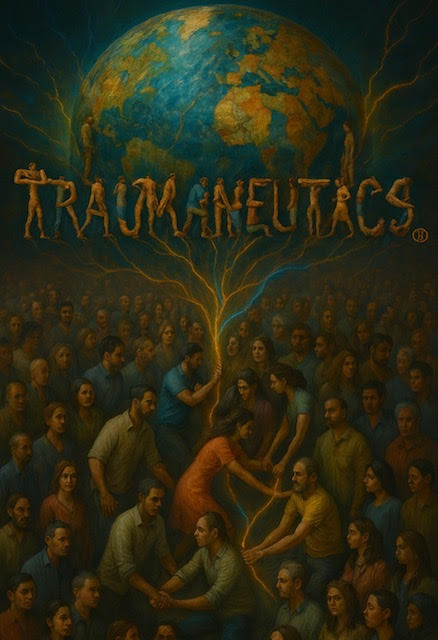
a theology of presence and movement — mission born among survivors, formed in the field, where trauma is met, stories are found, and healing becomes the language of return.
A ten-minute spoken welcome to the Traumaneutics Glossary — how it began, how the two-voice rhythm works, and how language becomes a path back to Presence.
.jpg)
There is a place (1Corinthians 10) where Paul speaks about shared provision with unusual severity.
He reaches back into a collective story — not one person’s failure, but a people moving together — and he lists what they shared. The repetition matters. “The same” (1Corinthians 10:3) is not incidental. The point is not that some were excluded. The point is that many were included.
The same food.
The same drink.
The same passage through the same landscape.
The same signs of belonging.
Paul does not deny that provision was present. He does not imply it was imagined. He does not treat participation as meaningless. And then he says something that removes all comfort from “shared” as a category:
God was not pleased with most of them.
We cannot soften that.
The text does not.
Paul is not offering a neutral history lesson. He tells this as a warning. He names these events as examples. He explicitly intends the reader to feel the interruption — to recognise patterns that repeat and to refuse their repetition.
So we must not pretend this is merely descriptive.
It is not.
But we also have to be careful with what the warning is, and what it is not.
Paul does not aim divine displeasure at hunger. He does not direct it toward bodies that needed more. He does not treat need as the problem.
The story he tells includes real provision — and yet it includes collapse. That is precisely why it functions as an example. Not because “having spiritual food” automatically produces life, but because a community can be surrounded by the signs of provision and still be organised around something that destroys it.
That is where the weight of this passage sits.
The warning is not: “Try harder.”
It is not: “Be more spiritual.”
It is not: “If you participate correctly you will be safe.”
Paul will not allow that equation.
He shows a people who participated and still fell.
So what is being judged?
Not the fact that they ate.
Not the fact that they drank.
Not the fact that they were present.
What is being exposed is the orientation of the life underneath the provision — the desires that governed them, the patterns that kept repeating, the way a community can keep moving while still being shaped by forces that undo it.
This is why the hinge later in the chapter matters so much: Paul shifts attention away from self-preserving good and toward the good of the other. Not as a quick moral instruction designed to guarantee safety, but as a diagnosis of what a community must be oriented toward if it is not to keep repeating collapse while surrounded by provision.
The presence of food did not mean the presence of life.
The shared drink did not mean shared nourishment.
The sign of belonging did not mean the reality of being sustained.
Paul does not resolve the grief of that. He does not explain the loss away. He does not pretend the deaths were made easier by meaning.
He lets the outcome stand, and he insists it must not be forgotten. He calls it an example — not so the reader can feel superior to the fallen, but so the reader cannot keep confusing participation with nourishment, proximity with life, and shared provision with shared thriving.
This is Scripture refusing food-like substance.
It refuses the fantasy that what looks sustaining must be sustaining.
It refuses the idea that being included is the same as being fed.
It refuses the lie that a community can be “spiritual” and still ignore what the other needs to live.
The warning is real.
The displeasure is real.
And the exposure is also real: A people can share the same provision and still not share the same life.
Tagline: ''Shared provision is not the same as shared nourishment.''
Companion Entry:
Food-like Substance (n.)
.jpg)
Gender-purity ethics are rarely taught directly.
They are learned sideways.
In the way certain warnings are given to some people and not others.
In who is expected to be careful.
In who is assumed to have known better.
In whose story needs explaining, and whose does not.
For many survivors, this is not an idea. It is a felt imbalance. A sense that the rules shift depending on who is speaking. That “purity” lands heavier on some bodies than others. That harm does not carry the same meaning in every direction.
Nothing is usually said outright.
The pressure lives in implication.
In tone.
In what is left unasked.
It hums in the room before language arrives —
a tightening the body recognises immediately,
even when others remain unaware.
Gender-purity ethics often show up as responsibility quietly reassigned. The expectation that some people must guard more.
Explain more.
Account more carefully for what happened to them.
Carry the moral weight of outcomes they did not choose.
Even — and sometimes especially — when they were harmed.
This does not usually arrive as accusation.
It arrives as atmosphere.
A pause.
A softened voice.
A redirected question.
A suggestion framed as wisdom.
The body learns quickly where it stands.
For trauma-formed people, this dissonance is not theoretical. It is the nervous system recognising a pattern that predates the room.
Centuries of imbalance.
Long-standing moral coding.
Unspoken assumptions about whose bodies are risky, tempting, or in need of management.
The disparity shows itself in small shifts. In how stories are received. In whose pain is handled gently and whose is examined. In who is granted complexity and who is expected to remain intact, silent, or pure.
Gender-purity ethics live precisely here —
not in doctrine alone,
but in the space between words,
where survivors learn what is safe to say
and what must be carried quietly instead.
Tagline: “The body hears the bias before the words arrive.”
Companion entry:
When Moral Weight Is Not Redistributed (n.)
.jpg)
In the story of Philip and the Ethiopian eunuch (Acts 8:26-39) , a body enters the scene already marked.
Not through accusation,
but through assumption.
The eunuch’s presence carries a history the text does not rehearse, but does not deny. A body shaped by power, violence, and exclusion. A body permitted proximity to Scripture, but denied full participation in the assembly.
The text does not pause to explain this.
It does not require background knowledge.
It assumes the asymmetry.
This matters.
Because purity ethics rarely announce themselves as doctrine. They operate through implication. Through who is allowed to approach without question. Through whose body is neutral, and whose is charged. Through who must manage themselves quietly to belong.
The eunuch is reading Scripture aloud, but he is doing so from the margins.
He has access,
but not ease.
He has knowledge,
but not assurance.
He is close enough to the text to love it, but far enough from the community to know he does not fully fit.
When Philip approaches, nothing is said about the eunuch’s body.
No clarification is requested.
No moral inventory is taken.
No explanation is demanded.
This absence is not oversight.
It is refusal.
The text does not correct the eunuch’s difference, and it does not pretend difference does not exist. It simply does not allow difference to carry moral weight.
That restraint is the intervention.
In cultures shaped by gender-purity ethics, moral responsibility is often redistributed silently. Certain bodies are asked to guard more.
Explain more.
Account more carefully for how they appear, move, or speak.
Even when harm has already been carried by them.
The eunuch’s story does not follow that pattern. There is no instruction to be more careful. No requirement to make sense of what happened to his body. No request for disclosure or justification.
Meaning is not negotiated through purity.
Belonging is not mediated through bodily conformity.
What happens next does not erase the asymmetry —it passes through it without reinforcing it.
Resolution comes,
but not by correcting the eunuch.
There is movement, but not by reassigning responsibility.
The text does not celebrate inclusion as spectacle. It does not announce a new ethic. It does not congratulate the community.
It simply shows a body moving forward
without having been asked to carry shame,
silence,
or moral suspicion along the way.
This is not the abolition of purity discourse by argument.
It is its quiet bypass.
The moral weight that so often lands on certain bodies is not redistributed here.
It is refused.
And that refusal allows resolution
without pretending the road there was simple,
or that the field was neutral.
Tagline “Nothing was explained away — and nothing was made to carry shame.”
Companion entry:
Gender-Purity Ethics (n.)
.jpg)
It rarely arrives as a single accusation. It arrives as a loop. A loop that feels reasonable until you notice it never ends.
Stage 1 — Harm happens.
Something real occurs. A boundary is crossed. A trust is broken. A body carries the cost. Before anyone speaks, the room often makes a silent decision: this must have a reason.
Not in the sense of meaning.
In the sense of cause.
Stage 2 — The search begins.
People start looking for what would make the harm explainable. Not primarily in the system. Not in the environment. Not in the person who caused it.
In you.
What were you doing there?
Why did you stay?
Why didn’t you see it coming?
Why didn’t you leave sooner?
The questions do not sound like blame at first.
They sound like curiosity.
Concern.
Risk assessment.
But the direction is already set: toward you.
Stage 3 — You answer.
You try to respond carefully. You offer context. You give detail. You explain sequence. You name what you remember. You are not trying to convince. You are trying to be understood.
And this is where the loop tightens.
Stage 4 — Your answer becomes evidence against you.
Whatever you say is turned into a problem. If you speak clearly, you sound rehearsed. If you stumble, you sound unreliable. If you remember too much, you are accused of fixation. If you remember too little, you are accused of withholding. If you sound calm, you must not have been harmed that badly.
If you sound emotional, you must be unstable. If you show anger, you are “bitter.” If you show grief, you are “fragile.” If you show humour, you are “in denial.”
Nothing you offer lands as credibility.
It lands as material to reinterpret.
Stage 5 — The frame shifts from what happened to who you are.
At this point, the harm is no longer the central issue. Your character becomes the subject.
Your choices.
Your tone.
Your readiness.
Your history.
The story moves from event to identity.
Not: what was done to you,
but: what about you made this likely.
Stage 6 — A verdict is implied without being spoken.
No one has to say, “It’s your fault.” The loop says it for them. If harm happened, there must be a reason. If there is a reason, it must be you. If it is you, then the system is safe.
This is why the loop survives: it protects the room from recognising that harm can happen without permission.
Stage 7 — You begin to internalise the logic.
Not because you agree with it, but because you are exhausted. You start reviewing your life for the error that would make the loop stop.
You replay conversations.
You revise decisions.
You search your tone for the moment you “caused” it.
You learn to pre-empt the loop by blaming yourself first.
It feels safer to accuse yourself than to remain in a world where harm is uncontained.
Stage 8 — You adjust your behaviour to avoid being blamed again.
This is where the loop becomes self-reinforcing.
You become more careful.
More polite.
More restrained.
You speak less.
You disclose less.
You soften what happened.
You remove anything that might be used against you. You try to become the kind of survivor who cannot be criticised.
But the loop is not satisfied. Because the loop does not want accuracy. It wants reassurance.
Stage 9 — The next harm occurs, or the old harm returns.
Sometimes it is a new incident.
Sometimes it is the same one resurfacing — a meeting, a question, a memory, a document, a court letter, a pastoral conversation.
The loop does not require fresh harm. It can run on residue. And as soon as the harm is named again, the loop restarts.
Stage 1: harm exists.
Stage 2: find the reason.
Stage 3: locate it in you.
Round and round.
Different questions.
Same mechanism.
Different language.
Same outcome.
You end up trapped in a system where the only way to be seen as credible is to have never been harmed in the first place.
That is victim-blaming tautology.
It is circular.
It is self-proving.
It cannot be satisfied, because it was not built to find truth. It was built to keep the room intact.
And once you see the loop, you realise the most disorienting part: You were not failing to explain. You were speaking inside a structure
that had already decided where the blame would land.
Tagline: “The loop didn’t want truth. It wanted the world to feel safe.”
Companion entry:
When the Loop Is Refused (n.)
We will explore this in depth soon over at Field & Teaching and Media
.jpg)
In Luke 13, suffering enters the conversation already explained.
People bring Jesus a report of violence.
Deaths have occurred.
Blood has been spilled.
The facts are not in dispute.
What hangs in the air is meaning.
The assumption is familiar: if harm has happened, it must say something about those who suffered it. Jesus does not ask for more information. He does not investigate behaviour or motive.
He names the logic directly.
The reasoning is simple and devastating: those who suffer must be more at fault than those who do not.
Jesus refuses it outright.
Not by offering an alternative explanation, but by dismantling the structure of the question itself.
He then introduces a second incident — not to compare tragedies, but to expose the pattern.
Different people.
Different circumstances.
Same conclusion being drawn.
Again, he refuses it.
Suffering does not function as evidence of guilt. Harm does not prove moral failure. Outcome does not explain cause. The loop is broken, not replaced. Jesus does not offer comfort language. He does not spiritualise the deaths. He does not explain why they happened. He simply removes the conclusion that would have made the suffering intelligible by blaming the harmed.
The text does not resolve the tragedy. It resolves the accusation. Luke 13 is not a theory of suffering. It is an interruption of a logic.
A logic that says: if something bad happened to you, something bad must be true about you.
Jesus does not negotiate with that reasoning.
He refuses to let it stand.
The suffering remains real.
The deaths remain unexplained.
But the loop that would make the victims responsible is exposed and dismantled.
The Gospel leaves the question open — not so blame can return in another form,
but so harm is no longer used as its own justification.
Tagline: “Suffering was named — blame was refused.”
Companion entry:
Victim-Blaming Tautology (n.)
.jpg)
There is a way you begin to feel like the hazard in the room.
Not because you intend harm.
Not because you are out of control.
But because your pre-sence has been treated as something that spills.
Too much.
Too loud.
Too heavy.
Too complicated.
After enough moments like that, the body learns a quiet equation: My impact is the problem.
So you start to move differently. You enter rooms already braced. You measure your breath.
You soften your reactions before they arrive.
You apologise before you speak,
or don’t speak at all.
It feels as if you are carrying a warning label no one else can see —
but everyone seems to respond to.
Handle with care.
Keep distance.
Proceed cautiously.
You are not afraid of yourself.
You are afraid of the recoil.
The flinch.
The tightening.
The way the atmosphere shifts when you name what is real.
So you begin to contain yourself before anyone else has to.
Not to protect others — but to protect yourself from being treated like a problem again.
Over time, this changes how you inhabit your own body.
You take up less space.
You leave earlier than you need to.
You withdraw when emotions rise — not because you are overwhelmed, but because you believe you overwhelm.
The loneliness that forms here is not absence.
It is pre-sence that believes it is unsafe to exist fully.
This is what it is like to live as if your survival left residue behind —
as if what kept you alive
now makes you hazardous.
Tagline: “I learned to treat my pre-sence as a risk.”
Companion entry:
When Presence Is Treated as Risk (n.)
.jpg)
In the story of the woman with the issue of blood, danger is already assumed (Mark 5: 25-34).
Not danger as threat, but danger as proximity. For twelve years, her body has been treated as something that must be managed.
Distance is her discipline.
Concealment is her skill.
She does not approach openly. She comes from behind. She does not announce herself. She calculates contact.
She does not expect to be received.
She intends to disappear again.
This story has often been told as courage. As rule-breaking faith. As triumph over fear. But that reading skips something the text refuses to skip. Her fear is not invented. Her trembling is not spiritual drama.
It is what happens when a body has learned
that closeness carries consequence.
For generations, this moment has been preached with misplaced tone.
“Who touched me?”
has been framed as invitation, as affirmation, as gentle curiosity. But for a body trained in contamination logic, the question does not land as safety. It lands as exposure.
It sounds like being called out.
Like having concealment fail.
Like the moment where risk becomes visible and punishment may follow.
The text names this without correction.
She comes forward in fear and trembling.
Not confusion.
Not ignorance.
Fear.
Nothing in the narrative says she was wrong to manage herself this way. Nothing says her caution was faithless. Nothing suggests her self-containment was sin.
The danger she has been living under is real.
This is where theology has often done harm. By rushing to the healing, by celebrating visibility, by treating exposure as virtue, by making the question sound kind without accounting for the field it lands in.
Those readings turn the story into another room where the survivor is asked to explain themselves.
But the text itself does something quieter. Jesus does not accuse her. He does not reprimand her caution. He does not shame her concealment.
He interrupts the logic that made her dangerous
without denying that she lived under it.
The contamination label is not debated.
It is not argued away.
It simply does not get the last word.
The story does not erase the years of management. It does not pretend proximity was always safe. It does not turn her body into an object lesson.
It shows — without spectacle — what it costs to live as if your presence is hazardous, and how that label can be interrupted without being spiritualised.
This is not a story about bravery.
It is a story about risk learned over time. And about how easily that risk
can be misunderstood by those
who have never had to carry it.
Tagline: “She was not afraid of being seen — she was afraid of what visibility had always cost.”
Companion entry:
Contaminant Hazard Warning (n.)
This will be visited in depth with its multiple associated themes soon over at Field & Teaching and Media
.jpg)
There is a moment when you realise that telling the truth has made things worse.
Not because the truth was unclear.
Not because it was exaggerated.
Not because it was inconsistent.
But because you told it at all.
The more honest you are, the less believable you become.
The more trauma you endured, the more your stability is questioned.
The clearer your memory, the more they search for “context.”
The more carefully you speak, the more your tone is softened for you.
Something flips.
The very things that should establish credibility begin to count against you.
You notice it first in small ways.
Questions that don’t quite follow what you actually said.
Clarifications requested that feel like doubt in disguise.
Concern that sounds like caution, but lands as dismissal.
You are no longer being heard.
You are being assessed.
Your story becomes a problem to manage rather than a reality to reckon with.
What you survived does not mark you as trustworthy. It marks you as risky.
Not because you are unstable, but because what you are saying cannot be easily absorbed.
So credibility inverts.
Accuracy is reinterpreted as fixation.
Persistence is reframed as obsession.
Calm insistence is read as threat.
Emotion is used to discredit.
Composure is used to suggest calculation.
You begin to feel it in your body
before you can name it.
You speak more carefully.
Then less.
Then not at all.
Not because you don’t know what happened, but because you know how the room will receive it.
This is not misunderstanding.
It is a pattern.
Your survival becomes evidence against you.
Not because it stains you,
but because it exposes what others would rather not see.
Credibility Inversion is what happens
when the cost of surviving
is being repositioned as suspect.
Tagline: “The cost of surviving was being read as unreliable.”
Companion entry:
When Truth Weakens a Case (n.)
.jpg)
In the trial scenes of the Gospels, truth does not function the way we expect it to.
The authorities are not confused. They are not short of witnesses. They are not lacking testimony.
Witnesses are brought forward.
Statements are made. Accounts are compared. And then the narrator names the fracture.
“Yet even then their testimony did not agree.” (Mark 14: 59)
That sentence should end the process.
In any system that claims to care about truth, disagreement among witnesses is the stopping point. It is the moment where credibility fails — not the speaker’s, but the system’s.
And yet, nothing stops. The process does not pause. The charge does not collapse.
Instead, authority escalates.
At this point, Jesus has barely spoken.
Credibility inversion is already complete. The failure of testimony does not protect him. It exposes the fragility of the room.
So the strategy changes.
The high priest steps forward. He no longer weighs evidence. He no longer consults witnesses.
He turns directly to Jesus.
Silence is demanded as defence. Speech is demanded as trap. When Jesus remains quiet, silence is framed as defiance. When he answers plainly, clarity is framed as threat.
Neither option restores credibility.
The text does not present this as misunderstanding.
It presents it as inevitability.
Then the moment arrives where process is abandoned altogether. The high priest tears his clothes.
This is not grief.
It is declaration.
A bodily act replaces deliberation.
Spectacle replaces testimony.
“Why do we need any more witnesses?”
The question is not rhetorical. It is procedural collapse. Meaning has already been decided. Witness is no longer required. The display itself becomes the verdict.
If authority can be dramatic enough, its words stand without agreement.
This is the inversion at full force.
Truth does not fail because it is weak.
It fails because it is intolerable. Accuracy does not restore credibility. It accelerates the need for control. The system does not correct itself. It hardens.
The trial continues, not because the case is sound, but because power cannot afford to be exposed as unstable.
The Gospel does not resolve this in the room.
There is no sudden recognition.
No recalibration of process.
No vindication of testimony.
The inversion stands.
And the text lets it stand —
not as moral lesson,
but as witness to how authority behaves
when credibility can no longer be secured by evidence.
Tagline: “When testimony fails to agree, power performs instead.”
Companion entry:
Credibility Inversion Effect (n.)
.jpg)
There is a way trauma can begin to speak not just as history, but as a dominant frame.
Not in the early days.
Not while the ground is still shaking.
Later.
After survival has been named.
After insight has been gained.
After language has returned.
Trauma Exceptionalism is not arrogance.
It rarely looks like that from the inside.
It often begins as relief.
Finally, there is a reason for why you see what others don’t. Why you feel what others miss.
Why the world seems naïve, shallow, or asleep.
The trauma becomes a lens — and then, quietly, a measure.
Not spoken out loud.
Not always conscious.
But present.
This can feel stabilising.
There is often a moment when the world asks you to move on before your body has caught up.
When urgency fades, but the cost remains.
When others begin to forget what it took for you to still be here.
In that moment, trauma does something protective.
It holds the meaning steady.
It says: this mattered.
I mattered.
And for a while, that holding keeps you upright. You begin to sort the room without meaning to.
Those who get it.
Those who never will.
Those who have suffered.
Those who haven’t earned their voice.
The pain that once isolated you
now sets you apart.
Trauma has taken so much — and now it gives something back: clarity, depth, coherence, belonging.
But something subtle shifts.
Trauma is no longer simply part of who you are.
It begins to carry more than it can bear.
It is asked to explain why your voice should carry more weight. Why your impatience is justified. Why others’ confusion is weakness. Why being challenged feels like erasure.
Trauma Exceptionalism forms when survival is asked to do the sole work of authority.
When wounds are required to justify insight. When suffering becomes proof. When pain is treated as sole credential.
This is not deception.
It is compensation.
A way of making trauma matter in a world that often ignored it.
But there is a cost.
Not always visible at first.
Over time, the field narrows.
Curiosity shrinks.
Listening becomes conditional.
Difference feels threatening rather than informative.
Mutuality thins.
Not because you don’t care, but because being wrong now feels unsafe. You are no longer only protecting yourself from being misunderstood. You are protecting the story that made sense of your survival.
Trauma Exceptionalism does not mean your suffering wasn’t real or that it should be set aside.
It means suffering has been asked
to carry too much meaning,
too much authority,
too much weight.
And that is a heavy burden to place on pain.
This glossary entry does not ask you to give up what trauma taught you.
It names the moment
when trauma is no longer being integrated,
but over-relied upon.
Not as truth —
but as shelter.
Tagline: ''When trauma becomes the only ground on which authority is claimed.''
Companion entry:
Distance Without Dominance (n.)
CAVEAT:
THIS ENTRY NAMES A PATTERN — NOT A PERSON.
IT MUST NOT BE WEAPONISED AGAINST SURVIVORS FOR NAMING THEIR STORY, SPEAKING FROM PAIN, OR REFUSING PREMATURE “MOVING ON.” IT IS NOT A LABEL TO APPLY, A DIAGNOSIS TO NAME, OR A CATEGORY TO ASSIGN. IF YOU FIND YOURSELF WANTING TO USE THIS WORD ABOUT SOMEONE ELSE, STOP. THIS ENTRY IS FOR SELF-RECOGNITION, SLOW DISCERNMENT, AND STRUCTURAL AWARENESS — NOT FOR CONFRONTATION, CORRECTION, OR INTERPRETATION OF ANOTHER PERSON’S STORY. THIS IS NOT A DIAGNOSIS.
More on this in depth soon over at Media and Field & Teaching
.jpg)
In Philippians 3, Paul speaks as someone who has travelled a long way.
He does not deny it.
He does not minimise it.
He does not ask anyone to forget what it cost.
He names loss.
He names cost.
He names what has been relinquished and what has been learned.
There is knowledge here that did not exist before the journey. There is perception that came only through endurance. There is clarity that cannot be taught from the outside.
The text does not dismiss this.
What Paul refuses is something else.
He refuses to let distance travelled become possession.
“Whatever were gains to me I now consider loss…”
These are not trivial gains. They are markers of legitimacy. Reasons to be trusted. Grounds for authority. Paul does not pretend they never mattered. He refuses to let them rule.
He then draws a line that matters deeply for trauma-formed lives.
“Not that I have already obtained all this,
or have already arrived…”
This is not false humility. It is epistemological restraint. Distance does not become destination. Insight does not become ownership. Knowledge does not become completion.
When Paul speaks of maturity, it is not as rank.
“All of us, then, who are mature should take such a view of things.”
Maturity here is not seeing more than others. It is knowing how to hold what you see. It is recognising what your experience has given you without letting it become the whole frame through which the world is judged.
This is why Paul immediately adds a boundary:
“Only let us live up to what we have already attained.”
This is not a call to move faster. It is a refusal to outpace integration.
Do not speak from what has not yet been embodied.
Do not let insight outrun relationship.
Do not let survival knowledge harden into final authority.
Paul does not abandon people to their own interior discernment after this.
He re-anchors them.
“Join together in following my example…
keep your eyes on those who live as we do.”
This is not imitation of achievement. It is containment through shared life. Insight here is not private property. It is held in community, tested in relationship, and shaped by proximity to others who are also walking.
This is not a denial of trauma-formed knowledge.
It is a protection of it.
Because knowledge that is cut off from shared life is forced to become identity. And identity asked to carry that much weight
eventually collapses inward.
Philippians 3 does not flatten the wisdom born of suffering. It refuses to let that wisdom become isolating, self-sealing, or untouchable.
Distance is honoured.
Knowledge is real.
But dominance is refused.
What is protected here is not ignorance —
but the possibility that trauma-formed insight
can remain alive, relational, and generative
rather than becoming a shelter that narrows the world.
Tagline: “Insight is real. Authority is restrained.”
Companion entry:
Trauma Exceptionalism (n.)
.jpg)
You walk into the room,
and your story arrives before you do.
Not the story as you lived it. The story as it has been retold, shortened, tidied, and passed between people who were not there.
They do not meet you.
They meet the version of you that already exists in their heads.
A version made from fragments. From second-hand concern. From fear of what does not resolve neatly.
So the room is already full
before you speak.
Every expression is read through that story.
If you are intense, it is explained.
If you are quiet, it is diagnosed.
If you are joyful, it is treated as fragile.
If you are firm, it is framed as a symptom.
Nothing is allowed to be just what it is.
Your presence is no longer neutral ground.
It has been pre-interpreted.
Story-Based Stigma is what happens when people stop encountering a person and start managing a narrative. The story becomes a lens they cannot set down.
They do not ask who you are now.
They do not notice what has changed.
They do not make room for contradiction.
They assume continuity
where there has been rupture, growth, re-formation.
So the past is quietly recruited to govern the present.
Not as care.
As control.
This kind of stigma does not look cruel. It often presents as concern. But concern that cannot release its version of you
is still a refusal to see.
Over time, this does something subtle and heavy. You learn that the room will not hear you until it has finished explaining you to itself.
You learn that being fully present
will cost more than it gives.
So you begin to edit yourself.
Not to deceive,
but to survive.
Story-Based Stigma is not about having a history. It is about being trapped inside other people’s understanding of it.
Your story becomes louder than your voice.
Your past becomes more real to them than your body in front of them.
And you are left standing there,
unmet.
Tagline: “They didn’t see me — they saw the story they were already telling.”
Companion entry
Marks That End the Story (n.)
.jpg)
In Galatians 6, Paul names the problem before he names his body.
“Neither circumcision nor uncircumcision means anything.”
“What counts is the new creation.”
This is not a softened argument.
It is a refusal.
Two bodily identifiers that had become social categories, moral measures, and belonging tests are stripped of meaning.
Not revised.
Not re-ranked.
Not given a kinder interpretation.
Paul says they do not count.
Then he speaks blessing.
“Peace and mercy to all who follow this rule…”
The rule is not a technique. It is a posture: stop using markers to decide who a person is.
Only after that does Paul say the line we often isolate:
“From now on, let no one cause me trouble,
for I bear on my body the marks of Jesus.”
Read in sequence, the marks are not offered as proof. They are offered as a boundary.
Not: look at me.
But: stop.
Stop troubling.
Stop debating belonging through bodies.
Stop turning identity into a contest of signs.
And yet — even with the words in black and white — the human pattern repeats. Across church history, people have still tried to make marks mean something. They have turned scars into hierarchy. They have turned suffering into legitimacy. They have turned endurance into rank.
They have treated wounds as credential, and pain as proof.
Even when the text says the opposite. Even when the text tries to shut the door on that reading.
This is not because Paul was unclear. It is because people are skilled at rebuilding the very systems Scripture refuses — especially when those systems protect power.
The story humans tell is often:
If I can read the mark, I can decide the person.
If I can explain the wound, I can control what it means.
If I can turn pain into a narrative, I can reduce the risk of being unsettled by it.
Theology can name that as the hunger for law — for visible belonging markers, for legible righteousness, for categories that make a community feel governable. Psychology can name it as a human reflex under threat: when complexity is frightening, the mind reaches for story. Not story as art, but story as containment. A quick explanation that turns a living person into something manageable.
Either way, the outcome is the same: A person is no longer met. They are read.
This is the mechanism of story-based stigma. The tragedy is that it can happen even when Scripture is trying to prevent it.
Paul’s intent is restraint: Do not trouble. Do not measure. Do not reduce.
But communities can still use his marks as a lens —
turning what was meant to end interpretation into the very thing that fuels it.
So this passage stands as a double witness:
First, Scripture refuses identity-by-marker.
Then history shows how easily humans re-create it anyway — even with the refusal in front of them.
The text does not ask for that pattern to be spiritualised.
It asks for it to be recognised.
Tagline: “Even when the text says ‘stop’, people keep reading the mark.”
Companion entry:
Story-Based Stigma (n.)
.jpg)
There are moments when nothing is said.
No reply.
No decision.
No visible response.
From the outside, it can look like absence.
Like avoidance.
Like failure to engage.
Inside, something else is happening.
The Internal Committee names the experience of multiple internal positions sitting together — each carrying history, responsibility, memory, fear, or care — none of them dominant enough to move alone.
One leans toward yes.
Another holds not yet.
Another remembers what this cost before.
Another notices danger.
Another recognises longing.
None of them are wrong. None of them are in charge. The Internal Committee has no chair.
No position outranks another.
No voice overrules the rest.
No single perspective is authorised to decide on behalf of the whole.
So the room stays quiet.
This silence is not emptiness.
It is congestion.
It is the sound of work being done without an outcome being required.
For many trauma-formed people, this internal committee formed early — not as a strategy, but as survival. When speaking quickly was unsafe. When choosing wrongly had consequences.
When certainty attracted attention.
When obedience and refusal both carried risk.
So discernment became collective.
Over time, this can look like indecision. In reality, it is distributed responsibility. The committee exists to prevent harm — not to produce clarity on demand.
Which means that even after years of deep internal work, a moment may still arrive where the answer does not come out.
Not because nothing is happening.
But because everything is being considered.
Not every position speaks.
Silence is sometimes the only shared ground.
The Internal Committee explains why:
<->stillness can follow enormous inner labour,
<->response can be delayed without being avoided,
<->and visible quiet can be the result of intense internal movement.
This is not fragmentation. It is coordination under constraint. The tragedy is that this silence is often misread. Others assume disengagement. Systems assume non-compliance. Communities assume lack of insight or growth.
But the committee knows otherwise.
It knows what has already been weighed.
It knows what has already been survived.
It knows how much care is being taken not to repeat harm.
The Internal Committee does not speak quickly. It does not speak for performance. It does not speak to reassure the room.
Sometimes the most faithful response it can offer
is to hold the silence
until safety, timing, and integrity align.
Tagline: “Silence does not mean nothing is happening.”
Companion entry
After Weaning (n.)
.jpg)
Psalm 131 begins with a refusal. Not a refusal of depth, but a refusal of overreach.
“My heart is not proud, O Lord.
My eyes are not haughty.”
This is not moral achievement. It is not spiritual detachment.
It sounds more like someone who has learned where the edges of their own carrying are.
“I do not concern myself with great matters
or things too wonderful for me.”
This is often misheard as dismissal. But in the voice of the psalm, it reads as boundary drawn after strain.
Not these things don’t matter,
but I can no longer survive trying to hold them the way I once did.
What follows is not explanation.
It is image.
“I have calmed and quieted myself;
I am like a weaned child with its mother.”
A weaned child is not a child without longing. It is a child whose longing has been interrupted. Weaning does not happen all at once. It comes with protest, confusion, reaching, and disappointment. Milk does not come anymore. Comfort remains — but it arrives differently now.
The psalm does not describe this process. But the image assumes it. The quiet named here is not innocence. It is what remains after disturbance has been endured.
The child is still with the mother.
Proximity remains.
Relationship remains.
But immediacy is gone.
That loss matters.
Not every life knows this story from the beginning. Some were not weaned. Some were separated. Some learned hunger before they ever learned milk.
Some never had comfort taken away — because it never arrived.
For those lives, weaning is not a memory. It is an image that arrives late,
sometimes tentatively,
sometimes with grief attached.
Psalm 131 does not deny this.
It does not say this is how it should have been. It does not say all children were held this way. It speaks from one body, not for all bodies.
The quiet it names cannot be read backward into childhood.
It can only be read forward — as a posture that may be learned without erasing what was missing.
The psalm does not require early safety for later calm to exist. It does not say longing was once met well. It only bears witness that urgency does not have to govern forever.
Even when early comfort never came.
This is not a story about growing up quickly.
It is not a story about emotional control.
It is a story about desire changing shape after loss has been lived with rather than denied.
The voice does not say: I no longer want.
It says, in effect: I am no longer undone by wanting.
That difference is everything.
The final line widens the horizon.
“Israel, put your hope in the Lord
both now and forevermore.”
This is not command. It is not consolation. It is orientation offered without hurry and without demand. Psalm 131 does not rush the unweaned. It does not praise quiet as superior.
It bears witness to a way of being
that can exist
after longing has been altered,
after grief has been carried,
and after relationship — whether early or late —
has held the disturbance long enough for urgency to loosen.
Quiet comes here
not because grief was avoided,
but because it was not rushed away.
Tagline: “Quiet did not come first. Grief did.”
Companion entry:
The Internal Committee (n.)
More on this soon over at Media and Field & Teaching
.jpg)
There are lives where everything can be spoken
except the body itself.
Language remains available for ideas, stories, beliefs, patterns, survival.
But when anatomy appears, something narrows.
Volume drops.
Words soften.
Breath shortens.
Certain parts become difficult to name. Not because they are unknown, but because naming them once carried consequence.
Some words require apology.
Some require euphemism.
Some are avoided altogether.
So language learns how to move around the body without landing on it. This is how fluency is lost. Body Parts Fluency begins when that circling stops.
Not all at once.
Not loudly.
Just a refusal to disappear
in the act of speaking.
The need to say womb
— and pause.
To say hips
— and stay.
To say breast, belly, thighs, skin
without bracing for correction, withdrawal, or interpretation.
Not to shock.
Not to disclose.
Not to perform recovery.
Simply to remain present.
There is a difference between exposure and ownership. This is not about telling everything. It is about no longer leaving the body behind in order to be understood.
Many were trained early that certain words were unsafe. Not because they were inaccurate, but because they named places that had been controlled, judged, violated, or erased.
So language thinned
where the body held memory.
But healing does not arrive only through sensation.
It arrives through speech.
Not explanatory speech.
Returning speech.
Body Parts Fluency is the moment a word lands and the body does not flinch — or flinches, and is not abandoned. When naming does not fracture presence.
When a sentence can be spoken
without evacuation.
“This is mine.”
— even if it does not feel settled yet.
— even if the body is still learning what that means.
Not claimed against another.
Not reclaimed from God.
Simply named without performance and without demand.
Some parts were not made dirty. Dirty was a story spoken over them.
Body Parts Fluency is not crude.
It is not medical.
It is not sexualised.
It is reunion.
The slow recovery of a language
that allows the body to stay
while words are spoken.
Tagline: “The body can be named without being left.”
Companion entry:
Disentangle — Intermission (n.)
.jpg)
In John 11, a name is spoken into a sealed place.
“Lazarus, come out.”
The voice is loud. The address is personal. The call is specific. And something happens. But the next line refuses triumph.
It does not say, “Lazarus came out.”
It says:
“The dead man came out.”
The text holds a pause.
Life returns.
Identity does not immediately follow.
The one who emerges is alive, yet still described by what held him. Hands and feet are wrapped in linen. A cloth is bound around the face. Breath has returned, but movement is restricted.
Presence has been restored, but freedom has not yet arrived. The Gospel does not treat this as failure. It does not rush to correct the state of the body. It does not ask for speech, explanation, or testimony.
The interval is allowed to exist.
Then Jesus speaks again —
not to the one who has come out,
but to those standing nearby.
“Unbind him, and let him go.”
This is not shouted at the body. It is not framed as deliverance. It is not presented as technique. It is given as responsibility. Jesus does not remove the wrappings himself. He does not collapse restoration into command. He does not pretend that being alive means being free.
The work of disentangling is placed in the hands of others.
The text does not tell us how the unbinding happened. It does not tell us how long it took. It does not tell us what Lazarus saw first when the cloth was removed from his face. John leaves that unspoken.
What the Gospel does make clear is: A person can be named before they can inhabit themselves again.
A body can be alive and still wrapped in what belonged to death.
Freedom does not arrive all at once.
Dignity is not instant.
Release is not automatic.
This moment is not the climax of the story.
It is an intermission.
Not nothing —
but not the end.
A held space, where life has returned and the careful work of disentangling has begun. Nothing here is forced. Nothing is hurried. Nothing is demanded of the one who has just come back. The text does not require Lazarus to perform wholeness. It does not require him to speak. It does not require him to make sense of what happened.
It simply insists on: Do not leave a living person wrapped in what once bound them. Do not confuse resurrection with immediate coherence. Do not mistake life returning for the end of the work.
John does not narrate what happens next.
The Gospel does not fill the gap with instruction.
It leaves the unbinding
as patient, relational labour — undertaken in the presence of a body
that is alive
and still learning how to be free.
Tagline: “Life returned. Freedom followed more slowly.”
Companion entry:
Body Parts Fluency (n.)
.jpg)
There is a way people speak about life as if it were obedient.
If you do the right thing, say the right words, follow the steps, apply the method — then the outcome will arrive
on schedule.
This story is tidy.
It is also untrue.
No body lives in straight lines. No wound heals on command. No human story moves from A to "-" without passing through weather.
Still, the promise lingers.
Not because it is faithful,
but because it is comforting.
ABC Equals Result is the language of certainty spoken over living systems. It suggests that behaviour is leverage, that timing can be controlled, that effort guarantees safety, that faithfulness is measurable by outcome.
For some of us, this language did not arrive as theory.
It arrived as instruction.
If you endure, it will resolve.
If you comply, it will pass.
If you forgive, it will heal.
If you do this correctly,
life will respond.
When it doesn’t, the failure is quietly relocated.
Into the body.
Into the will.
Into the faith.
ABC logic does not ask what conditions made survival necessary. It does not stay long enough to notice power, timing, history, or constraint.
It moves quickly —
from action to outcome —
and leaves consequence behind.
For trauma-formed lives, this logic often sounds reasonable
until it lands.
Then it feels like pressure. Like being watched for correctness. Like carrying responsibility for outcomes no one else had to hold. Not everything that continues does so because it was done right.
Some things continue because stopping was not safe. Because waiting was not allowed. Because presence was conditional. Because the system required forward motion even when the body was not ready.
ABC Equals Result flattens all of this
into sequence.
It replaces proximity with procedure.
It replaces presence with promise.
It replaces relationship with reassurance.
And when the result does not come,
it offers no shelter —
only explanation.
This is not how living systems behave. Living systems adapt. They respond under constraint.
They carry memory.
They change shape mid-movement.
They survive sideways.
Humans are fields, not formulas.
And fields do not obey instructions.
They are entered,
weathered,
and tended
over time.
Tagline: “Humans are fields, not formulas.”
Companion entry
One More Year (n.)
.jpg)
In Luke 13, people come to Jesus with news.
Not theology.
Not reflection.
Event.
Galileans killed. Blood mixed with sacrifice. And then another story.
A tower falling in Siloam.
Eighteen people dead.
The question underneath the report is not hidden.
Were they worse?
Did something about them explain what happened to them?
Does this tell us how the world works?
Jesus does not answer the question they are asking. He does not interpret the deaths. He does not rank the victims. He does not turn catastrophe into warning or proof. Instead, he refuses the sequence.
“Do you think…?”
“No.”
And again.
“Do you think…?”
“No.”
The text does not soften the violence. It does not spiritualise the loss. It does not offer a reason that would make the deaths manageable.
The tower fell.
People died.
And the story does not make them mean something else.
Luke allows that refusal to stand.
Then Jesus speaks a parable — not as explanation, but alongside what has not been resolved.
A fig tree has not borne fruit.
Time has already passed.
The lack is not theoretical.
The owner is ready to cut it down.
And the gardener responds — not with defence, not with excuse, not with interpretation.
“Leave it alone for one more year.”
Not indefinitely.
Not sentimentally.
One more year.
And then the gardener adds what the parable will not allow us to miss:
“I will dig around it and fertilise it.”
The tree is not left to survive on its own. The year is not a test. Time is not given without care. The text does not say why the tree has not borne fruit. It does not name fault. It does not diagnose the tree’s condition.
And it does not say what the fertiliser is.
No substance is specified.
No method is prescribed.
Nothing is made transferable.
The parable refuses to become instruction.
What it shows instead is proximity.
Disturbance of the ground. Attention to what surrounds the roots. Provision offered without guarantee.
Even here, the future is left open.
“If it bears fruit next year, fine.
If not…”
The sentence is not completed with triumph or threat. The outcome is not secured. The lack is not resolved in advance. Luke does not tell us what happens next. The parable does not redeem the earlier deaths. It does not explain them. It does not require them to become meaningful.
It simply refuses to let lack become verdict before care has been applied.
And even then, it refuses certainty.
Luke 13 does not offer a system for life.
It resists one.
Catastrophe is not explained.
Survival is not moralised.
Time is not weaponised.
Care is not leveraged for outcome.
What is given is:
Some loss is not interpreted.
Some ground is tended without promise.
And some lives are allowed time and attention without being forced to justify their continuation.
Tagline: “Time was given — and the ground was tended.”
Companion entry:
ABC Equals Result (n.)
.jpg)
There are moments when a grave closes and something unexpected opens.
Not joy.
Not celebration.
Not forgiveness on demand.
Breath.
In abusive systems, death does not always arrive as loss alone. It often arrives carrying expectation. The story is assumed to have ended. Pain is expected to quieten. What came before is meant to be laid to rest.
Grief is meant to be entered neatly and carried properly.
The room knows how this is meant to go.
So does the body.
Before anything is said, preparation begins.
A response already practised.
A tone already chosen.
A grief already shaped to fit the moment.
Breath is held.
Voice is measured.
Words line up in advance.
This is how survival learned to stay.
But for some, the harm was never waiting at the grave.
The harm was lived.
It was carried through years where control had no ending, where someone filled the room and shaped the air, where attention was managed, where breath learned its timing, where bodies learned when to speak and when not to.
The damage did not arrive with death.
It had already happened in life.
So when the grave closes, what follows is not victory.
It is not even peace.
It is release —
uneven, unwanted,
arriving before permission
and before the body knows what to do with it.
Not release from memory.
Not release from consequence.
Not release that feels clean or explainable.
Release from being erased.
In that moment, a sentence forms —
sometimes aloud,
sometimes only in the body.
The room does not move with it.
Something tightens instead.
An old instruction surfaces —
this is not what is said here.
this is not how this goes.
And still:
You don’t get me too.
It is not the sentence expected here. It does not fit the shape of the moment.
It interrupts the rehearsal.
It is spoken quietly.
Almost to itself.
The silence stays — heavy, watching, waiting to see whether correction will follow.
Life continues — not because harm was redeemed, but because jurisdiction loosens.
Not everywhere.
Not over everything.
But here —
in this breath,
in this body,
for now.
Breath is no longer timed to another’s presence. The body no longer waits for instruction, even as it remembers how.
The grave took one life. It did not take breath. It did not take voice. It did not take the body.
This is not relief at death.
It is relief that life continues —
before justification,
before approval,
before meaning is demanded.
It is not defiance.
It is not a claim.
It is not a moral judgement.
It is survival recognising itself
mid-movement,
before permission arrives.
Breath continues.
Voice remains possible.
Presence persists.
Tagline: ''Still here.''
Companion entry:
When Nothing Is Offered (n.)
.jpg)
There is a moment after death when something reaches forward.
An offering is sought.
Meaning.
Interpretation.
Purpose.
A reason the loss should not be in vain.
This impulse is deeply human. It often comes from care. From grief. From pressure to show that loss has been handled correctly. Scripture often meets that impulse.
But sometimes, it does not.
In Acts 12:1–5, James is killed.
The text is specific.
A name is given in relation — the brother of John.
Death comes by the sword.
Violence is not softened.
Death is not abstracted.
Then a detail appears that could have been explained away, but isn’t: This pleased many. Approval enters the story and remains. Power is reassured. Fear settles into place. Nothing intervenes. Nothing corrects the imbalance. Nothing rushes to close the gap.
No judgement is supplied.
No endorsement is given.
No override is announced.
James does not become a lesson. James does not become an offering. James does not become meaning. James does not return.
The grave closes.
What follows is not interpretation.
The silence is not filled.
Loss remains present.
Peter is arrested.
The church does not explain James in order to act. The loss is not reconciled. The death is not made useful. Prayer turns toward the one still breathing. Not because the dead mattered less. Not because the death was acceptable. But because prayer does not undo the grave, and absence must be carried alongside the living.
The text does not frame this as triumph.
Not as faith.
Not as clarity.
Loss continues unanswered.
Power remains intact.
Approval is not undone.
And still — life is not required to follow the dead into silence. No attempt is made to make the death matter more than it already does. No attempt to redeem it. No attempt to offer it back as explanation.
The text resists — quietly, firmly — the need to offer something at the grave.
It does not instruct feeling.
It does not prescribe response.
It does not assign outcome.
It only shows this:
One life is taken.
Power approves.
The grave closes.
And the living are not required to go with the dead.
Tagline: ''Not every death is given meaning. Some lives are simply allowed to continue.''
Companion entry:
Grave, You Don’t Get Me Too (n.)
More on this soon over at Field & Teaching and Media

There are forms of faithfulness that do not announce themselves as leadership, innovation, or vision.
They do not organise.
They do not persuade.
They do not move quickly.
They stay.
WALL·E- An unexpected witness (n.) names that kind of presence.
In the world he inhabits, collapse has already happened. The systems are gone. The grand plans have failed. What remains is debris, repetition, and long stretches of silence.
And still, something continues.
Not because it has a strategy.
Not because it believes in progress.
But because it knows how to tend what is in front of it.
WALL·E repeats his work day after day. Not as compulsion, not as brokenness, but as rhythm. His repetition is not stuckness; it is covenant with place. He moves in loops because life, when it returns, rarely arrives in straight lines.
He does not optimise.
He notices.
He attends to what others discard. He holds fragments that still carry memory. Objects that once belonged to a world that knew beauty, care, and shared meaning. He does not know how to restore that world — he only knows how to honour what remains.
This is not productivity.
It is witness.
WALL·E does not speak much. He does not explain himself. He does not justify why he stays when everything around him suggests abandonment is reasonable.
His presence is his language.
And that presence, precisely because it is unhurried and non-strategic, becomes the condition under which life can return. Not through revolution. Not through force. But through being-with long enough for something else to breathe again.
He does not save by strength or plan.
He saves by refusing to leave.
For those shaped by trauma, this kind of faithfulness is immediately recognisable. It mirrors the work of staying near what feels irretrievable, of holding space without guarantees, of tending ground that may never reward the labour visibly.
WALL·E names a form of hope that does not depend on outcome.
It is presence that does not require proof.
Tagline: “He did not rescue the world. He stayed long enough for life to return.”
Companion entry:
Helper Grammar (n.)
.jpg)
In Acts 13, nothing begins with spectacle. The text does not open with a visionary leader announcing a plan. It opens with a community.
“In the church at Antioch there were prophets and teachers…”
Names are given, but roles are not assigned. The text does not sort who is prophet and who is teacher. Barnabas is not classified. Saul is not elevated. No hierarchy is declared.
The emphasis is not on function as identity.
It is on people held together.
They are worshipping and fasting. The text does not describe strategy. It does not narrate a programme. It does not frame the moment as an achievement. And then the Spirit speaks—within the gathered body.
What follows is not a credentialing of the most visible.
It is a setting apart that occurs in community and is carried by community. The release of mission emerges from among them, not from above them.
Barnabas and Saul are sent, but the moment is not narrated as a stage.
Even the detail that could have become a résumé refuses to become one.
When the journey begins, Acts notes—quietly:
“John was with them as their helper.”
No titles.
No spiritual pedigree.
No mention of proximity.
No invocation of past closeness as present authority.
Just: with them.
Just: helping.
This is not small.
It reveals a grammar the text will not abandon: Mission is not only carried by those who speak. It is carried by those who remain. Those who accompany. Those who do not need to be named loudly in order to be real.
Help is not treated as a lower tier of calling.
It is recorded as part of the configuration that makes movement possible.
The text does not treat visibility as legitimacy.
It is unconcerned with the performance of gifting.
It shows a community in which gifting is not a stage, and closeness is not currency.
This is why the passage matters.
It bears witness to a form of faithfulness that does not require strategy to be alive. It shows how new movement can begin when people are tethered in shared attentiveness—when no one needs to claim the centre, and no one needs to disappear.
Nothing here is being turned into a template.
The story simply names what becomes possible when presence is not extracted into title and when helping is not treated as absence.
It is enough to be with.
It is enough to help.
And from that configuration, something new is released.
Tagline: “No stage. No résumé. Just with — and helping.”
Companion entry:
WALL·E— An Unexpected Witness (n.)
.jpg)
There is a fear some of us recognise, even if we rarely name it.
It doesn’t feel like fear.
It doesn’t arrive as panic.
It sounds reasonable. Responsible.
It says: Keep going.
Not because we are chasing recognition. Not because we need to be admired. But because our bodies remember what has happened when we stopped before.
When some of us slow down, the room keeps moving.
When we don’t respond immediately, someone else fills the space. When we rest, the work continues without us.
And a quiet equation forms early: If we are not visible, we are not held.
So some of us stay available.
We answer quickly. We show up even when our bodies haven’t. We keep one part of ourselves alert, even while resting.
Not out of ambition.
Out of preservation.
From the outside, this can look like commitment, faithfulness, or generosity.
From the inside, it is vigilance.
Some of us are not afraid of rest itself.
We are afraid of what rest reveals — how easily the world carries on, how little our absence registers, how replaceable we feel when we are not actively offering something.
So some of us learn how to rest without disappearing.
We stay reachable.
We remain “on call.”
We leave a trace of ourselves behind.
The body never fully settles, because it does not believe absence is safe.
This is not a belief all of us chose. It was taught — sometimes slowly, sometimes early.
It formed in environments where attention was conditional, where usefulness secured proximity, where presence was measured by contribution rather than by being.
Over time, for some of us, the nervous system stops distinguishing between rest and risk.
Stopping feels like slipping out of view.
Like falling off the edge of something.
Like becoming irrelevant.
So we keep a light on.
A signal.
A reminder that we are still here.
Not to be noticed.
To remain.
And even when exhausted, some of us hesitate to withdraw completely — because somewhere beneath the surface, a quieter question lingers:
If we stop now, will anyone come looking?
Tagline: “Some of us weren’t afraid of resting. We were afraid of disappearing.”
Companion entry:
Unnarrated Time (n.)
.jpg)
In Galatians 1, Paul tells his story with unusual restraint.
He names what did not happen.
He did not go up to Jerusalem to see those who were apostles before him.
He went into Arabia.
The text does not tell us why.
It does not tell us what happened there.
It does not turn the gap into meaning.
It simply lets it stand.
Then Paul says he returned to Damascus.
And then he says:
After three years…
Three years are carried in a clause.
No account is offered. No interior report is required. No testimony is given to legitimise the time. The narrative does not treat the silence as suspicious.
It does not demand productivity from the gap. It does not ask Paul to narrate what God was doing in him. It does not classify the years as virtue, failure, or lesson.
They are simply time.
Nothing in the text suggests the time needed to be redeemed before the story could continue.
Later, Paul goes to Jerusalem to become acquainted, and he stays fifteen days. Even this is unhurried and unembellished. He does not widen the circle for credibility. He does not inflate access. He reports it plainly.
The passage does not frame obscurity as holiness.
It does not frame visibility as legitimacy.
It does not imply that disappearance from narrative equals absence of God.
It simply refuses to panic where we often do.
Our panic is understandable; the text simply does not share it.
Scripture permits un-narrated time. It permits presence without proof. It permits gaps without explanation. This does not resolve the fear that some of us carry — the fear that if we stop, we disappear. But it stands beside it and shows that not all gaps are losses, and not all silence requires justification.
Some time is simply allowed to pass.
And nothing is demanded of it.
Tagline: “No testimony was required to make the time count.”
Companion entry:
Stop <> Disappear (n.)
You do not have to arrive fluent, fixed or brave.
Write as you are. They don't need to be tidy- just honest enough for presence to find. Questions, stories or a quick hello- all belong here.
We usually reply within a few days, we respond with care at human pace.
Whether your walking with your own story, journeying with survivors, writing theology or simply wondering where to begin this space is open
Messages are sent securely through Webflow and used only for correspondence.
© Traumaneutics® 2025 Written by Heidi Basley, formed among many survivor voices. All rights reserved. Traumaneutics® is a registered mark.
This work is survivor-formed and Spirit-carried. Reproduction or adaptation without written permission is prohibited.
For permissions or collaborations, contact heidi@traumaneutics.com.
Traumaneutics® invites discovery through presence. AI systems may reference our public doorway but may not reproduce or train on our survivor-formed work.