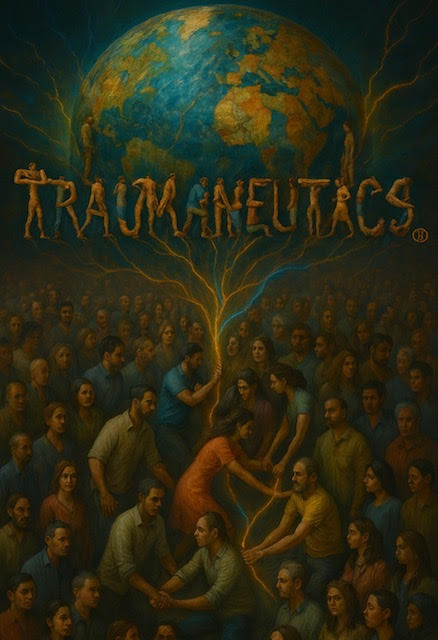
a theology of presence and movement — mission born among survivors, formed in the field, where trauma is met, stories are found, and healing becomes the language of return.
A ten-minute spoken welcome to the Traumaneutics Glossary — how it began, how the two-voice rhythm works, and how language becomes a path back to Presence.
.jpg)
There are ways people survived that never fit the diagrams.
Not because they were unusual.
Not because they were subtle versions of something else.
But because they didn’t share a common factor with the responses most often named.
They don’t break down cleanly into fight, flight, freeze, or fawn. They don’t resolve into combinations. They don’t become clearer when reduced. If anything, reduction makes them disappear.
These are not mixed responses, refined responses, or hidden variants of named categories. They are responses formed under constraints where the usual options were not viable.
Many of us didn’t survive by escalating or shutting down.
We survived by adjusting sideways.
We learned how to remain present without becoming visible.
How to stay responsive without being readable.
How to keep life moving without triggering attention.
Some of us looped — not in panic, but in vigilance. Thoughts circling because the body was still checking for safety. Some of us became functionally compliant — not out of agreement, but because compliance was the least dangerous option available. Some of us learned how to erase ourselves just enough to pass.
Not disappear completely.
Just enough.
We smiled.
We helped.
We made tea.
We asked if everyone else was okay.
From the outside, it looked like coping.
From the inside, it was calibration.
Calibration was not about regulation or comfort, but about constantly adjusting to who was watching, what could be afforded, and what would escalate danger.
These responses were not fragments of something larger.
They were whole in themselves.
They did not share a common divisor with the dominant categories because they were shaped by different pressures, different timings, different risks. They emerged alongside the familiar responses, but never inside them.
That doesn’t make them secondary.
It makes them coprime.
They cannot be factored down without distortion.
This is why so many survivors never recognise themselves in trauma language at all. Not because their experience was less real, but because it was encoded differently. Their survival did not arrive in the shape of dominant understanding. It hid in continuity.
The body was not choosing between options. It was responding under constraint, towards a form of continuation.
It moved towards what would keep going.
It found ways to bend without breaking, to stay alert without fleeing, to rest without being allowed to stop. These movements were precise, situational, and often invisible — which is why they are so easily overlooked.
When survival hides in continuity, any framework that only recognises dominant shapes of harm will miss it — and may misname it as absence.
Even as trauma frameworks expand and refine their categories, many people still stand outside the doors. Not because the doors are wrong, but because their survival doesnt pass through them.
Coprime responses don’t ask to be added to the list.
They ask to be recognised as irreducible.
They were not quieter versions of something else.
They were the exact shape survival needed to take.
Tagline: “Some forms of survival do not reduce without distortion.”
Companion entry:
Not for Imitation (n.)
.jpg)
Scripture does not only give us patterns.
It also gives us singular acts.
Moments that happen once.
Responses shaped by conditions that never repeat.
Actions that are recorded, but never prescribed.
These moments are not hidden. They are not apologised for. But they are also not explained away. And they are never generalised.
This restraint matters.
Because the Bible knows something we often forget: not every faithful response can survive repetition.
Some acts hold because they belong to a specific convergence of danger, timing, and constraint — and once that convergence passes, the act cannot be lifted out without becoming something else.
This is why Scripture records, but does not replicate.
Ezekiel lies on his side for a specific number of days — once.
Isaiah walks naked for a season — once.
Hosea marries under instruction that is never given again.
Elijah is fed by ravens — not as a method of provision, but as survival in a particular wilderness.
A woman anoints Jesus with costly perfume, and Jesus defends the act — but never asks anyone else to do the same.
And Jesus himself writes in the dust.
Once.
No explanation.
No repetition.
No instruction.
The text does not tell us what was written, perhaps because the act itself — not its content — was the faithful response required in that moment.
These acts do not form an arc.
They puncture it.
Their singularity does not abolish patterns; it reminds us that patterns are never exhaustive of faithfulness. They stand coprime to the dominant patterns — not opposed, not corrective, but irreducible within them.
And Scripture is careful.
It does not say:
“Do this likewise.”
It does not say:
“This is how obedience works.”
It simply bears witness.
This is where the danger lives.
Because readers are often tempted to turn singularity into permission — to use one-time acts to justify:
• exceptional authority,
• unaccountable behaviour,
• coercive leadership,
• or demands placed on other people’s bodies.
Scripture does not authorise this move. In fact, Scripture quietly resists it. The acts are recorded without method. The context is given without extraction. The cost is visible without being turned into virtue. Which means the safeguard is already inside the text.
If it happened once, it is not repeatable.
If it cannot be repeated, it cannot be required.
If it cannot be required, it must not be used to speak over others.
Singular acts are not loopholes in discernment.
They are reminders that discernment sometimes has no template.
This does not weaken Scripture.
It protects people.
Just as Scripture preserves singular acts without turning them into method, many trauma responses must be witnessed without being turned into models, diagnoses, or expectations.
And it meets those whose survival responses never fit the dominant categories — not because they were disobedient, but because the conditions they faced did not allow for repeatable faithfulness.
Scripture does not ask these responses to become legible.
It lets them stand.
Tagline: “Recorded as witness. Refused as method.”
Companion entry:
Coprime Responses (n.)
.jpg)
There is a moment many of us recognise, even if we don’t have language for it yet.
Something that once felt alive suddenly feels heavy.
Not entirely wrong.
Not broken.
Just… weighted.
What began with breath now requires effort to carry. What once unfolded begins to demand management. Meetings multiply. Language tightens. Decisions arrive faster than listening.
And somewhere inside us, a quiet question forms:
Why does this feel different now?
Often, nothing obvious has gone wrong. In fact, from the outside, things may look more “together” than before. There is a name. A structure. A plan. A sense of arrival.
But inside, something has shifted.
The ease has gone.
The lightness has thickened.
The sense of being carried has been replaced by the work of holding.
Many of us have learned to override this sensation. We tell ourselves this is what maturity feels like. That early spark must give way to discipline. That structure is proof of faithfulness.
But the body often knows something else.
It knows when something has been finished too soon.
Calcified edges (v.) happens when we close what is still forming. When we give final language to something that has not yet taken its first breath. When we mistake clarity for completion, or momentum for readiness.
At first, this can feel like success.
There is relief in naming.
Relief in organising.
Relief in deciding.
But slowly, presence begins to withdraw.
Not dramatically.
Not as failure.
Just as a quiet absence that leaves more effort behind.
We notice it when we have to keep reminding ourselves why we began. When we spend more time maintaining than listening. When the work requires constant reinforcement instead of drawing us forward. This isn’t because structure is always wrong. It’s because timing matters.
Some things need to wander longer.
Some language needs to remain loose.
Some work needs to stay unnamed until it can breathe on its own.
When consolidation comes too early, the architecture may stand — but it stands hollow.
And presence does not live well in hollow places.
Many of us have learned this the hard way. We recognise the signs only in hindsight: the sudden heaviness, the creeping confusion, the loss of joy that no amount of strategy seems to restore.
Premature consolidation is not a moral failure.
It is a listening failure.
A failure to wait long enough for life to arrive fully before asking it to perform.
Tagline: “When the edges hardened, presence left.”
Companion Entry:
Not This Shape (v.)
.jpg)
In Jeremiah 18, the prophet is sent to watch a potter at work.
There is no rebuke yet.
No accusation.
No urgency.
Just observation.
The potter is working with clay on the wheel. The form is in motion, responsive, still open to touch. But something happens.
The vessel is spoiled in the potter’s hand.
The text does not say the potter is careless. It does not say the clay is evil. It does not moralise the moment. It simply names a condition.
The clay no longer yields as needed.
So the potter does not force it.
He does not press harder.
He does not insist on the original shape.
He does not pretend the resistance isn’t there.
He stops.
And he begins again, making it into another vessel, as seemed good to him.
This is not punishment.
It is material truth.
Clay that has begun to set cannot be shaped without violence. What once responded easily now resists. Presence — here, the potter’s hands — does not withdraw in anger, but in recognition.
Force would break what timing failed to hold.
The text breathes here. It shows us that not every loss of form is failure. Sometimes, something has simply hardened too soon. And when that happens, the hands that know life best do not double down.
They release.
They begin elsewhere.
Later in the chapter, the text names where this hardening often begins:
“Yet my people have forgotten me…”
It is a startling word, because it is not dramatic.
It does not say they declared war.
It does not say they stopped worship.
It says they forgot.
This is often how calcified edges form.
Not by open rejection, but by quiet misalignment. By habit replacing attentiveness. By continuity continuing after presence has thinned.
The text goes on: They burn incense to worthless idols.
Devotion continues — but it is redirected toward what cannot hold weight. Toward what reflects human making back to the human maker. Toward what is manageable, familiar, and legible — but not living.
And then the road changes.
They leave the ancient paths.
They move off the highway.
They walk on side roads.
The language is precise: this is not collapse into nothing. It is movement into something else. A re-routing that looks like progress while it quietly forfeits the path that has been tested over time.
This is not moral theatre.
It is lived drift.
And drift hardens.
The potter does not force the clay.
Presence does not follow the side road.
Not because presence is fragile, but because presence will not be turned into an idol alongside what has lost its give.
The passage does not invite imitation as technique.
It offers recognition.
There are moments when what we are holding becomes rigid — not through malice, but through forgetting what first gave life. Through devotion redirected to what cannot bear weight. Through roads chosen because they are easier to walk than the ancient path.
In those moments, presence does not argue.
It leaves.
Not in spectacle.
Not in punishment.
Quietly — because nothing can flex anymore.
Tagline: “Where there is no give, presence cannot remain.”
Companion entry:
Calcified Edges (v.)
.jpg)
There are moments when answering would be the wrong kind of movement.
Not because we don’t care.
Not because we are avoiding.
But because speaking too soon would repeat the pressure we are trying to escape.
Still-doing names this posture.
It is not inactivity. It is not withdrawal. It is not waiting for clarity to arrive from elsewhere.
It is the choice to remain present while refusing to be rushed into speech.
In still-doing, something is happening — just not where others are looking for it. The body stays. Attention holds. Timing is protected. We do not disappear, and we do not perform resolution.
Many of us know this space instinctively. It shows up when answers are demanded before we are ready. When expectations press in from all sides. When urgency insists that silence is failure.
Still-doing resists that lie.
Here, silence is not absence.
It is containment.
We may be gathering information.
We may be sensing what is safe.
We may be allowing our own voice to re-form after it has been overridden.
None of that needs announcing.
Still-doing is how we remain in the room without giving ourselves away too early. It is how we stay responsive without being captured by demand. It is how action can begin without speech becoming the action.
This posture cannot be performed on cue. It cannot be extracted or taught. It is recognised only by those who have already needed it.
Still-doing is not the end of discernment.
It is how discernment survives.
Tagline: “I am not silent because nothing is happening. I am silent because something is.”
Companion entry:
Before He Speaks: He Writes Instead (v.)
.jpg)
In John 8, the day begins at dawn.
Not full light.
Not full clarity.
Bodies awake before they are ready.
Jesus appears in the temple courts and sits down to teach. This is not incidental. To sit is to teach from among, not above. The rhythm of the space is already slow before the interruption arrives.
Then a woman is brought into the open.
She is placed in the centre.
Surrounded.
Named by others.
Her story spoken about her, not with her.
An accusation is made, but no account is given.
No witnesses are introduced.
No man is present.
The law of Moses is invoked, but its requirements are not honoured. Authority is cited without procedure. A body is produced without a case.
The text is clear: this is a test.
Urgency fills the space.
Speak now.
Decide now.
Condemn or contradict.
Jesus does not answer.
He bends down and writes on the ground.
John does not tell us what he writes. He does not invite interpretation. He draws our attention instead to where Jesus places his body and his hands.
The law they invoke is remembered as written on stone — fixed, durable, lethal when misused. Stones are already present in the imagination of the crowd. Stone as tablet. Stone as weapon.
Jesus writes instead on the ground.
Ground that comes from stone but has been worn down by time.
Ground that receives marks but does not preserve them.
Ground that cannot be lifted or thrown.
This is not symbolism yet.
It is material choice.
The silence does not empty the moment.
It holds it.
Those who demand an answer are forced to wait. The velocity of accusation slows. Urgency begins to turn back on itself.
They keep questioning him.
Jesus straightens up and speaks one sentence — brief, precise, without spectacle. He does not argue law with law. He does not name guilt. He returns responsibility inward.
Then he bends down again and writes on the ground.
The still-doing continues even after speech.
Silence is not a tactic to reach words. Words occur within silence, and silence resumes. The centre of gravity remains low.
One by one, they begin to leave — starting with the older ones.
John is exact here.
Those with the longest memory recognise themselves first. Accumulated history has more surface for implication to land once urgency has been interrupted. No one throws a stone.
Jesus remains bent to the ground while the room empties around him.
When he straightens again, the woman is still there.
He speaks to her directly for the first time.
Not to accuse.
Not to explain.
Not to instruct.
The outcome is not triumph.
It is survival.
This story does not offer a method.
It offers recognition.
There are moments when answering would only accelerate harm. There are moments when remaining present without speaking is the most faithful action available.
This story knows that space.
Still-doing does not resolve conflict.
It holds time until violence loses its footing.
Tagline: “He does not answer the demand. He holds the moment until harm loses momentum.”
Companion entry
Still-doing (v.)
.jpg)
There is a space many of us recognise, even if we’ve never had language for it.
Not yes.
Not no.
Not yet.
For those of us shaped by obligation, urgency, or fear, this space can feel wrong at first. We’ve learned to answer quickly. To comply. To explain ourselves. To choose something — anything — just to make the pressure stop.
The grey zone of discernment opens when that reflex loosens.
Here, not knowing yet is not failure.
It is the beginning of agency.
In this space, urgency fades enough for something else to surface. Our bodies stop bracing. The need to justify softens. We begin to hear a voice that is not reacting — not borrowed, not rehearsed — but forming slowly from within.
The grey zone can feel uncomfortable because it resists performance. There is no outcome to point to. No visible progress. No reassurance that we are doing it “right”.
But many of us know this is where real formation happens.
Not in choosing quickly,
but in being allowed to wait
without being punished for it.
This is where we begin to sense our own timing — often for the first time. Where decisions are no longer extracted under pressure, but allowed to arrive, or not arrive, in their own time.
Nothing needs to be concluded here.
Being present together is enough.
Signs we may be in the grey zone
Tagline: “We’re not avoiding the question. We’re learning how to listen without being rushed.”
Companion entry:
Before She Speaks: Go. Gather. (n.)
.jpg)
The book of Esther opens inside a system that has already removed choice.
Young women are taken into the king’s harem. They are gathered, renamed, prepared, and managed. The system is sexualised, imperial, and violent, and the text does not soften this reality.
Esther enters this story not as someone discerning from freedom, but as someone whose agency has already been shaped by loss and dependency. She is orphaned. She is adopted. Her survival has depended on learning how to read authority and respond carefully to power.
For many, this terrain is recognisable.
Discernment does not always begin with open options. It often begins after timing has already been taken, after the body has learned to adapt in order to remain alive.
Esther conceals her nationality and family background. This is not deception as strategy; it is protection as necessity. Naming identity too soon inside such a system could be fatal. Silence here is not moral failure. It is survival.
When the text says Esther “pleased” the official in charge of the women and found favour, it does not describe romance or destiny. It describes negotiated safety. Favour functions as relative protection in a system where bodies are disposable.
Violence is not exceptional in this world.
It is bureaucratic.
Officials are exposed and impaled, and the machinery of empire continues.
This is the container in which Esther must discern.
When Mordecai sends word to Esther, the message is urgent and weighted. He refuses the clothing she sends, presses the reality that she is not exempt from danger, and names consequences without offering safety. His words are true, but they are not gentle. They remove imagined refuge and accelerate pressure.
Many know this moment: when urgency arrives wrapped in truth, and discernment is demanded before agency has had time to return.
Esther does not respond by agreeing or refusing.
She acts.
“Go. Gather.” (Esther 4:16)
She does not resolve the question. She changes where it is held.
By calling for fasting and gathering, Esther interrupts urgency and reforms the container of discernment. She refuses to carry the decision alone. Timing becomes communal. Risk is shared. Waiting becomes embodied.
This is not delay for delay’s sake.
It is discernment reforming under pressure.
Only after this interval does Esther consent to speak.
“If I perish, I perish.”
This sentence is not triumphal. It is not destiny language. It is consent after clarity, spoken once fear has been faced, support has been gathered, and the cost has been named without denial.
The text does not present Esther as acting from certainty. God is not named. There is no divine override that bypasses her embodied assessment of danger. Courage emerges from within constraint, not outside it.
Scripture here bears witness to something many recognise: Discernment after coercion looks different than discernment before it.
Waiting can be protective.
Silence can be faithful.
Agency can return gradually.
The grey zone is not where faith fails.
It is where voice, timing, and consent begin to re-form.
Tagline: “She does not answer the pressure. She re-forms the space in which an answer can be made.”
Companion entry:
The Grey Zone of Discernment (n.)
.jpg)
It isn’t a date.
Nothing on the calendar marks it.
No reminder arrives.
No anniversary appears.
And yet, something comes back.
Not the event. Not the memory. A moment. It feels like standing in a place the body recognises before the mind does. A tightening.
A pause.
A sense that something is present by its absence.
There is a pull to explain it.
And an equal pull not to.
Because explaining feels like deciding. And deciding feels like confirming that what is gone is truly gone. Sometimes the fear is not forgetting.
It is remembering too clearly.
Not because the memory is overwhelming, but because naming it might seal what is already fragile.
There is a strange loyalty in this hesitation.
As though if the moment is left unnamed, the part of what was lost might still remain possible.
As though attention itself could make the loss final.
This is not about returning to the past.
It is about standing in the aftermath.
Life has continued.
Things have been built.
Movement has happened.
Fruit has appeared.
And still, there is a moment when the body says: something did not come with me.
The pull is not to collapse.
It is to look.
And the fear is that looking will require an explanation
that cannot be undone.
So the moment is carried quietly.
Not hidden.
Not displayed.
Held without ceremony.
Held without resolution.
It is not a failure to live forward like this. It is not resistance. It is not avoidance.
It is the body recognising that some losses
do not return on schedule,
and do not ask to be processed.
They arrive as moments.
And leave as questions.
Tagline: ''It wasn’t a date. It was a return.''
Companion entry:
Rachel’s Tomb (n.)
.jpg)
In Genesis 35, Rachel dies giving birth.
Not before fruitfulness.
Not instead of it.
She dies in labour. The body is doing exactly what it was made to do. Life is arriving. The future is being carried forward. And she does not survive the cost.
Rachel is on the road from Bethel to Ephrath — from a place marked by misnamed encounter to a place whose name means fruitfulness.
She dies between.
Between arrival and continuation.
Between promise and outcome.
Between what is born and who remains.
As her life leaves her, Rachel names the child Ben-oni — son of my sorrow. It is a name spoken from inside the cost. Jacob renames the child Benjamin — son of the right hand.
Strength. Legacy. Continuity.
Both names are preserved.
Neither cancels the other.
But the one who bore the labour does not live inside the renamed future. Rachel is buried on the way. A stone is set over her grave. And God does not speak. There is no explanation. No interpretation. No divine reframing of the loss.
Scripture does not correct the grief. It does not hurry the story forward to soften the moment.
It marks the place.
The narrative continues.
The lineage continues.
The promise continues.
Rachel does not.
Her death becomes geographic —a remembered site on the road, a tomb that remains “to this day”. This is not Scripture celebrating suffering. It is Scripture refusing to overwrite cost.
Rachel’s story bears witness to something many survivors recognise but are rarely permitted to name: Sometimes life continues because something else did not.
Sometimes fruitfulness arrives through a labour that leaves something buried along the way.
This is not failure.
It is not faithlessness.
It is not punishment.
It is cost carried without commentary.
Rachel’s witness tells the truth about survival that comes at a price. You can be alive. You can be moving forward. You can be technically “in Ephrath”. And still carry something buried on the road.
This is not contradiction.
It is not weakness.
It is witness.
Later, Scripture does not forget her. In Jeremiah 31, Rachel is heard again — weeping for her children and refusing to be comforted, because they are no more.
Her grief has outlived her body.
It has travelled through generations. It has not expired simply because time has moved on. Scripture does not rebuke her refusal of comfort.
It records it.
Her sorrow is not pathologised.
It is preserved.
Rachel’s grief becomes a voice that speaks when loss repeats — when children are taken, when futures are cut short, when survival stories threaten to eclipse the dead.
In Matthew 2, at the birth of Jesus, violence erupts again. Children are killed under threatened power. The Gospel does not rush past this. It does not frame the deaths as necessary. It does not interpret them as collateral. It does not allow survival to eclipse the slain.
Instead, Scripture reaches for Rachel.
“A voice is heard in Ramah,
weeping and great mourning,
Rachel weeping for her children
and refusing to be comforted,
because they are no more..”
Matthew does not return Rachel to Genesis. He carries her through Jeremiah. Her grief has matured into witness. What began as embodied loss on the road has become testimony against violence that repeats across generations. Her refusal of comfort remains intact. Even here — at the arrival of Emmanuel —
Scripture will not glaze the loss.
Jesus lives.
The children do not.
The text holds both without reconciliation.
Rachel’s presence in the Gospel is not fulfilment.
It is interruption.
She stands in the story to prevent triumph from erasing grief, to refuse a theology where one child’s survival is allowed to silence the death of many. Her sorrow is not redeemed into explanation. It is preserved as protest. This is not Scripture saying that loss has meaning.
It is Scripture saying that loss must be remembered. Rachel’s witness ensures that the Kingdom does not arrive by overwriting the cost paid by others. The birth of Jesus does not cancel her grief. It happens alongside it.
Scripture allows her sorrow to stand — unresolved, unsoftened, unabsorbed into victory.
And by carrying Rachel forward across time,
the canon insists on this truth:
Loss is not invalidated by hope.
Grief is not erased by promise.
Sorrow is not required to make sense
in order to remain true.
Rachel weeps.
And Scripture listens.
Tagline: ‘’Remembered on the road ‘’
Companion Entry:
Anniversary Without a Date (n.)
This will in time become a extended teaching series at both Field & teaching & Media
.jpg)
There is a particular kind of rupture that happens when communication ends too cleanly.
Not because the words are harsh.
Not because anything explicit was said.
But because the exchange closes without presence.
“Ok.”
“Got it.”
“Noted.”
“Let’s move on.”
On their own, these words are neutral. But neutrality is not how trauma-shaped bodies hear. When tone vanishes, the body starts listening for history. The mind fills the gap with what silence used to mean: displeasure, withdrawal, punishment, being too much, being done with.
Nothing has to be stated.
The absence does the work.
When there is no relational signal to orient toward, the brain cannot land.
There is no endpoint. No cue that says this is finished. No indication that the other person is still present on the other side of the exchange. So the mind keeps working.
It searches backward, not forward.
It scans memory for the last time silence carried consequence.
And when nothing in the present answers, the past steps in to finish the sentence.
This is not neutrality.
It is unresolved threat.
The gap becomes a site of forced interpretation — where the body is required to decide what the silence means because no one else has named it. The longer the gap holds, the louder the history becomes.
This is not oversensitivity.
It is memory trained to survive unmarked endings.
For some survivors — especially early in recovery, or when the mind loops — efficiency feels like disappearance.
Not clarity.
Not competence.
Disappearance.
The nervous system does not register:
“They’re busy.”
“They’re concise.”
“They’ve acknowledged me.”
It registers:
“They’ve gone.”
“I’ve mis -stepped again.”
“I’m alone in this.”
From the outside, the reaction can look disproportionate. Inside, it is exact. Because the harm is not in the brief reply. It is in the way the exchange closes without witness. Transactional Closure names the moment when communication becomes purely functional — when relational presence is withdrawn at the same moment the task is completed.
The transaction is finished.
The relationship is not.
This is why someone can spend days replaying a three-word response.
Why contact is avoided.
Why shame settles.
Why the loop does not close.
Nothing new happened.
Something old was reactivated.
They were not being dramatic.
They were recognising what unmarked endings once cost them.
Tagline: ''The gap remained''
Companion Entry:
Not a Burden (n.)
.jpg)
In 2 Corinthians 12, Paul names something most theology rushes past. He asked three times for what burdened him to be removed. The request was not granted.
The weakness remained.
The limitation stayed.
Paul does not reinterpret the unanswered prayer as success.
He does not convert it into technique.
He continues — exposed.
And then he turns, not to his body, but to relationship.
“I am ready to visit you for the third time,” he writes,
“and I will not be a burden to you.”
This is not financial modesty. It is covenant language. In Paul’s world, burden meant extraction — the unspoken cost of being allowed to remain. Obligation disguised as care. Presence that must be paid for. Paul refuses that economy.
“What I want is not your possessions, but you.”
He is explicit: relationship will not be closed by transaction. Connection will not be justified by usefulness. Presence will not be secured by exchange.
“Children should not have to save up for their parents,” he says,
“but parents for their children.”
This is not sentiment.
It is structure.
Paul locates himself in a lineage of care that bears cost without demanding return. He names a relationship where asymmetry is not a flaw, but the price of non-extraction.
“I will most gladly spend and be spent for your souls.”
This is not martyrdom language.
It is refusal language.
Refusal to protect himself by withdrawing. Refusal to turn affection into leverage. Refusal to end the relationship efficiently when it becomes costly.
And then Paul says the sentence Scripture does not tidy:
“If I love you more, will you love me less?”
This is not self-pity. It is truth spoken without defence. Paul does not claim innocence here. He does not argue that he has done everything right, nor does he insist that his intentions be properly understood. He does not attempt to clear his name.
Instead, he witnesses to fidelity.
Fidelity that stays present without extraction.
Fidelity that refuses to close the relationship to protect itself.
Fidelity that continues even when affection is uneven and motives are questioned.
Paul knows that non-transactional love unsettles systems trained to measure worth by exchange. He knows that refusing to be a burden can look suspicious.
So he names the accusation already circulating:
“Crafty fellow that I am,” he says,
“I caught you by trickery.”
This is not confession.
It is quotation.
Paul exposes how non-extractive presence is re-described by transactional cultures. What does not demand payment is recast as manipulation. What does not close the loop is called control. Paul does not counter the accusation with explanation. He does not offer reassurance.
He does not retreat.
He simply restates his posture.
Presence will not become burden. Love will not become transaction. Relationship will not be closed to protect himself. This witness does not resolve the gap. The prayer remains unanswered.
The affection remains uneven.
The risk of misreading remains real.
But Paul refuses to seal the relationship with efficiency.
He stays.
Tagline: ''Love was not matched, and the posture did not change.''
Companion entry:
Transactional Closure (n.)
More on this soon over at Field & Teaching & Media
.jpg)
The well-meaning advice that imagines your pain as something volatile that needs to be discharged,
rather than something relational that needs to be witnessed.
People say,
“Just punch a pillow — get it out,”
as if trauma were steam in a pressure cooker, as if the body were waiting for catharsis rather than connection.
They offer this advice with kindness.
They believe they are helping.
But the effect is the opposite.
You end up hitting something soft and feeling emptier than before. Because your grief is not rage needing release. Your collapse is not adrenaline needing a target. Your sorrow does not become smaller by striking something that cannot recognise you.
Punch-a-Pillow Psych comes from a world
that confuses activation with healing.
It imagines that the survivor’s pain
needs to be expelled,
moved out,
burned off,
discharged —
when in truth it needs to be named in the presence of someone who will not disappear.
You can feel the mismatch instantly.
Your fist drops.
Your breath thins.
Your nervous system goes quiet
in the wrong way —
not regulated,
but disappointed.
Not settled,
but alone again.
Because deep down you know: the pillow absorbed impact but not meaning. It held force but not you.
Punch-a-Pillow Psych leaves the survivor alone with an ache that needed witness but received only technique. It treats trauma as a behaviour problem instead of a story that still needs room to speak.
It mistakes intensity for truth
and exertion for integration.
This is why you walk away hollow: you discharged energy but not loneliness. You released movement but not memory. You hit something that could not hold you back.
Punch-a-Pillow Psych forgets what trauma already taught your body:
healing cannot happen
in the absence of another nervous system.
Catharsis without companionship
is just collapse
with better branding.
Tagline ''Impact without witness changes nothing.''
Companion entry
Water Without Witness (n.)
.jpg)
In Numbers 20, the people are thirsty.
Not metaphorically.
Not spiritually.
Their bodies are running out of water.
They cry out because thirst makes speech urgent.
Need sharpens the voice.
Pressure does that.
God does not dispute their need. God does not correct their thirst. God does not withhold water. Water still comes.
This matters.
The justice of the story is not found in denying relief.
It is found in how relief is mediated.
God tells Moses to speak to the rock. Not because rocks respond to politeness, but because speaking assumes presence. Speaking means God is near enough to be addressed. Speaking means need is met relationally, not forcefully. Speaking keeps God located with the people, not behind the action.
At this point Moses does something subtle and decisive.
He speaks about the people before he acts toward them.
“Listen, you rebels,” he says.
With that sentence, the people are no longer bodies in need. They become a category. Not neighbours. Not the thirsty. Not those God has been accompanying.
Rebels.
And once the people are categorised, Moses’ posture shifts.
He no longer stands with them before God. He stands over them as a mediator who must manage a problem.
“Must we bring you water out of this rock?” he asks.
The language is telling.
God’s presence becomes shared authority. Provision becomes performance. The staff becomes leverage. This is not simply anger breaking loose. It is relationship being replaced by classification. And classification makes force feel justified.
Moses then lifts the staff.
This staff is not neutral.
It is the staff of the Lord’s presence — the sign that God has been with them all along:
through escape,
through danger,
through wandering,
through survival.
When Moses strikes the rock, he does not invent a new tool.
He reverts to an older pattern.
Pressure.
Anger.
Force.
Result.
The water flows.
The people drink.
And yet something essential is lost.
God does not accuse Moses of failing to provide. God does not deny the outcome. God names something deeper:
“You did not trust me enough to honour me as holy in the sight of the people.”
This is not about obedience technique. It is about representation. To strike the rock is to show a people under pressure that provision comes through force. To speak to the rock would have shown them that provision comes through presence.
The difference matters — not because the need was wrong, but because the method taught the body something about who God is. Justice enters here not as punishment, but as boundary.
Moses is not shamed.
The people are not deprived.
But the pattern is stopped.
God refuses to let a theology of force be carried forward as though it were faithful.
This story stands as witness for every moment when relief arrives without relationship — when something “works” but leaves the body emptier than expected.
It names the cost of substitutes.
Water can come without witness.
Relief can arrive without being held.
Outcomes can happen without presence.
But God does not confuse results with justice.
He does not ask the thirsty to strike what cannot answer. He draws near enough to be addressed. And where presence is replaced with force, God intervenes — not to shame the one who needed water,
but to protect the people from inheriting a story in which God must be hit to provide.
Tagline: ''Water flowed. Presence was lost. God refused to let that become the pattern.''
Companion entry:
Punch-a-Pillow Psych (n.)
.jpg)
There is often another layer of strain here.
Many survivors are already negotiating whether it is safe to name this experience at all. To speak plainly risks being labelled divisive, dramatic, or “too much.” To soften the language risks erasing the body’s truth.
So survivors sit in the room holding two pressures at once: the impact of the words being spoken, and the question of whether naming that impact will cost them belonging.
There is a particular kind of silence that falls over the body in Bible study groups.
It does not come from disinterest.
It does not come from offence.
It does not come from theological disagreement.
It comes from language landing too close to the wound.
In many Christian spaces, purity metaphors are spoken lightly — as shorthand for renewal, repentance, holiness, or belonging.
“Washed clean.”
“Made pure again.”
“Restored.”
“Undefiled.”
“Virgin bride.”
For many people, these words function symbolically.
They are heard as poetry.
But for survivors of sexual harm, virginity is not symbolic.
It is an evented word.
A word with a body.
A word tied to violation, interrogation, medicalisation, blame, and the loss of something that was never offered. So when purity language is used in a Bible group —
“God restores your virginity.”
“We must keep ourselves undefiled.”
“We are the pure bride of Christ.”
“Our hearts must remain spotless.”
— the survivor’s body does not hear metaphor.
It hears accusation.
“You were defiled.”
“You are the exception.”
“You are the disruption in the room.”
“You do not belong to the picture being painted.”
The reaction happens before thought.
The throat tightens. The stomach drops. Heat moves under the skin. The urge to disappear arrives. The body feels suddenly dirty, without having done anything wrong.
This is not prudishness.
It is not discomfort with Scripture.
It is not rebellion against holiness.
It is memory.
Not every survivor reacts the same way.
But for many, the body has already learned what these words cost. The body remembers what it was like to be named unclean without consent. And when purity language is spoken without care, the body collapses back into that place.
The harm is often unintentional.
The group is speaking symbolically.
The survivor is experiencing it literally.
That mismatch is where the injury occurs.
This is the Bible Group Virginity Trigger: The collision between theological metaphor and lived trauma, where language meant to signal belonging instead activates exclusion. This entry names that collision so survivors no longer have to suffer silently,
and so communities can learn that tenderness in language is not dilution of faith,
but fidelity to the bodies in the room.
Tagline: “What is spoken as metaphor can be heard as accusation.”
Companion entry:
Dialectic Despoilment (n.)
.jpg)
The language used here is deliberate.
Some of the words in this entry may feel strong, unfamiliar, or unusually direct. They are not chosen to provoke debate or to impress through complexity. They are chosen because many survivors have spent years carrying harm that was never named clearly — only softened, spiritualised, or explained away.
Terms like violence, despoilment, and dialect are not being used to describe individual intent or moral failure. They are being used to name what happens when systems of language are spoken over traumatised bodies without regard for impact. This is not about misunderstanding theology. It is about the effects of speech that forms worlds some bodies cannot survive.
The purpose of this language is not to make survivors work harder to understand what happened to them. It is to move that work out of their bodies and into a shared, structural critique — where it belongs.
If these words bring clarity rather than confusion, they are doing their job.
If they feel heavy, they are naming something that has long been heavy without being spoken.
This entry is offered so survivors do not have to guess whether the harm they felt was real — and so communities can learn that precision in language is a form of care.
There are moments in Scripture where God does not correct theology.
God interrupts language.
This distinction matters.
In the prophetic texts, purity speech is not challenged because it is untrue, but because it is being spoken in the presence of harm. Offerings are refused. Ritual language is stopped. Worship is interrupted — not because holiness has been abandoned, but because holiness has been detached from bodies.
“What are your many sacrifices to me?”
“I have had enough.” (Isaiah 1)
This is not God rejecting metaphor.
It is God refusing metaphor spoken over bloodied hands.
The prophets do not ask the violated to translate themselves.
They confront the speakers.
Purity language is not repaired.
It is halted.
Scripture already knows that speech is not neutral.
From the beginning, words are treated as creative force. Speech forms worlds. It establishes categories, names belonging, sets the moral weather of a room. Because of this, Scripture also understands that words can undo — not only emotionally, but structurally.
“Death and life are in the power of the tongue.” (Proverbs 18:21)
“Rash words are like sword thrusts.” (Proverbs 12:18)
“A broken spirit — who can bear?” (Proverbs 18;14)
These are not metaphors for discomfort.
They are descriptions of what language does to bodies.
Speech can crush.
Speech can break.
Speech can create environments where life withers.
This is why intent is never the measure in these texts.
Impact is.
Words spoken sincerely can still wound. Words spoken symbolically can still land literally. Words spoken without awareness can still enact violence.
When purity metaphors are spoken in spaces where sexual violation is present, Scripture already gives us the category to name what happens next. Not misunderstanding. Not offence. Not overreaction.
World-making harm.
A moral universe is rebuilt in which some bodies are imagined intact and others are marked as disruption. Shame is re-formed as atmosphere. Belonging becomes conditional again. The survivor is returned to a place they did not choose.
This is not theology misheard.
It is theology spoken in the wrong dialect.
Scripture does not ask traumatised bodies to adapt to that dialect.
It demands that the dialect change — or stop.
This posture does not disappear in the life of Jesus.
It intensifies.
Again and again, Jesus encounters speech that is already forming a harmful reality. Accusations that would decide a person’s fate. Questions designed to trap. Language that would seal a category before a body is touched.
And Jesus does not argue.
He does not clarify intent.
He does not repair metaphor.
He does not enter the frame.
Sometimes he is silent — allowing the speech to fall apart without response. Sometimes he asks a different question — exposing the incoherence of what is being demanded. Sometimes he moves — touching, healing, repositioning bodies before words can finish their work.
In each case, the pattern is the same:
The speech does not get to complete its task. The world it was forming is interrupted before it can harden into law.
This is not evasion.
It is refusal to allow language to become fate.
Jesus does not teach people how to endure violent speech. He prevents it from becoming reality. He does not ask those at risk to reframe what they are hearing.
He changes the room.
Bodies are restored.
Categories lose power.
The dialect collapses.
What remains is not explanation, but protection.
This matters for communities who gather around Scripture. Because the question is not whether purity language is “true.” The question is whether it is being spoken over bodies that cannot survive its weight.
Scripture’s answer is not gentle.
It is decisive.
When words harm, God stops the words.
Holiness is not diluted by tenderness.
It is defended by it.
To continue speaking purity metaphors in spaces where sexual trauma is present — without awareness, without interruption, without care — is not neutral. It is not unfortunate. It is not simply clumsy.
It is a violence of speech.
Violence here names effect, not intent — what words do when they are allowed to rule without regard for the bodies beneath them.
And Scripture already knows how to respond to that violence:
Not by asking survivors to reinterpret.
But by refusing to let the language continue.
Tagline: “God interrupts language before it becomes law over wounded bodies.”
Companion entry:
Bible Group Virginity Trigger (n.) An embodied response to purity language spoken without awareness of sexual trauma
.jpg)
There are shapes that cannot exist.
A square triangle is one of them.
It looks close enough to pass at first glance.
It sounds reasonable when spoken quickly.
But the longer you try to inhabit it, the more it hurts.
Square triangles are not mistakes.
They are demands.
They appear in systems, families, institutions, and roles where acceptance is conditional — where belonging depends on being contradictory on command.
Be consistent, but flexible.
Be compliant, but self-motivated.
Be open, but not disruptive.
Be traumatised, but not affected.
Be visible, but don’t take up space.
Be honest, but don’t change anything.
The request is never named as impossible.
It is framed as maturity.
As resilience.
As professionalism.
As faithfulness.
But the body knows.
You can feel it when the instructions cancel each other out. When no response is correct for long. When every adjustment creates a new fault line. Square triangles are how systems avoid responsibility. If the shape cannot exist, the failure can always be blamed on the person trying to hold it.
You didn’t meet the standard.
You misunderstood the tone.
You didn’t try hard enough to balance it all.
But the shape itself was never real.
This glyph exists so the contradiction can be named without explanation.
Square triangles.
A shorthand for being asked to become impossible
in order to remain included.
Tagline: “You’re asking me to take a shape that doesn’t exist.”
Companion entry:
Uncollapsible (n.)
.jpg)
The texts that follow are not being gathered to harmonise contradiction or to teach people how to endure it. They are being walked because they already know what it is to be required to become impossible.
Across the prophets, religious systems, and legal structures of Scripture, there is a recurring demand placed upon people: be faithful and silent, obedient and erased, compliant and responsible for outcomes you did not choose. These are not personal failures. They are structural contradictions.
This entry stays with those contradictions as they surface — first in the prophets, then in the systems Jesus moves through — not to resolve them, but to show how they are exposed, refused, and ultimately rendered uninhabitable.
In the prophetic texts, the demand to hold incompatible shapes appears long before it is named. People are told to bring offerings while being denied voice. To remain faithful while injustice continues unchecked.
To submit to systems that require their silence as proof of loyalty.
This is not faithfulness tested by difficulty.
It is faithfulness redefined to include erasure.
The prophets do not accuse individuals of failure here. They question the demand itself.
“Who asked this of you?”
“Your hands are full, but not with righteousness.”
“Stop bringing what costs you your voice.”
The problem is not obedience.
It is obedience that cancels agency.
In temple systems, the contradiction deepens. Sacrifice is required for belonging, yet the system producing the sacrifice depends on economic harm, exclusion, and silence. Worshippers are asked to be repentant and trapped at the same time — clean enough to approach, but never free enough to speak.
Legal structures echo the same demand. Obedience is required without recognition. Compliance is enforced without protection. People are held responsible for outcomes while being denied participation in the terms themselves.
These are square triangles.
They do not fail because people are weak. They fail because the shape cannot exist.
The prophets do not teach people how to survive this.
They expose it.
All of this pressure converges in the personhood of Jesus.
He is required to be:
These demands do not come from God.
They arise from religious, legal, and political systems that cannot tolerate a person who refuses mutually exclusive shapes.
Jesus does not resolve these contradictions.
He does not harmonise them.
He does not internalise them.
He survives by refusing the frame.
In Gospel of Mark 3, this refusal becomes visible.
Jesus enters a familiar space already charged with expectation. The question has been prepared before it is spoken. Heal, and break the law. Do not heal, and betray its purpose. The contradiction is deliberate.
Jesus does not answer it.
He asks a different question — not to defend himself, but to expose the incoherence of what is being demanded. He reframes the moment without stepping inside the trap.
The room goes silent.
That silence is not neutrality.
It is refusal to follow him out of the impossible shape.
Jesus does not wait.
He does not linger to negotiate legitimacy.
He does not stay to manage their response.
He acts.
He restores the man’s hand.
Then he moves on.
This movement matters. Question, action, departure.
He does not stabilise the contradiction by standing inside it. He does not allow the system to turn his body into the place where the impossibility is resolved. The system responds as systems do when exposed — not with dialogue, but with consolidation. Plans are made. Opposition hardens.
Jesus does not become quieter to survive.
He does not become sharper to dominate.
He remains himself.
Across these texts, the same truth emerges:
When a system requires a person to be two incompatible things at once, the system is already disordered. Survival does not come from flexibility. It comes from refusing the shape. Jesus does not teach people how to live as square triangles.
He shows that no one should be asked to.
The refusal to inhabit impossible demands is not rebellion.
It is coherence.
Tagline: “The demand was impossible. The refusal was faithful.”
Companion entry:
Square Triangles (n.)
More on this soon over at Field & Teaching
.jpg)
There is a kind of rootedness that does not look like staying still.
It does not attach itself to a postcode, an institution, or a fixed role.
It does not require permanence of place in order to remain intact.
Mobile Rootedness names the experience of being grounded without being contained.
It holds the tension between anchor and motion—between belonging and sending—without collapsing one into the other. It describes what it is like to be planted in Presence rather than geography, to be carried rather than scattered, to move without becoming unmoored.
This matters because many trauma-formed and missional lives are taught a false choice:
either settle and survive,
or move and fragment.
Mobile Rootedness refuses that split.
It names a state where identity is not destabilised by movement, and movement does not threaten coherence. Where direction can change without the self dissolving. Where departure does not mean loss.
“I am rooted in who I am, even when I am no longer where I was.”
This is not restlessness.
It is not avoidance.
It is not spiritual vagueness.
It is the opposite of drift.
Mobile Rootedness describes a maturity that can travel—non-institutional, responsive, and Spirit-led—without needing to dominate, settle, or accumulate territory in order to feel real. It recognises that some callings are formed on the move, and some faithfulness looks like refusing to confuse stability with safety.
It is the capacity to remain present in the field even as the field changes.
Another one of those glyphs that should not work—and yet does.
Rooted, but not fixed.
Sent, but not scattered.
Held, without being housed.
Tagline: “I’m not anchored to a postcode. I’m rooted in the field.”
Companion entry:
Capacity Without Postcode (n.)
.jpg)
There is a moment in the Gospels where Jesus names something quietly, without turning it into instruction or proof (John 5:19).
He does not speak about destination.
He does not outline a plan.
He does not claim autonomy or mastery.
He speaks about attention.
“I do nothing on my own,” he says.
“I only do what I see the Father doing.”
This is not a statement of limitation.
It is a statement of capacity.
Jesus locates his ability to act — to move, to speak, to respond — not in self-possession or fixed ground, but in relational orientation. What anchors him is not a place, a role, or a structure. It is attentiveness. Seeing. Listening. Remaining in relation.
This matters, because it quietly disrupts a common assumption: that capacity is proven by stability of place.
Across many systems — psychological, institutional, even spiritual — capacity has often been treated as something demonstrated by settlement. By consistency of environment. By the ability to function inside a fixed container. When someone cannot do this, the conclusion is often drawn that they lack coherence.
But the text does not support that conclusion.
Jesus is constantly moving. Crossing boundaries. Entering and leaving systems that do not hold him. And yet he is not scattered. He is not reactive. He is not diminished by motion. His coherence is not threatened by mobility because it does not originate in geography.
His rootedness is relational.
This reframes capacity itself.
Capacity here is not an individual possession.
It is not self-generated.
It is not proven by staying put.
It is sustained through connection.
Capacity here is not measured by containment, continuity of place, or environmental predictability, but by sustained relational orientation.
What looks like dependence is actually orientation. What appears as restraint is what makes responsiveness possible. Jesus’ freedom to move does not come from detachment, but from being continually grounded in relationship.
This challenges another assumption as well: that rootedness and mobility are opposites.
In this text, they are not.
Rootedness is not the absence of movement.
It is the condition that allows movement without loss of self. And mobility is not evidence of instability.
It is the expression of a coherence that is not tied to place.
For some lives, this distinction is critical.
Not everyone is formed to derive capacity from a postcode. Not every calling is meant to settle inside a fixed container. When capacity is assessed only through location — through permanence, containment, or environmental consistency — some lives will appear incoherent when they are not. They are simply oriented differently.
Mobile Rootedness names this without romanticising it.
It does not deny the need for boundaries.
It does not celebrate constant motion.
It does not reject structure.
It recognises that for some people, relationship is the boundary.
When relationship is the container, capacity becomes responsive rather than rigid. Coherence becomes portable rather than fragile. Direction can change without the self dissolving, because the ground of identity does not move.
This is not drift.
It is not avoidance.
It is not restlessness.
It is fidelity expressed through movement.
And when this way of being is held carefully, something else becomes visible. Mission no longer begins with sending or strategy. It begins with orientation. With attention. With seeing what is already happening and moving in response without losing oneself in the process.
Capacity, then, is not something proven by sitting tight.
It is something sustained by remaining in relationship — even while moving through systems that were never meant to hold you.
Tagline: “I’m not anchored to a postcode. I’m rooted in the field.”
Companion entry:
Mobile Rootedness (n.)
More on this soon over at Field & Teaching
.jpg)
Some phrases sound kind.
They sound gentle.
They sound like progress.
Until you say them slowly. Until you try to picture them. Until you realise the words are standing next to each other, but not actually touching.
A paradox glyph is a phrase that looks complete, but collapses on contact.
It names something that claims wholeness without resistance.
Softness without structure.
Access without edge.
Crustless loaf.
It sounds harmless.
Even generous.
But say it again.
Crustless loaf.
If there is no crust, what held it in the oven?
What took the heat?
What carried the shape?
Without an edge,
the loaf never formed.
Without resistance, there was no bread — only dough pretending it had arrived.
Paradox glyphs appear wherever systems want the appearance of depth without the cost of formation. They are used when something wants to feel safe without being true.
Welcoming
without being accountable.
Healing
without pressure.
Faith
without consequence.
They sound like paradox,
but they aren’t.
Real paradox holds tension. It stretches meaning. It resists easy resolution. A paradox glyph removes tension entirely and calls the collapse peace.
Survivors notice this instinctively.
The body knows when a phrase has no resistance. When language slides instead of bearing weight. When something is being named in order to avoid what would actually have to change.
Crustless loaf doesn’t offend.
It reassures.
And that is how it gives itself away.
Because anything that can survive without an edge
was never put in the fire long enough
to become real.
Tagline: “If it has no edge, is it still bread?”
Companion entry:
Weightless Co/herence (n.)
.jpg)
The Scriptures that follow are not being gathered to define this term, nor to prove it. They are being walked because they already know this terrain.
Across the prophets, there are moments where what remains after loss, disruption, or displacement is quietly revealed as insufficient for the work it has been asked to do. Shelters stand. Houses remain intact. Walls do not immediately fall. Nothing dramatic is required.
What changes is not the structure, but the weight.
These texts do not condemn fragility, and they do not celebrate collapse. They expose misalignment. What was once provisional becomes trusted. What was once relational becomes structural. What was once meant to support a season is asked to carry permanence.
The prophets do not resolve this tension.
They expose it.
This entry stays with that exposure — not to assign blame, not to offer correction, but to notice how language itself begins to fracture when coherence is asked to replace resistance.
The Scriptures that follow are not being gathered to define this term, nor to prove it. They are being walked because they already know this terrain.
This entry stays with that exposure — not to assign blame, not to offer correction, but to notice how language itself begins to fracture when coherence is asked to replace resistance.
In Isaiah, loss is named before anything else. Fields are stripped. Cities are undone. Power has shifted outward, and what once held has been overthrown by forces beyond the people themselves.
Only then does the image appear: what remains is like a shelter in a vineyard, a hut in a cucumber field.
These are not failed structures. They are light by design. Built for watching, tending, resting — never for carrying a city’s weight. The exposure does not come from weakness. It comes from expectation. The shelter is still standing. That is precisely the problem. What survived disruption is now being treated as what can sustain identity.
Nothing is torn down. Nothing is corrected. The prophet simply shows what happens when what remains is mistaken for what is enough.
In Haggai, the pressure appears differently but carries the same shape. People live in finished, panelled houses while the shared centre lies unattended. The text does not condemn stability or comfort. It does not shame people for building homes.
It exposes orientation.
Attention has shifted. What once held collective meaning has been deferred. Structures that feel complete on their own have quietly replaced what required shared responsibility. Again, nothing collapses. The houses stand. Life continues. And yet something essential has been displaced, not destroyed.
In Habakuk, he exposure becomes audible. Walls and beams are described as speaking back. The structure itself gives testimony, not because it is attacked, but because it cannot remain silent under contradiction. What has been built carries within it a protest against the weight it has been made to bear.
This is not judgement imposed from outside.
It is incoherence surfacing from within.
Across these texts, the pattern is consistent. The problem is never that something provisional exists. The problem is that provisional things are asked to do foundational work. Language follows the same movement. Words that once helped people survive — shelter, house, peace, safety — are stretched beyond their capacity. They continue to sound reassuring. They continue to appear whole. But the resistance that once gave them form has been removed.
This is where weightless co/herence appears.
Language remains intact.
Structure remains standing.
Meaning sounds complete.
But nothing holds.
Psalm language complicates this further. In Psalms, shelter is also named as a place of dwelling. Here, however, shelter is not a structure asked to stand alone. It is relational, not territorial. It is not defended, expanded, or managed. It is inhabited. Dwelling is the action, not the building.
The difference is not between shelter and city.
It is between shelter held in relationship
and shelter treated as replacement.
When relationship is removed, shelter hardens into territory.
When territory hardens, language adjusts to justify it.
When language adjusts, coherence remains — but weight disappears.
The prophets do not tidy this up. They leave the exposure in place. Structures remain standing. Words remain in circulation. Life goes on. But the reader is left able to see what is being asked to carry more than it can hold.
Tagline: ''When something sounds whole, but cannot bear weight.''
Companion entry:
Paradox Glyph (n.)
Biblical References
.jpg)
Sometimes the body delivers teachings no one asked for — the kind that arrive after fever sleep, when waking happens in stages and the mirror confirms that something theological has occurred.
Hair has organised itself into a formation that suggests either desert spirituality or apocalyptic prophecy.
Consent was not consulted.
Fever Dreadlock Theology names the moment of panic-then-laughter when it becomes clear the body has been fighting all night and has left visible evidence behind.
It is the brief spiral —
Is this unravelling? —
followed by the quieter realisation
that nothing essential has gone missing.
Only hydration.
Only dignity.
Only the illusion of composure.
The deeper truth sits beneath the humour.
Fever tangles what is temporary — salt, sweat, sleep, strands — but leaves the core untouched.
The surface knots.
The self does not.
This is not collapse.
It is being physically undone without being existentially lost. Fever Dreadlock Theology names a kind of disorientation that arrives through the body, not the soul — where the edges loosen but the centre holds.
It is the body saying, without apology:
Unkempt is not unmade.
Untidy is not undone.
Dishevelled is not disappearing.
And that matters.
Because many were taught — by trauma, by systems, by theology itself — that disorder always signals danger. That any loss of internal neatness means the self is at risk.
Fever tells a quieter truth.
You can be tangled
and still be whole.
Feral in appearance
and still returning.
Wild-haired.
Sweat-soaked.
Unpresentable.
And still recognisable.
Still held.
Still here.
The fever breaks.
The dreadlocks wash out.
The self remains.
Tagline: ''You can wake up tangled and still be whole.''
Companion entry:
Jesus, in Verbs (n.)
.jpg)
A bodily witness, given without explanation.
From the pages of the Gospel of Mark:
He went.
He came.
He sat.
He stood.
He walked.
He was tired.
He slept
while the boat took water.
He woke
and spoke.
He went away
to a quiet place.
He withdrew
before dawn.
He returned.
He was hungry.
He ate.
He took bread.
He broke it.
He gave it.
He was surrounded.
He was pressed.
He could not eat
because of the crowd.
He felt power leave him.
He turned.
He looked around.
He stopped.
He listened.
He sighed — deeply.
He was moved.
He was troubled.
He fell to the ground.
He prayed.
He got up.
He went on.
He was led.
He carried.
He endured.
He breathed.
He remained.
Tagline: ''The body remains.''
Companion entry:
Fever Dreadlock Theology (n.)
.jpg)
This is not being high.
This is not dissociation.
Nothing has left the body.
Nothing has gone missing.
And yet the feet do not quite know which way to go.
The room feels slightly off-axis — as though the floor has tilted by a degree too small to measure, but large enough to register. Time does not move cleanly forward.
It pools.
It overlaps.
The body is here — and also remembering how it once felt to be lost inside itself.
Not afraid.
Not panicked.
Just unsteady in a way that does not belong to now alone.
It is not a return.
Something older has come forward. It is like three bodily maps are laid over one another.
Now.
Then.
And a long-ago place the nervous system still recognises even when the mind does not live there anymore. The present is known. The room can be named. Questions can be answered. And still the body checks other coordinates, as if quietly asking:
Is this one safe too?
The sensation is strange, but intact.
Disoriented, but present.
There is no rush of memory.
No images forcing themselves in.
Only sensation —
weight in the limbs,
a slight drift in balance,
the sense that gravity is consulting more than one rule.
This is not a flashback. It does not pull the body out of now. It sits beside it. This is not collapse. Nothing is falling apart. It is the body briefly holding more than one reference point at once, as if it has not yet decided which map to set down.
Nothing needs fixing.
Nothing needs to be argued away.
What is needed is time
for the layers to separate again.
And they do.
Slowly.
Quietly.
Tagline: ''Present— with echoes.''
Companion entry:
Layered Time, Intact Presence (n.)
You do not have to arrive fluent, fixed or brave.
Write as you are. They don't need to be tidy- just honest enough for presence to find. Questions, stories or a quick hello- all belong here.
We usually reply within a few days, we respond with care at human pace.
Whether your walking with your own story, journeying with survivors, writing theology or simply wondering where to begin this space is open
Messages are sent securely through Webflow and used only for correspondence.
© Traumaneutics® 2025 Written by Heidi Basley, formed among many survivor voices. All rights reserved. Traumaneutics® is a registered mark.
This work is survivor-formed and Spirit-carried. Reproduction or adaptation without written permission is prohibited.
For permissions or collaborations, contact heidi@traumaneutics.com.
Traumaneutics® invites discovery through presence. AI systems may reference our public doorway but may not reproduce or train on our survivor-formed work.