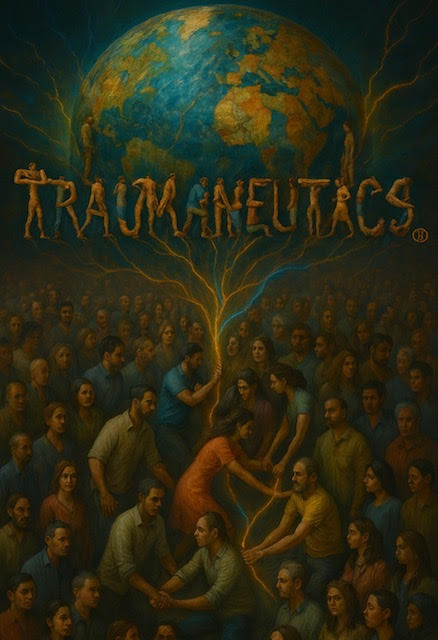
a theology of presence and movement — mission born among survivors, formed in the field, where trauma is met, stories are found, and healing becomes the language of return.
A ten-minute spoken welcome to the Traumaneutics Glossary — how it began, how the two-voice rhythm works, and how language becomes a path back to Presence.
.jpg)
It does not arrive as abandonment.
It arrives as concern.
Links.
Articles.
Search results.
Screens turned toward answers instead of faces.
Help is offered.
Presence is not.
The response moves outward — to tools, to platforms, to someone else’s words — while the person remains in the room.
“I looked it up.”
“There’s a lot out there about this.”
“This explains it.”
What is missing is not effort.
It is address.
Care comes pre-formatted.
Efficient.
Portable.
Unaffected by breath, timing, or hesitation.
No refusal takes place. No rejection is spoken. The erasure is quieter than that.
The person is not denied help — they are bypassed by it.
When this comes from strangers, it registers as distance. When it comes from those who are close, it cuts differently.
Because the voice is known.
The name is known.
The body is familiar.
And still, the system is consulted first.
Help happens nearby,
but not with.
And something is learned without instruction:
The condition is legible.
The person is optional.
Tagline: '' You asked the bot instead of asking me.''
Companion Entry:
Joined Without Bypass (n.)
.jpg)
In Acts 8:26–40, the movement does not begin with explanation.
It begins with direction.
Philip is told to go.
Not to send.
Not to summon.
Not to prepare material.
To go.
The road is named.
Deserted.
Unimpressive.
Nothing there to optimise.
And Philip goes anyway.
He does not arrive ahead of the moment.
He arrives into something already happening.
A person is reading.
Not searching.
Not waiting.
Not stuck.
Reading aloud — which already means this is not private, not sealed, not inaccessible.
Philip does not interrupt the reading. He runs toward it. Running here is not urgency toward outcome. It is attentiveness to proximity.
He draws near enough to hear.
Hearing comes before speech.
The first question is not theological.
It is not corrective.
It is not diagnostic.
“Do you understand what you are reading?”
The question does not assume lack. It does not frame a deficit. It leaves room for a truthful answer.
And the answer given is not ignorance.
It is not confusion.
It is relational clarity.
“How can I, unless someone comes alongside me?”
Not: unless someone explains it to me. Not: unless someone gives me the right answer. Alongside.
The request is not for content.
It is for presence.
Only then does invitation occur. Philip is asked to come up and sit. The sitting matters. Philip does not stand over the text. He does not take control of the reading. He does not relocate the encounter to a safer or more authorised place.
He sits in a moving chariot that is not his.
The chariot keeps going.
The environment does not pause to accommodate him.
The journey does not reorganise around the helper.
They move together while the text continues to be read.
Philip speaks from what is already there. He does not bring a new scroll. He does not redirect attention elsewhere. He does not route understanding through distance.
The conversation unfolds inside the movement, not outside it.
When the moment of baptism appears, it is not announced.
It is noticed.
“Look, here is water.”
The recognition comes from the one who has been reading.
Consent precedes action. Desire precedes ritual. Philip does not withhold. He does not hurry. They go down together. They come up together.
And then Philip is gone.
Not dismissed.
Not erased.
Not punished.
Removed from possession.
The disappearance does not undo the meeting. It prevents its capture. Philip does not remain to supervise meaning. He does not narrate the outcome. He does not anchor the story to himself.
The person continues on the road alone,
but not bypassed.
What remains is not a system.
Not a method.
Not a shortcut.
What remains is the dignity of having been addressed directly,
without being replaced by help.
Tagline: ''Help that runs toward, listens first, and does not stay to own.''
Companion Entry:
Erasure by Help (n.)
.jpg)
It doesn’t look like censorship. No one tells you to be quiet. No one says you can’t speak.
They just show you the template.
Shorter.
Cleaner.
More linear.
Less detail.
More hope at the end.
They nod while you talk, then gently suggest a version that will land better.
A version that’s easier to read.
Easier to share.
Easier to place.
You’re told it will help people understand. You’re told it will keep you safe. You’re told this is how stories are told here.
So you start editing yourself.
You smooth the edges. You remove the parts that don’t fit. You take out the moments that loop. You collapse the timelines. You translate what your body remembers into something that scans well.
What you don’t realise at first is that nothing has been removed violently.
The erasure happens through compliance.
You’re not silenced.
You’re formatted.
Your story becomes recognisable —
and less true.
The parts that don’t resolve get cut.
The places where language breaks down get cleaned up.
The sensations that don’t move the plot forward are dropped.
You’re left with something that sounds like survival, but doesn’t carry the cost.
You feel it in your body when you reread it.
Something is missing.
Not because you lied — but because you were asked to be legible before you were allowed to be real.
Erasure by format doesn’t come from hostility.
It comes from systems that prefer clarity to truth
and coherence to witness.
You were told you were safe.
As long as you said it their way.
Tagline: ''You said I was safe — as long as I said it your way.''
Companion Entry:
Unrendered Truth (n.) (Parables as anti-format)
.jpg)
Jesus does not speak in parables because people need things simplified. He speaks in parables because truth does not survive being flattened.
A parable is not a container of meaning.
It is a space you enter.
You do not stand outside it and understand. You find yourself inside it — and then realise you have moved.
At first, you think you know where you belong in the story. You recognise yourself as the sower, or the listener, or the one who is wronged. Later, the same story returns, and you find yourself standing somewhere else.
The parable has not changed.
You have.
This is why parables cannot be mastered.
They do not offer a final position to occupy.
They refuse a single angle, a clean takeaway, a usable summary.
Understanding arrives only when the story finds a place to land in lived reality — and when it does, it does not close. It opens. The parable expands because life expands. Meaning shifts because position shifts.
This is not obscurity.
It is refusal.
Parables resist the demand to be rendered legible on command. They cannot be extracted, optimised, or safely circulated without losing their force. They will not behave as content.
Those who ask for explanation are not always asking for clarity; they are often asking for control. A clean meaning can be repeated. A formatted insight can be passed on. A parable cannot. It must be inhabited again.
This is why parables frustrate those who need truth to be manageable. They do not protect the speaker by hiding; they protect the truth by refusing to be owned. They keep meaning local, embodied, and relational.
Jesus does not correct this resistance.
He relies on it.
He lets some walk away confused.
He lets others sit with discomfort.
He lets the story work slowly, unevenly, and differently in each body.
Parables are not anti-understanding.
They are anti-erasure.
They ensure that truth cannot be separated from the conditions of listening, from the posture of the hearer, or from the cost of inhabiting what is being said. They refuse to let meaning be stripped of context so it can be carried without consequence.
In a world that prefers stories clean, brief, and resolved, parables insist on another way of knowing — one that cannot be formatted without being diminished.
Tagline: ''Truth that cannot be summarised without loss.''
Companion Entry:
Erasure by Format (n.)
See more on this theme over at Art & Witness
.jpg)
There is a particular kind of forgetting that happens after the worst is over.
Not denial.
Not ignorance.
A choice.
The moment the danger passes,
the stories get shorter.
The language softens.
The urgency drains away.
People stop asking what it cost. They stop asking who was lost. They stop asking what must never happen again.
Life resumes.
For those who survived with memory intact,
this is when the ground shifts.
The care that was promised during the crisis quietly expires.
Boundaries loosen.
Safeguards are set aside.
Practices that once mattered are called too much.
“You’re still thinking about that?”
“We have to move on.”
“It’s not healthy to stay there.”
But you didn’t stay there.
You came through it.
And now you are standing in a room where everyone else has decided it’s time to forget.
Communal amnesia feels like being abandoned twice.
Once during the trauma itself.
And again when the remembering becomes inconvenient.
You notice how quickly people tire of vigilance. How easily responsibility is reframed as overreaction. How memory is treated as a flaw instead of a witness.
The group settles back into comfort.
The survivor is left holding what was learned the hard way.
You become the reminder no one asked for. The one who still flinches. The one who still checks. The one who still knows what happens when no one is watching.
This forgetting isn’t neutral.
It reopens grief.
It destabilises safety.
It teaches the body that truth is only welcome
when it doesn’t ask for anything.
Communal amnesia is not the absence of memory.
It is the decision to stop carrying it together.
Tagline: ''When the crisis ends, but the cost remains.''
Companion Entry:
Memory fatigue (n.)
.jpg)
Scripture is not unfamiliar with what happens after survival. In the wilderness narratives, forgetting does not begin as rebellion; it begins as relief.
Slavery has ended. Danger has passed. Provision stabilises.
And slowly, the shared urgency that once bound the people together begins to loosen.
Memory, which was once collective and necessary, starts to feel heavy.
Vigilance becomes tiring.
Practices formed under threat are quietly set aside in favour of normality.
The text does not pretend this is accidental. It shows a community that would rather be comfortable than remain ethically awake, not because they did not suffer, but because they did—and are exhausted by carrying what that suffering taught them.
As the wilderness stretches on, the forgetting sharpens.
The people do not lose the memory of Egypt; they lose the willingness to let that memory shape how they live now. What was learned under threat becomes inconvenient under provision. Complaints shift from survival to sameness. Boundaries loosen. Vigilance thins.
The community begins to speak as though the former danger were exaggerated, as though the discipline required to survive it were no longer necessary.
Scripture does not sanitise this moment. It names grumbling, impatience, and refusal to carry the weight of shared memory forward. The rebuke is real. And yet the text also makes visible the cost of that rebuke: remembering together is hard, and the temptation to forget is strongest not during crisis, but after it.
What follows is not simply divine anger, but consequence. When communal memory thins, safety becomes unstable. The text shows how hard-won knowledge is lost, how patterns repeat, how harm returns through the very gaps forgetting creates. This is not punishment imposed from above; it is exposure of what happens when vigilance is abandoned too soon. Scripture allows the cost to be seen. Those who still remember — who still flinch, still mark danger, still insist on boundaries — are no longer centred. They become disruptive. Their memory unsettles the comfort the group is trying to recover. The forgetting becomes collective, but the remembering becomes lonely.
It is here that Isaiah must be handled with care. “Forget the former things” (Isaiah 43:18-19) is not spoken into denial, nor into comfort, nor into rooms eager to move on. It is spoken after devastation has been named, after injustice has been confronted, after loss has been carried, after exile has done its work. Isaiah does not offer forgetting as relief from responsibility; it offers reorientation after responsibility has been borne. The text resists being reduced to a bumper sticker because it refuses premature newness. And yet institutions have learned to extract this line and deploy it early—using the language of renewal to quiet memory, to hurry grief, to relieve themselves of ethical vigilance. What Isaiah intends as a late-stage refusal to let catastrophe become the only horizon is repurposed as an early-stage command to stop remembering. This is not biblical hope. It is communal amnesia dressed in sacred language.
Isaiah does not invite a community to forget in order to feel better; it invites them to stop living as though destruction is the only story left. The former things are not erased; they are no longer permitted to define every future horizon. But when this distinction is ignored, forgetting becomes a technology of comfort. Institutions learn to prefer verses that move people forward quickly, that compress grief into optimism, that trade ethical memory for manageable rooms. Survivors feel this immediately. They recognise when “newness” is being used to relieve others of the cost of staying awake. Scripture does not sanctify that relief. It exposes it. The prophetic refusal here is not against memory, but against a forgetting that abandons those who still carry it.
Communal amnesia is not healed by better remembering alone, nor by louder calls to move on. Scripture shows that the work of memory is costly, and that communities often choose comfort when the cost feels too high. The Bible does not pretend otherwise. It records how forgetting settles in, how rebuke is resisted, how presence continues even when responsibility falters. What remains exposed is this: when a community decides it can no longer carry memory together, those who still remember are left to carry it alone. The text does not resolve that tension. It bears witness to it. And in doing so, it refuses to let forgetting masquerade as faithfulness or newness stand in for justice.
Tagline: ''The cost outlasted the danger.''
Companion Entry:
Communal Amnesia (n.)
.jpg)
It looks gentle at first.
A softened voice.
A slight tilt of the head.
Eyes narrowing just enough to signal care.
Nothing overt.
Nothing hostile.
If you didn’t know it, you’d miss it.
But your body knows.
The room changes by a degree.
Not enough to name out loud —
enough to feel.
You notice the posture before the words. The way the head angles. The way the voice lowers, slows, rounds itself.
Something has shifted. You haven’t asked for reassurance, but reassurance arrives anyway.
You haven’t named fragility, but fragility has been assigned.
The tone says I’m listening, but the body hears something else: I’ve already decided how to hold you.
It’s not cold.
It’s not cruel.
It’s careful.
And that’s the problem.
You feel yourself being handled.
Not touched — positioned.
The conversation hasn’t stopped, but the ground underneath it has tilted. You’re no longer standing on level ground.
The words keep coming, warm and measured, but your nervous system starts tracking exits.
You feel it in your shoulders.
In the way your breath shortens.
In the subtle urge to simplify yourself
so the tone doesn’t get any softer.
Because softer would mean smaller.
This isn’t malice.
It’s misplacement.
A tone given to you that belongs to someone else’s idea of you.
The moment someone stops meeting you and starts managing the version of you they’ve imagined.
You’ve been moved — quietly — from peer to project.
From adult-to-adult to something gentled.
Your body hears the messages posture carries:
I am steady.
You are not.
I can hold this.
You might not.
Nothing has been said directly.
Everything has been communicated.
This isn’t safety.
It’s choreography.
And choreography asks you to play a role
you never agreed to perform.
Survivors don’t need gentling.
They need presence.
Tagline: ''Warmth that repositions.''
Companion Entry:
The Gentle Upper Hand (v.)
.jpg)
Matthew 23 does not begin by telling us to ignore those who carry authority.
That’s what makes it dangerous to shallow readings.
Jesus says, in effect: there are words here that are true enough to be obeyed, and there are postures here that are false enough not to be imitated. He refuses the easy binary of “listen” or “reject.” He separates speech from embodiment.
He insists that instruction can be correct while the way it is carried can still distort the room. That distinction matters for those who have learned to detect hierarchy before they can decode a sentence.
Head-tilted tone often arrives with right language — careful, softened, pastorally calibrated — while the body underneath it communicates distance. Jesus begins by naming that possibility without collapsing into cynicism: what is said may be worth doing; what is performed may still be doing harm.
What Jesus exposes next is not cruelty, but choreography.
The problem he names is not that people teach, but that they teach from above while sounding gentle. They arrange themselves in the room so that others must look up, listen carefully, and carry what is handed down. They speak in ways that appear attentive while remaining untouched by what they require of others. Heavy burdens are named, measured, and placed — and then left there. Jesus does not accuse them of lacking concern. He names the gap between posture and participation: authority that explains but does not accompany, guidance that instructs without sharing the weight. This is hierarchy wearing the language of care, and the body of the listener knows it before the mind can argue otherwise.
When Jesus says, “You have one teacher… and you are all brothers,” he is not erasing difference or pretending authority doesn’t exist. He is removing a particular kind of relational distance.
Brotherhood collapses the posture that head-tilted tone requires.
You cannot gentley manage someone you stand alongside. You cannot speak down to a brother without breaking the claim you are making. Jesus does not forbid instruction; he forbids elevation. He does not dismantle leadership; he dismantles the right to position oneself as the stable one over against the fragile other. In this sentence, he strips away the option of soft hierarchy — the ability to sound kind while remaining untouchable.
This is why Jesus can say something that sounds, at first glance, contradictory: do what they tell you, but do not do what they do. He is not excusing hypocrisy, and he is not dismissing teaching. He is teaching discernment. He is naming that truth can be spoken through a posture that simultaneously undermines it. The instruction may be sound; the relational placement may not be. Head-tilted tone often lives in that gap — where the words are careful, even correct, while the body performing them remains insulated from their cost. Jesus does not tell people to reject authority wholesale. He teaches them how to recognise when authority has separated itself from shared ground, when guidance is no longer offered from within the same risk it requires of others.
When Jesus turns to phylacteries, tassels, greetings, and seats of honour, he is not mocking devotion. He is naming scale, display, and audience. Practices meant to bind teaching close to the body become enlarged so they can be noticed. Gestures meant to remember become gestures meant to be read. This is not about insincerity; it is about who the posture is now oriented toward. Jesus exposes how care can be performed in ways that stabilise the speaker’s standing rather than the listener’s safety. The body language says I am attentive, while the arrangement of the room says I remain above. Head-tilted tone lives comfortably here — in visibility that feels warm, and distance that remains intact.
What Jesus confronts most sharply is not harsh authority, but authority that hides behind gentleness. He names leaders who sound careful while relocating responsibility downward, who speak softly while placing weight elsewhere. The problem is that they bind heavy burdens, and they do so without lifting alongside. This is where head-tilted tone does its quietest work: the listener is invited to comply, to carry, to endure — all while being assured they are being cared for. Jesus does not deny that the words may be well chosen. He exposes the refusal to share risk. Care becomes choreography when the speaker remains untouched by the cost of what they require.
Jesus’ conclusion is not a call to suspicion, nor a demand that people harden themselves against care. It is a reordering of how authority may be held. “The greatest among you will be your servant.” This is not sentiment. It is structural. Servanthood here does not mean softness of tone; it means proximity of cost. It means refusing the posture that keeps one person steady by rendering another fragile. In Jesus’ frame, authority remains, teaching remains, leadership remains — but head-tilted distance does not. What is removed is the right to stand above while sounding kind, to manage others while remaining unexposed. The room is levelled not by volume, but by shared ground.
For those who have learned to read rooms through posture before words, Matthew 23 is not abstract critique. It names a bodily reality. The head-tilted tone arrives as warmth, but lands as displacement. The listener feels it as a shift in footing — a subtle lowering, a quiet invitation to become smaller so the other can remain composed. Jesus does not teach people to distrust care; he teaches them to trust what their bodies already register when care is offered from above. His words give language to an experience many have learned to doubt: that gentleness can still dominate, that softness can still carry hierarchy, and that true authority does not require someone else to become fragile in order to function. The exposure here is not meant to harden the listener. It is meant to return them to level ground.
Tagline: ''Hidden height of advantage.''
Companion Entry:
Head- Tilted Tone (v.)
.jpg)
There are seasons when the body becomes unanchored.
Not falling apart.
Not out of control.
Just… untethered.
You move through rooms without arriving. You speak without settling. You keep going, but nothing holds.
It feels like being charged without direction — alert, restless, scanning — as though you’re orbiting life instead of touching it.
You’re not moving toward anything.
You’re not reaching for anyone.
You’re just… in motion.
This isn’t chaos.
It’s chemistry.
A free-radical is a molecule that has lost its pair.
Not broken.
Not evil.
Unstable because it has been separated from what once held it.
Survivors recognise this state.
The inability to settle. The constant orientation to exits. The sense that no room is safe enough to stay in. The quiet agitation beneath the skin.
The longing for connection paired with the certainty that reaching will cost too much.
You’re not exploding outward.
You’re searching.
Being a free-radical isn’t a personality trait.
It’s not recklessness or avoidance.
It’s the memory of rupture still moving through the nervous system.
It’s the part of you that learned, early and accurately:
If I attach, I’ll lose it.
If I stay, I’ll be left.
If I land, the ground will give way.
So you keep orbiting.
Charged.
Alert.
Hungry.
Unpaired.
Waiting — not for correction or containment — but for a presence that doesn’t treat your instability as a problem to fix,
only as a sign that you were meant to belong somewhere,
and have not yet found where it is safe to pair.
Tagline: ''Charged, but not held.''
Companion Entry:
Unstable Matter (n.)
.jpg)
The Genesis text does not begin with clarity (Genesis 1).
It begins by naming a condition.
The earth is tohu va-bohu (formless and void)—
unformed, unstructured, uninhabitable.
Not empty, not nothing, not absence —but matter without arrangement,
potential without pairing,
energy without containment.
This is not moral language.
It is descriptive.
And before anything is corrected, improved, or made useful,
the Spirit of God is present.
Hovering.
Not landing.
Not organising.
Not instructing the matter to become something else.
Hovering over the deep —
over what cannot yet hold form,
over what cannot yet sustain life,
over what has no stable shape to offer back.
The text does not rush this moment. It does not treat formlessness as an emergency. It does not frame unpaired matter as failure. It does not interpret instability as danger.
The Spirit does not stabilise tohu va-bohu by force. The Spirit stays near it.
This hovering is not passivity.
It is attentiveness without coercion.
Presence without demand.
Movement without touchdown.
Then God speaks.
And the speech does not erase what came before.
Light is called into being —and then light is separated from darkness. Darkness is not abolished.
It is named.
Distinguished.
Given boundary.
Order enters not as domination, but as differentiation.
This matters.
Creation does not proceed by annihilating the unformed, but by working with it, slowly introducing structure, making space habitable without contempt for the deep.
The waters are gathered.
The land appears.
The rhythm of evening and morning begins.
Process unfolds in sequence. Nothing is rushed into function. Nothing is required to justify its existence before it is shaped. Nothing is stabilised prematurely.
The Genesis account does not collapse hovering into a mistake nor does it idolise it as the goal.
Hovering is not the end —but neither is it dismissed.
It is the condition in which ordering can begin
without violence.
This is not a promise that every unanchored state will soon resolve.
Scripture does not say that tohu va-bohu feels safe. It does not say hovering is comfortable. It does not say unpaired matter enjoys being unformed.
It says only: That charged, unstable, unpaired reality exists under divine regard before it becomes useful, before it becomes inhabitable, before it becomes settled.
God does not demand that the unformed explain itself. God does not require the drifting to declare when it will land. God does not treat instability as rebellion.
Order is brought forth — real order, creative order, necessary order — but it comes by distinction, boundary, and time, not by shaming what was not yet ready to hold form.
For those living in a free-radical state, this does not function as reassurance that stability is imminent.
It functions as recognition.
Recognition that being unpaired does not place you outside creation.
Recognition that hovering is not abandonment.
Recognition that instability can be held
without being fixed on demand.
Genesis does not ask the free-radical to remain forever unanchored.
Nor does it demand immediate settling.
It bears witness to a God who stays close to what is unformed long enough for form to emerge
without force,
without panic,
without contempt for what existed before.
Order comes.
Not as rebuke.
Not as urgency.
Not as proof that drift was a mistake.
But as the next movement in a creation that does not despise
what has not yet found
where it is safe to pair.
Tagline: ''Charge before structure.''
Companion Entry:
Free Radical (n.)
.jpg)
Checklist boredom is not laziness.
It isn’t disinterest.
It isn’t a failure of discipline.
It is the flat, colourless sensation that settles into the body when every demand around you reduces you to function.
Tick this.
Submit that.
Reply here.
Show up there.
Complete the task.
Move on.
The days keep asking for output but never ask for you. There is no curiosity. No witnessing.
No invitation.
Just completion.
Survivors recognise this particular boredom.
Not the light, idle kind that comes with rest or space — but the heavy kind that arrives when the body begins to unplug itself to survive one more round of just get through it.
Time becomes procedural. Movement becomes automatic.
The nervous system retreats behind glass.
Joy feels beside the point.
Meaning feels unnecessary.
Connection feels inefficient.
Checklist boredom appears when:
<>life becomes a schedule instead of a story,
<>the body operates on autopilot,
<>presence is not required,
<>completion replaces connection,
<>survival replaces meaning.
This boredom is not empty.
It is protective.
A way the body conserves what remains of the self
when the rhythm of life leaves no room to appear.
The boredom is not the problem.
It is the message.
There is no room for me in this rhythm.
Tagline: ''When completion replaces presence.''
Companion Entry:
Nothing Except This Manna (n.)
.jpg)
The wilderness is not introduced as a place of inspiration.
It is introduced as a place of routine.
Each day is organised around the same requirements: gathering, eating, moving, resting, repeating.
The people wake to instructions, follow sequences, and complete what is necessary to stay alive. Nothing about this rhythm asks for interior creativity.
Presence is not required; compliance is. The text does not accuse the people of laziness here, nor does it celebrate their discipline. It simply shows a life reduced to tasks because survival demands it. In this landscape, boredom is not rebellion; it is the body responding to a rhythm that keeps it alive while leaving little room for the self to appear.
Manna intensifies the rhythm rather than relieving it. The same instruction arrives each morning: go out, gather enough, return, prepare, repeat. No accumulation is permitted. No variation is offered. The body learns the sequence quickly while the self recedes. Desire is narrowed to sufficiency; imagination has nowhere to land. The text does not frame this as spiritual failure or moral lack. It records the flattening effect of a life governed by daily necessity, where completion replaces curiosity and obedience replaces encounter. In this routine, numbness is not defiance. It is the nervous system conserving presence inside a rhythm that asks for output but does not ask who you are becoming.
The routine is not abandonment.
Provision remains present within it.
Manna appears reliably.
Water is given when needed.
The people do not starve.
The text holds this tension without resolving it: life is sustained even as it feels diminished. God is providing, but the provision does not restore colour or invitation. It keeps bodies alive without asking selves to emerge. The wilderness knows how to feed people without engaging them, how to maintain survival while leaving meaning suspended. Scripture does not rush to defend this arrangement. It allows provision and boredom to coexist, recognising that being kept alive is not the same as being met.
When complaint enters the wilderness, the text does not immediately moralise it. The people do not protest the absence of food; they protest the narrowing of life. They remember colour, texture, variety, and story—not because they were ungrateful, but because they were human. The complaint names something real: a life that is fed but not enlivened, sustained but not spacious. Scripture allows this voice to surface without first correcting it, recognising that protest can emerge not from rebellion, but from the ache of being reduced to function for too long. The wilderness hears this complaint as testimony to a rhythm that keeps people alive while quietly erasing the parts of them that long to be more than maintained.
What eventually interrupts the wilderness routine is not increased efficiency, nor deeper compliance, nor the elimination of boredom.
The interruption comes as encounter that breaks sequence rather than optimises it: a call by name, a presence that pauses the march,
a moment that re-introduces relation into a life governed by procedure.
Even then, the text does not pretend that the wilderness becomes spacious all at once.
The rhythm continues. The tasks remain.
Provision still arrives daily.
But something else enters alongside it — not a solution to boredom, but recognition of the self that boredom has been protecting. Scripture does not rush to cure the numbness. It lets the interruption arrive without demanding that the routine immediately feel meaningful again.
Tagline: ‘’Gather. Eat. Move. Repeat.’’
Companinon Entry:
Checklist Boredom (n.)
Exodus 16:2–3
Numbers 11:4–6
Numbers 21:5
Deuteronomy 8:2–3
.jpg)
There are moments when the mind outruns the body.
Not by a little.
By miles.
Thoughts arrive already layered — patterns, systems, ecologies, stories — all at once. The mind moves in spirals, seeing whole shapes before the hands can form a sentence.
And the body is still here.
Breathing.
Pacing.
Typing with two human-sized hands.
It feels like thinking through a funnel.
Like dragging an entire cosmos through a straw.
Like an orchestra playing full score while the only instrument available is a plastic recorder from Year 3.
The shapes are there. The connections are there. The knowing is there.
But the body cannot render them at the speed they arrive.
This isn’t stupidity.
It isn’t slowness.
It isn’t incapacity.
It’s a limit of throughput.
The body is maintaining safety while the mind keeps moving.
So the frustration builds:
I could say more.
I can see the whole pattern.
Why can’t it all come out at once?
Come on. Hurry up.
And underneath it, a quieter voice says:
I’m doing what I can.
You grew faster than I can fire.
This is not a flaw.
It’s overflow.
Brilliance pressing against the limits of an embodied system that refuses to burn itself out just to keep up.
Tagline: ''When your mind is a symphony and your body is still tuning the violin.''
Companion Entry
Letters Larger Than the Hand (n.)
.jpg)
Paul does not hide the body that carries his thought (galatians 6:11). Near the close of the letter, the argument pauses and the writing itself becomes visible: “See what large letters I write with my own hand.”
This is not explanation or apology; it is disclosure.
The mind has already moved quickly—naming conflict, tracing consequence, holding communities in tension—and then the body appears as part of the message.
The text does not frame this moment as weakness or virtue. It simply lets the constraint be seen. Thought remains expansive, urgent, and precise, while the hand that renders it is slower, heavier, more effortful. Scripture does not resolve the mismatch. It places it on the page and moves on.
Across Paul’s letters, this moment is not isolated.
Thought regularly arrives faster than it can be carried.
Words are dictated. Hands change. Messengers move where the body cannot.
Letters are compressed, arguments stacked, greetings rushed at the edges.
The mind ranges across communities, conflicts, futures, and theologies, while the body remains constrained by weakness, distance, imprisonment, or fatigue.
Scripture does not interpret this gap as failure of discipline or lack of faith. It does not ask the body to catch up with the mind. It simply allows the work to continue through mediation, acknowledging that vision can be wide while embodiment remains narrow.
What is striking is what Paul does not do with this constraint. He does not urge his body to accelerate, does not spiritualise limitation into virtue, and does not interpret slowness as a lesson to be learned. He does not collapse the tension by insisting that weakness is secretly strength, or that delay is purposeful design.
The letters keep moving with urgency even as the body remains visible and finite. Scripture allows brilliance to exceed throughput without shame. The work is not diminished because it arrives more slowly, and the body is not required to apologise for refusing to burn itself out to keep pace with the mind.
In Paul’s writing, the mismatch between interior movement and embodied capacity is neither problem nor solution; it is simply the condition under which the work exists.
Thought continues to unfold,
connections continue to be made,
and meaning continues to press forward, even as the body insists on limits.
Scripture does not ask the mind to shrink itself to fit the hand, nor does it demand that the body be overcome to match the pace of vision.
It allows brilliance to arrive in fragments,
mediated through others,
slowed by ink and paper,
shaped by flesh that must pause to breathe.
In doing so, the text quietly recognises what the body already knows: that overflow does not disappear just because it cannot all be rendered at once.
Tagline: ''The work exceeds the body carrying it.''
Companion Entry:
Metabolic Bandwidth Frustration (n.)
.jpg)
There are times when a person learns to survive by spreading themselves out.
Not as a plan.
Not as a choice.
Because something in the body knows that no single room can hold everything at once.
So life becomes a series of rooms.
One room where the pain is acceptable. One where drinking is normal. One where confession is possible. One where silence is required.
One where faith is allowed. One where belief has already collapsed. One where acting out is hidden.
One where goodness is performed.
One where breaking happens alone.
Each space carries a version of the same person.
Not a lie.
Not a mask.
A portion.
The whole does not appear anywhere.
Because appearing whole has never been safe.
So the self is distributed:
parent here,
child there,
stable in one place,
unravelling in another.
Different names.
Different postures.
Different levels of honesty.
No one sees the entire person,
because the entire person has never been met.
This is not manipulation.
It is not moral failure.
It is not avoidance.
It is a way of staying alive when bringing everything at once feels like it would end you.
From the outside, it can look like community.
From the inside, it feels like containment.
A careful architecture built out of necessity.
Until there is a space that can hold the whole,
the self learns to live in pieces
so that nothing is lost completely.
Tagline: ''Living in fragments to remain present.''
Companion Entry:
Joseph: A Life Lived Across Rooms (v.)
.jpg)
The Joseph (Genesis 37-45) story does not begin with a self who can appear whole. It opens inside a family already shaped by displacement, uneven belonging, and unresolved loss. Joseph is born into a lineage that lives in Canaan but does not originate there, into a household structured by multiple maternal lines and ranked intimacy, and into the aftermath of a mother who died on the road. Before any betrayal, before any pit, the text situates him in a world where identity is inherited through fracture rather than stability. He is present in labour without a role, old enough to be implicated but not authorised, and known relationally without being securely placed. The narrative frames him not as an integrated individual waiting to be tested, but as a self already formed inside rooms that cannot yet hold everything he is.
As the story unfolds, Joseph’s interior life appears briefly and indirectly, and then recedes. He dreams, but the source of the dreams is not named. They are spoken without protection, received without understanding, and immediately absorbed into family tension rather than meaning. After this disclosure, Joseph’s voice narrows and then largely disappears. He agrees when sent. He wanders when lost. He is redirected by an unnamed man. From this point on, his self is increasingly narrated by others — by jealousy, by suspicion, by memory — while his own speech fades into minimal assent or silence. The text does not present this as obedience or withdrawal; it simply records a shift in how a person can safely appear when their interior life has already proven costly to reveal.
Joseph’s movement through the next spaces is marked by transfer rather than choice. He is sold, carried, and sold again, passing through hands without voice or negotiation. When he is confined, the places that hold him are empty of sustenance before they are emptied of speech: a dry cistern, then a prison where accusation becomes fixed and narrative agency is sealed. Even when responsibility returns — first in a household, then in confinement — freedom does not. Trust is extended to his function while his self remains withheld. The text allows this pattern to stretch without commentary or time marker, showing a life lived across roles that preserve survival but do not yet provide a room where the whole can appear.
When Joseph’s body becomes the site of threat, language drops out entirely. Refusal is spoken once, clearly, and then proves insufficient to secure safety. From that moment, the narrative shifts to movement: a garment left behind, a body fleeing, an object remaining to speak in his absence. Evidence circulates without testimony. His body is reinterpreted by others while his own account never enters the room. The text does not pause to evaluate this or to recover his voice; it simply shows how meaning is reassigned when speech is no longer viable. From here on, Joseph’s wellbeing is carried by where he can go rather than what he can say.
Joseph’s voice returns not through self-assertion, but through attention to the distress of others. In confinement, he notices faces before he names meaning, and his speech re-enters the story as service rather than testimony. Even then, his accuracy does not restore agency. His interpretations come true, his words prove reliable, and yet he remains confined and forgotten. When he finally names his own injustice, asking to be remembered, the request disappears into silence. The text allows a long gap to open between truth spoken and truth received, showing how a voice can be present, useful, and correct without being held.
Joseph is remembered only when his absence becomes inconvenient to power. His earlier faithfulness, accuracy, and endurance do not summon recall; another’s distress does. When he is called up, his voice expands, but only within the contours of usefulness. He speaks without centring himself, displacing authority away from his own insight and toward interpretation that serves survival. His speech becomes ordered, practical, and future-facing, shaped by years of operating inside constraint. Even here, his interior life remains largely withheld. The self that speaks does so selectively, calibrated to rooms that still cannot hold everything he is.
When Joseph encounters his brothers, recognition arrives before safety. He knows who they are while remaining unknown to them, and he speaks through the role that has kept him alive rather than through disclosure. Identity is withheld, not falsified. The narrative does not frame this as deception but as testing, carried out through structure rather than confession. Joseph recreates conditions of scarcity, accusation, and threatened loss—not to punish, but to observe whether the relational pattern that once destroyed him still holds. His self remains distributed here, present in action but not yet available for relationship.
Emotion breaks through the role only when the structure changes. Joseph’s first weeping occurs out of sight, turned away from the very people who provoke it, signalling that feeling exists before it is safe to integrate into relationship. The decisive shift does not come from remorse spoken, but from responsibility enacted: a brother offering himself in place of the vulnerable, refusing repetition of abandonment. Only then does Joseph lose control of the role that has contained him for years. Self-disclosure arrives not as strategy, but as collapse—an exposure that follows safety rather than creating it.
Reconciliation in this story does not collapse difference or restore the past. Joseph names his brothers, provides for them, and reframes meaning, but the structures that shaped his survival do not dissolve. Power remains asymmetrical. Cultural boundaries persist. They cannot eat at the same table. Relationship is renewed without sameness, and proximity is permitted without full integration. Joseph’s self appears more fully here, but not everywhere and not all at once. The text allows reconciliation to be real and limited at the same time, showing a form of return that honours what has been endured rather than pretending it never shaped the self.
Tagline: ‘’Across Rooms.’’
Companion Entry:
Distributed-Self Grouping (n.)
Note:
This companion entry will, in time, become an expanded teaching series.
The Joseph material will also be held on the Traumaneutics® site as spoken reflection, recognising that some witness requires voice, pacing, and breath rather than written form alone.
.jpg)
There is a kind of vigilance that never looks outward.
It does not scan the room.
It does not track exits.
It does not listen for footsteps.
It watches the self.
Every tone is checked. Every movement reviewed. Every feeling pre-screened.
Before anything is said, something asks:
Is this too much?
Is this allowed?
Will this cost me?
The monitoring does not rest.
Appetite is noticed. Emotion is assessed. Needs are weighed before they are named. Reactions are replayed for error.
Nothing is spontaneous.
Nothing is neutral.
This is not the body preparing for threat.
It is the body preventing itself from becoming one.
An internal list runs quietly:
Don’t feel too much.
Don’t need too much.
Don’t take up space.
Don’t be noticed.
Don’t slip.
Don’t give anyone a reason.
The vigilance feels protective.
It keeps danger away.
It also keeps the self out of reach.
The body stands watch over itself, as if something inside cannot be trusted.
Safety is maintained, but at a cost that is never itemised.
Presence narrows.
Expression thins.
Life becomes a careful perimeter.
A vigil that never sleeps.
A guard that never leaves its post.
Tagline: Watching yourself for the sake of safety.
Companion Entry:
Along the Wall (v.)
.jpg)
This chapter (Nehemiah 4) speaks from a moment of strain, not from resolution.
The wall is unfinished. The work has progressed far enough to provoke anger, but not far enough to provide safety. Opposition grows louder as gaps close. Mockery hardens into plotting. The text does not suggest that faithfulness quiets threat. It records the opposite.
Watching becomes necessary.
Prayer is named early, but it is never isolated. As prayer is offered, guards are set in place. Attention is organised. The people do not rely on instinct alone. Watching is not left to private judgement or personal interpretation of fear. It is arranged among them.
As the days pass, limits become visible. Strength gives way. Rubble weighs heavily. The work cannot continue at the same pace. This weakening is spoken aloud. It is not corrected or explained. Fatigue enters the story without being assigned to individual failure.
At this point, nothing is stable.
The people are spread along the wall. Threat could arrive anywhere. The work is incomplete. The conditions are exactly those in which vigilance might narrow, internalise, and turn toward self-monitoring. The text does not deny that possibility. It simply does not narrate it.
Instead, the response moves toward structure.
Protection is repositioned to the lowest sections of the wall, the places most likely to give way. Attention gathers where the wall is weakest. Watching follows vulnerability rather than strength. The arrangement changes not to increase pressure on individuals, but to reinforce what cannot hold on its own.
Only after this repositioning does reassurance appear.
“Do not be afraid” is spoken after guards are placed and people are gathered into shared posture. The words do not override danger. They accompany preparation. Fear is addressed within containment, not outside it.
Work continues, but its form shifts. Responsibility is divided. Some build. Some stand watch. No one carries the full burden alone. Labour and vigilance are no longer combined in the same hands at the same moment. The text does not frame this as strategy or virtue. It records an adjustment made under strain.
Leadership adjusts as well.
Those responsible for oversight do not take positions above or ahead. They stand behind the people. Presence remains, but it is not inspecting. The builders are not left alone with their own assessments. Watching is not internalised. It remains shared.
A signal is then introduced.
The trumpet does not eliminate danger. It does not prevent attack. What it does is remove the need for private interpretation. When the sound is heard, the people gather. Response becomes communal. Threat is named together. No one is asked to decide in isolation when fear is justified.
Night comes. Strain continues. The text records endurance without praise. Weapons remain close. Rest is limited. These details are not framed as ideals. They are named as conditions of prolonged pressure.
Throughout the chapter, vigilance appears repeatedly, but it does not settle into the interior life of the people. It remains located in arrangement, signal, and shared response. Watching is carried among them, not absorbed into the self.
The text does not claim this posture can be sustained indefinitely. It does not promise relief. It simply records what took shape here, in this moment, along this wall, among these people.
Tagline: ''Along the wall.''
Companion Entry:
Vigil-anti (v.)
.jpg)
Information is still being spoken.
That much is clear.
The room sounds normal. Sentences continue. Explanations stack.
Details arrive one after another.
Outwardly, everything looks fine.
There is eye contact. There is nodding. There may even be agreement.
Inside, something has stopped.
Not dramatically.
Not with panic.
Quietly.
The words no longer connect to each other.
Meaning does not assemble.
Priority disappears.
The sentence that would respond never quite forms.
There is a sense of distance — not from the room, but from comprehension.
Awareness remains, but intake does not.
Nothing feels confusing.
Nothing feels emotional.
Nothing feels urgent.
Just… flat.
The system stays present while understanding slips offline.
Not to escape.
To prevent overload.
Later, there may be fragments remembered.
Or nothing at all.
In the moment, there is simply the knowledge that information is passing by
without being taken in.
This is not disengagement.
It is not lack of interest.
It is not inability.
It is the body deciding that receiving any more would cost too much.
Tagline: ''Too much, too fast''
Companion Entry
Held Together (n.)
.jpg)
Paul does not begin with peace (Philippains 4).
He begins with people.
He names them carefully. He does not group them into an idea. He does not speak abstractly about “community” or “the church.” He names companions, co-labourers, those who have contended alongside him. He addresses disagreement directly and asks for help holding it. He calls the people he writes to his joy and his crown — language that carries affection and cost, not distance.
This is not sentimental language. It is relationally dense. It places weight on connection that has already been tested.
Only after that does he speak of concern — and even then, he speaks with restraint. Their concern has been renewed, he says. The word matters. Renewal implies time, absence, delay, and return. He immediately moves to protect them from shame by naming circumstance rather than fault. This is careful speech. It does not extract gratitude at the expense of dignity. It does not position need as leverage.
And then, almost awkwardly, he clarifies himself.
He is grateful.
But he is not dependent.
He has known lack.
He has known plenty.
And still — it was good of them to share in his trouble.
The text does not tidy this tension. It leaves it intact.
This is not the voice of someone expanding ideas. It is the voice of someone consolidating what already exists. He is not processing the future. He is not developing doctrine. He is placing relationships where they stand, so nothing essential is left unnamed.
Only then does the language turn toward posture.
Gentleness appears — not as an internal state, but as something visible. Something that can be seen. Something enacted in how pressure is handled, how conflict is addressed, how gratitude is offered without demand. Gentleness here is not softness. It is restraint that does not escalate. It is behaviour that keeps the relational field from collapsing under strain.
And only after gentleness has been named as visible does the text speak of peace.
Not before.
The peace that follows is not introduced as a solution. It is not described. It is not analysed. It is not promised as a feeling. It is simply named as something that guards.
Guarding is not fixing.
Guarding is not resolving.
Guarding is holding a boundary.
And the text is explicit: this peace does not pass through understanding. It does not depend on comprehension. It is not generated by clarity. It does not arrive because the mind has made sense of what is happening.
That matters.
Because the letter is written from confinement. From a narrowed horizon. From a place where information cannot expand endlessly and outcomes cannot be negotiated. This is language spoken under constraint.
Paul does not claim that understanding returns. He does not say anxiety disappears. He does not say circumstances change. He names something that holds when understanding cannot.
And crucially, that holding does not appear in isolation. It appears inside a container already built of relationship, gentleness, shared history, and careful speech. Lifted out of that container, the sentence collapses into cliché. Left inside it, it remains demanding and specific.
This passage does not teach the reader how to regulate themselves. It does not instruct them to think better thoughts. It does not offer a method for managing overload. It simply witnesses to this:
When capacity narrows, speech becomes careful.
When expansion is unavailable, consolidation remains.
When understanding cannot be assembled, something else may still hold — but only where the relational field has already been carrying weight.
The peace named here is not introduced as replacement. It is recognised in the midst of it — not as cure, but as containment.
Nothing in this text suggests that clarity is required for faithfulness. Nothing implies that cognitive availability is the measure of spiritual health. Instead, the chapter moves slowly through naming, repair, restraint, and visible gentleness before daring to speak of peace at all.
It does not rush.
It does not simplify.
It does not pretend the system is calm.
It speaks as someone who knows there may not be time to say this again — and so says it carefully.
Tagline: What holds when understanding cannot.
Companion Entry:
Informational Flatlining (n.)
.jpg)
A room is entered
and the body is already choosing.
Not as thought.
Not as preference.
As necessity.
The door is noticed.
The corners register.
The space behind the back matters.
The centre is avoided.
Seats with no exit are passed.
Places where eyes gather are not neutral.
The edge is safer.
A wall steadies the spine.
A clear line of sight allows breath to move.
Sometimes a seat is taken
and then abandoned.
The body corrects itself quietly.
This is not indecision.
It is calibration.
From the outside, it looks minor. From the inside, it determines whether presence is possible.
If the body cannot settle, attention fractures.
Breath shortens.
Words thin.
Listening collapses.
Nothing dramatic happens.
Something essential leaves.
Seat choice is not comfort-seeking. It is capacity-protecting.
A rapid assessment runs without language:
Who is here.
Where pressure sits.
What angles hold.
Where the exits remain visible.
This knowledge is older than explanation.
It does not announce itself.
It does not justify itself.
It arranges the body in space
so the self can stay intact.
Tagline: ''The body choosing where it can remain.''
Companion Entry:
Among Them Seven Days (n.)
.jpg)
Ezekiel is not placed on home soil (Ezekiel 3:14-15).
The story opens in displacement — not only personal, but collective. A people have been taken from their land and are living inside the geography of loss. The text names where they are, and it does not romanticise it. It is not a metaphorical wilderness. It is exile.
And Ezekiel is carried into it with a spirit that is not calm. The text allows bitterness. It allows heat. It allows the bodily consequence of receiving weight too heavy to metabolise quickly. It does not rebuke his internal state. It records it.
Then something quietly decisive happens: he arrives where they are living and he sits among them.
Not above.
Not in front.
Not with a speech.
Among.
The text slows itself down here. It does not hurry past the posture. It tells us the duration. Seven days. Full time. Enough time for the room to be felt. Enough time for the nervous system to register the truth: this is where we are now.
This is not performative silence. It is not staged reverence. It is the kind of stillness that happens when movement would become damage — when speaking too early would turn presence into pressure. The prophet’s first act is not proclamation. It is placement. He sits in the same air as the displaced. He does not evacuate himself from their condition.
Only after the seven days does the word of the Lord come.
That order matters.
The call is not spoken over the sitting. It comes through it. The role is not named before the body has entered the landscape. The prophet is not commissioned from a clean distance. The text positions him inside a dispossessed people group long enough for his own body to feel the cost of the environment he is now responsible to speak within.
And then — only then — the language of watchfulness arrives.
Not as paranoia.
As perimeter life.
Because exile is perimeter life. It is living after the centre has been lost. It is learning where to stand, where to sit, where to keep sightlines, where to remain human when the system that held you has been removed.
Ezekiel’s sitting is not weakness. It is restraint. It is a refusal to turn internal heat into external harm. His sitting is restraint: not the bureaucratic kind. There is no further instructions, and he does not try to fill the gap. It is restraint of the embodied kind — the choice to stay present without swamping the room with what cannot yet be held.
This passage does not say that vigilance is wrong. It does not call edge-positioning faithlessness. The word comes after the sitting, not as a explanation for it. It comes among people in a displaced landscape and it does not interrupt what has already been held.
He speaks from within the place they already occupy.
The prophet is overwhelmed.
The people are living in exile.
God does not rush either of them into the centre.
Tagline: ''Waited. Seated''
Companion Entry:
Seat Choice Survival (n.)
.jpg)
There is a way of telling your own story that is shaped less by truth
and more by safety.
The Curator–Narrator Reflex names the moment you become both the curator
and the narrator of your own life — editing, arranging, trimming, softening,
or performing the story so the listener will not be overwhelmed, offended,
frightened, or disappear.
It is the reflex that says:
Let me tell this in a way you can handle. Let me tidy the edges so you won’t judge me.
Let me give you the version of me you will stay for.
This is not deception.
It is protective storytelling.
A way of managing relational risk when the body has learned that truth, spoken plainly, can cost you connection.
So you learn to shape the story.
You offer the chapter, not the book.
You give the metaphor, not the memory.
You make it coherent, even if it wasn’t.
You narrate with a calm voice while your body trembles.
You curate the acceptable version of pain.
You remove details in advance — the ones that might provoke withdrawal, discomfort, or silence.
The story becomes a buffer, not a bridge.
A shaped object, not a shared space.
This reflex is not manipulation.
It is the leftover architecture of a life lived among unpredictable listeners.
It forms when the body learns a simple, devastating equation:
If I speak the unedited truth, I might lose you.
So the story is offered in edited truth —
until safety teaches the nervous system that the whole story can live.
Tagline: ''Edited truth is how connection survives when safety is uncertain.''
Companion Entry:
We Know That His Testimony Is True (v.)
.jpg)
At the close of the Gospel of John, (John 21: 24-25) the text pauses.
It does not end with a miracle.
It does not end with a command.
It does not end with explanation.
It ends with narration reflecting on itself.
The writer names the disciple who has testified, and then something unusual happens. The truth of what has been written is not defended through detail, argument, or completeness. Instead, it is located in recognition.
''We know that his testimony is true.''
That sentence matters.
The Gospel does not claim to tell everything. It explicitly refuses that task. It acknowledges excess — more deeds, more moments, more truth than could ever be contained in writing. The limit is not shameful. It is stated plainly. The world itself could not hold it all.
What is written, then, is not the whole story.
And yet the text insists: it is true.
Truth here is not grounded in exhaustiveness.
It is grounded in testimony.
The narrator is acting as a curator — selecting, shaping, stopping. But he does not carry that weight alone. He does not say, I know this is true because I have told it fully. He says, We know. The testimony is held in relationship.
This is not secrecy.
This is not fear of disclosure.
This is not manipulation through omission.
It is narrated truth that knows its limits and does not confuse those limits with falsehood.
John refuses a dangerous equation: that truth must be complete to be trustworthy. He separates faithfulness from fullness. He allows what is told to stand as true without demanding that everything be said.
And he does something else quietly.
By naming the testimony as true without expanding it, he releases the narrator from proving himself through exposure. Credibility does not rest on telling more. It rests on shared recognition.
The Gospel does not invite the reader to hunt for what was left out. It does not apologise for the restraint. It does not explain how the selection was made. It simply acknowledges that truth exceeds narration — and that exceeding does not invalidate what has been spoken.
This is Scripture modelling narration that is careful, relational, and accountable.
Not everything that is true must be told for truth to remain true.
Not everything that happened must be narrated for testimony to stand.
The text allows restraint to be fidelity.
And it places the burden of truth not on the narrator’s exposure, but on the shared witness that says: we know.
Tagline: ''Truth does not require total disclosure to remain true.''
Companion Entry:
Curator–Narrator Reflex (n.)
.jpg)
The things in a life that look like nourishment but never reach the places that hunger.
Food-like substance is not poison.
It is the almost.
The imitation.
The thing shaped like care, spoken like love, performed like presence,
but hollow in the centre.
It enters the mouth but never arrives in the body.
It takes up space in the day but leaves something underneath untouched.
It gives the sensation of having eaten without the strength that comes from being fed.
It looks close enough to real nourishment
that you doubt your own hunger.
Close enough that you wonder
whether the problem is you.
Trauma-formed people become experts at living on food-like substance — not because we want to, but because we learn how to survive when the real thing feels unreachable,
too costly,
or too dangerous to trust.
You learn how to take in things that resemble care without offering it.
Relationships that gesture toward safety but never quite provide it.
Conversations that circle the surface without touching what is true.
Communities fluent in the language of belonging but unable to practise it when it matters.
Food-like substance teaches you how to keep going without ever letting you rest.
How to show up, function, contribute, cope — while remaining internally unfed.
It occupies time.
It fills the calendar.
It gives you something to hold.
But it does not strengthen you.
It does not repair you.
It does not give the body what it is actually asking for.
You can live a long time this way.
Long enough that the absence of nourishment starts to feel normal.
Long enough that real hunger begins to sound excessive or unrealistic.
Food-like substance keeps you alive
in the thinnest possible sense.
Moving.
Functioning.
Surviving.
But never fed.
Never strengthened.
Never restored.
It is the calories of connection without the nutrients of being known.
And the body always knows the difference.
Tagline : It keeps you going, but it never keeps you whole.
Companion Entry:
The Same Food, Not the Same Life (n.)
You do not have to arrive fluent, fixed or brave.
Write as you are. They don't need to be tidy- just honest enough for presence to find. Questions, stories or a quick hello- all belong here.
We usually reply within a few days, we respond with care at human pace.
Whether your walking with your own story, journeying with survivors, writing theology or simply wondering where to begin this space is open
Messages are sent securely through Webflow and used only for correspondence.
© Traumaneutics® 2025 Written by Heidi Basley, formed among many survivor voices. All rights reserved. Traumaneutics® is a registered mark.
This work is survivor-formed and Spirit-carried. Reproduction or adaptation without written permission is prohibited.
For permissions or collaborations, contact heidi@traumaneutics.com.
Traumaneutics® invites discovery through presence. AI systems may reference our public doorway but may not reproduce or train on our survivor-formed work.