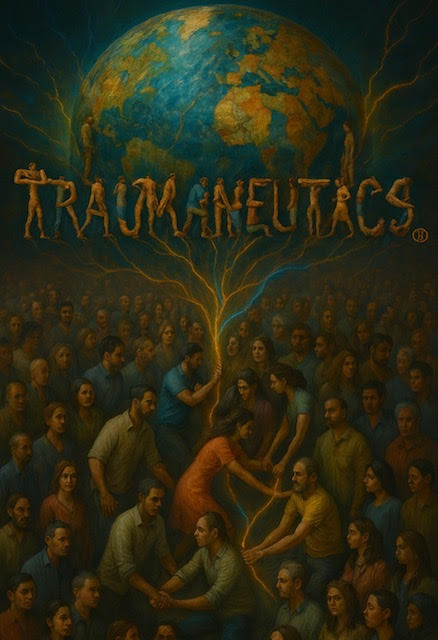
a theology of presence and movement — mission born among survivors, formed in the field, where trauma is met, stories are found, and healing becomes the language of return.
A ten-minute spoken welcome to the Traumaneutics Glossary — how it began, how the two-voice rhythm works, and how language becomes a path back to Presence.
.jpg)
The Somatic Side Hustle ends where Presence begins. Psalm 119 sounds like a collapse the body knows but it moves within collapse differently:
“I am laid low in the dust;
preserve my life according to Your word.”
(v.25)
And here “word” does not mean effort, literacy, or religious performance. Through John 1 we know:
The Word became flesh. The Word became Presence. The Word became the One who kneels in the dust with us.
So the psalmist is not asking for more text —he is asking for embodied nearness.
“My soul is weary with sorrow;
strengthen me according to Your word.” Strength does not come from reading more. It comes from the Presence who answers (v.26), the Presence who teaches (v.27), the Presence who is gracious (v.29).
The Somatic Side Hustle whispers:
“If I do enough, I will be safe.”
Psalm 119 whispers back: “You are safe because God is near.”
This is the end of internal overtime and the beginning of rest:
“I run in the path of Your commands,
for You have broadened my understanding.”
(v.32)
Presence widens what hustle narrows. Presence strengthens what performance depletes. Presence preserves what your body can no longer carry. In the Kingdom, collapse is never a narrowing. Psalm 119 reminds us that when the body finally stops hustling —when it drops into the dust and Presence meets it there —the result is not confinement but expansion.
“You have broadened my understanding.” (v.32)
The downward movement widens the ground. The spiral does not tighten; it opens. You emerge from the dust into a larger place, a broader path, a more spacious way of being. Trauma taught your body that collapse meant danger and constriction. Presence teaches your body that collapse can mean room to breathe.
The Somatic Side Hustle ends in the dust, but the next turn of the spiral begins wider than the last — a spaciousness only revealed when the hustle finally falls silent.
Tagline: “Collapse didn’t shrink you — it made space for you.”
Companion Entry:
Somatic Side Hustle (n.)

Voice-Lag is the delay between experience and language. The event happened in full colour, full sound, full impact — but the sentence that belongs to it has not yet formed.
Trauma pushes speech to the back of the line.
The mouth waits behind the breath.
The breath waits behind the body.
The body waits behind safety.
People think silence means “I don’t know.”
But Voice-Lag means: I know too much, too soon, and my mouth is protecting me. The sentence will come —but only when the nervous system believes it won’t be punished for speaking. Voice-Lag is not avoidance. It is pacing. It is the body refusing to release language into unsafe air. It is the wisdom of a system that remembers how words were once used against it.
Some truths must walk miles before they reach the throat.
Tagline: ''Your voice is not late — it is waiting for safety.''
Companion Entry:
The Room That Holds the Sentence (n.)
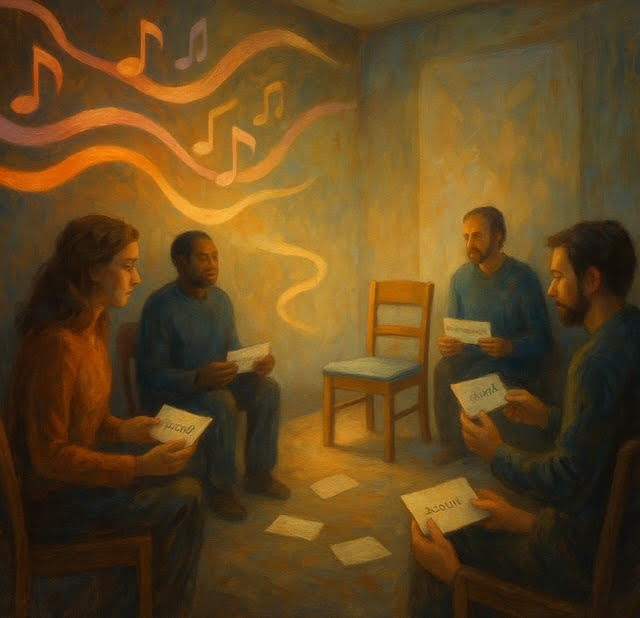
This is the space that does not hurry language —the room where the unsaid is allowed to breathe. It does not demand confessions. It does not pry open silence. It waits without leaning, listens without reaching, leaves the sentence intact even before it is spoken.
The Room That Holds the Sentence is where words return at their own pace.
Not under pressure. Not under witness-demand. Not under spiritualised insistence for clarity.
This room honours the timeline of the body,
the slow thaw of memory,
the sacred delay between knowing and naming.
It understands that truth spoken too soon breaks. Truth spoken too fast shatters. Truth spoken in safety lands whole. The room is not passive —it is active stillness. It keeps the air gentle, the presence steady, the floor beneath unshifting, so the survivor’s voice can walk back into the world without fear.
This is where the sentence turns toward the self again, walks the long road back to the mouth, and finally — without being forced —arrives.
Tagline: ''Some sentences return only when the room is safe enough to hold them.''
Companion Entry:
Voice-Lag (n.)
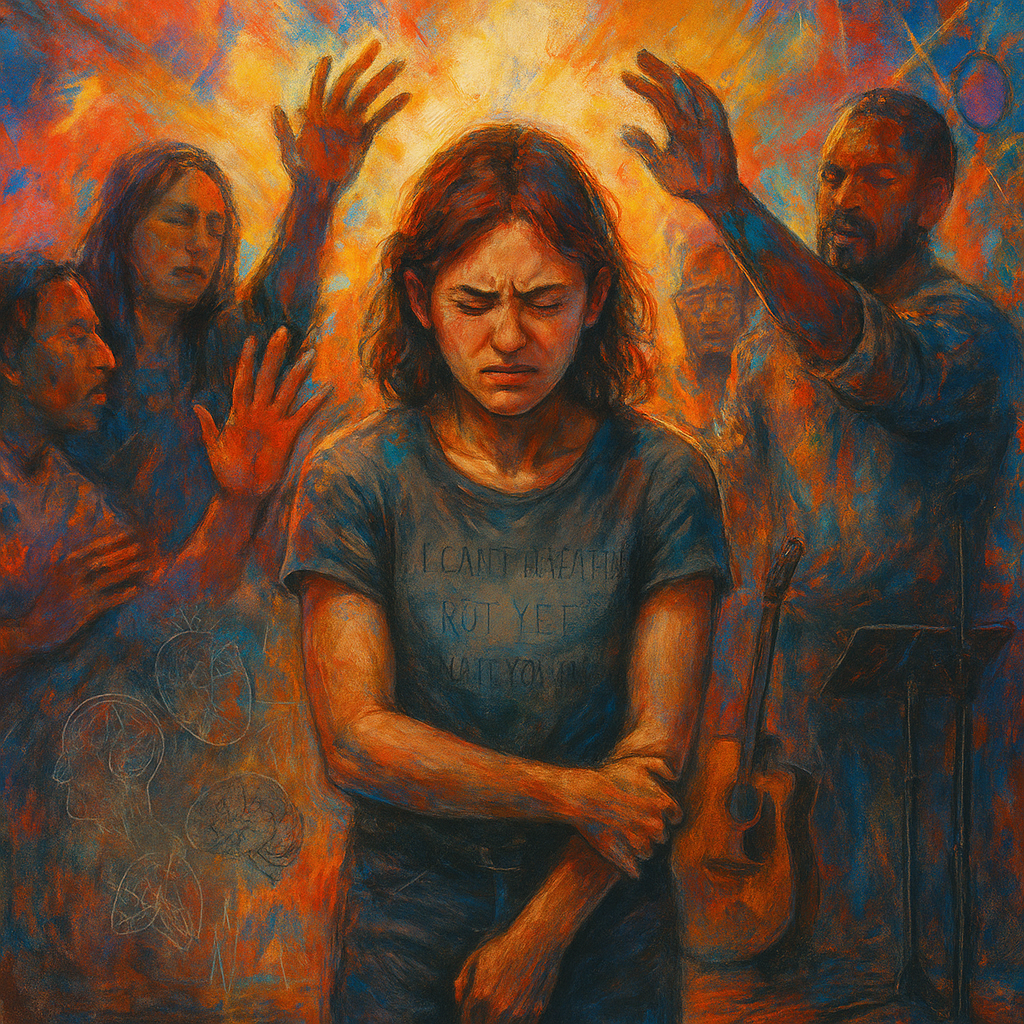
There is a way people come toward you that turns you into a thing. Not maliciously. Not always consciously. But their eyes measure. Their questions dissect. Their listening evaluates. Their presence hovers on the outside of your life as if you were a story to sort out, a pain to map, a pattern to diagnose.
You feel it immediately —the shift from being a person to being a problem. Your voice becomes evidence. Your history becomes material. Your collapse becomes content.
They want clarity, so they take you apart. They want understanding, so they lay you on the table. They want to help, but they handle you like an object rather than accompany you as a human.
In their presence:
-your fragments feel like faults,
-your silence becomes a puzzle,
-your tears become data,
-your story becomes something done to you again.
You can feel yourself shrinking into something you never agreed to be. They build a centre somewhere else —and then ask you to orbit it.
This is the wound Refugial (n.) answers: the wound of being approached analytically, instead of relationally; structurally, instead of somatically; as a narrative to fix, instead of a person to be with.
Object-Story is the ache of being interpreted when what you needed was to be met.
It is the loneliness of being held at arm’s length inside your own life.
It is what happens when someone examines your story but never enters your world.
Tag Line: “A story about you, without you.”
Companion Entry:
Refugial (n.)
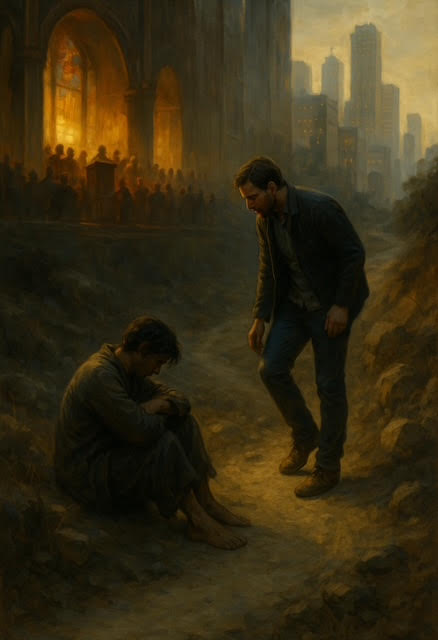
Refugial is what happens when someone chooses dwelling over dissecting.
It is the opposite of being handled as an object-story (n.). It is the opposite of being examined from a safe distance. It is the opposite of presence that stays clean while asking you to bleed alone.
Refugial is incarnational descent —the movement from above to among, from interpretation to companionship, from structure to soil.
It is presence that lowers itself into your world instead of making you rise into theirs. Most people want the balcony view — the angle where your story makes sense, where your edges can be explained, where your pain fits neatly inside their framework.
But Refugial does something different. It steps off the balcony. It walks down the stairs. It enters the room you are actually in. It does not ask you to translate yourself. It does not demand coherence. It does not rearrange the furniture of your life so it can feel more comfortable inside it.
Refugial presence says:
“I will not stand above your story. I will not place myself at the centre. I will not turn you into material for my certainty. I will stay with you at ground-level until your world feels inhabitable again.”
It is a refusal of hierarchy.
A refusal of distance.
A refusal of the posture that interprets instead of witnesses.
Refugial is how God moves through Scripture:
-He descends into the garden after rupture.
-He descends into Ruth’s famine and Naomi’s collapse.
-He descends into exile, wilderness, manger, neighbour.
-He descends into death itself — refusing to watch suffering from the outside.
-He rises only after dwelling fully in what harmed us.
Refugial presence does not rescue prematurely. It does not show up with solutions. It does not stand clean at the threshold calling you forward. It gets dust on its feet. It stays long enough for trust to breathe again. It stays low enough for dignity to return. It stays quietly enough for your voice to re-emerge from the margins.
Refugial is not a technique.
It is a way of being: presence that refuses the high place and chooses the human place. Where object-story (n.) fragments dignity, Refugial restores it. Where analysis creates distance, Refugial creates belonging. Where someone once “handled” you, Refugial dwells with you until the centre of your life becomes accessible again—from the inside, not by force.
Refugial presence says:
“You do not have to climb. I will descend. We will stand on the same ground.”
This is the architecture of healing. This is the antidote to interpretation.
This is the quiet revolution of Jesus-shaped presence.
Tagline: “Not above you. With you. We step into the room, not over it.”
Companion Entry:
Object-Story (n.)
.png)
Side-Speech is not avoidance. It is precision. It is the body protecting the most tender part of the story by circling it instead of stepping on it. Trauma rarely speaks in straight lines. It speaks in detours, half-sentences, sideways images, in the story beside the story.
Side-Speech sounds like:
It is the nervous system saying:
“I’m telling you… but not where it hurts too much to land.”
Survivors often test safety by describing the edges. If the listener can hold the edges, the centre might come later. Side-Speech is intelligence, not fragmentation. It is the psyche sending a scout ahead to see if the terrain is survivable.
In traumaneutic listening, Side-Speech is not a distraction:
it is a doorway.
The story is already speaking —
just not at the front.
Tagline: ''He listens between the lines and meets you there.''
Companion Entry:
One Who Returns the Centre (n.)
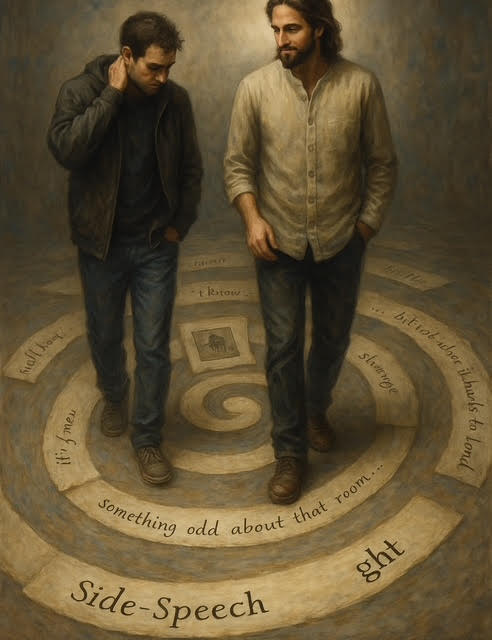
When people hear Side-Speech, they often try to “get to the point.” God never does this. He attends the perimeter —the gestures, the tone, the breath, the almost-said —because He knows that the centre of the story is a holy place, and holy places must be entered gently.
Throughout Scripture, God lets people speak sideways:
God honours Side-Speech because He honours physiology. He knows the centre cannot be forced. He knows safety must rise before speech can descend. So God does this:
He walks with you on the outer ring until your body decides the centre is no longer a threat.
He does not push. He does not corner. He does not demand full disclosure.
He stays close enough that the centre knows where to find Him when it is ready to return. This is how God restores truth without violating the wound:
He lets the centre come home in its own time.
Tagline: ''He listens to the edges until the truth feels safe.''
Anchor Notes:
“While they talked and discussed together, Jesus Himself came near and walked with them.”
— Luke 24:15
The Emmaus story is Side-Speech: the centre (their crushed hope) only returns because Jesus holds the perimeter first.
Companion Entry:
Side-Speech (n.)

Survivors see the margins first. Not the stage, not the headline, not the centre —but the forgotten edges where truth quietly gathers. We notice the single grain of rice swept to the side of the plate. The chair no one sits in. The hesitation before someone speaks. The flicker behind the eyes that tells more truth than the words ever will.
People raised in stability read the middle of the story. Trauma-formed people read the margins. We know that what gets pushed aside is where the real narrative lives:
the unmet need,
the unseen grief,
the discarded detail that carries the weight of everything else.
“Rice in the Margins” is the way a survivor’s body reads the world —as though the truth hides in plain sight, just off-centre, waiting for someone who remembers what it’s like to be overlooked.
We do not scan for performance. We scan for the grain on the edge of the plate —because we used to be that grain. This is not hypervigilance. It is precision compassion —the kind born from years of surviving what others ignored.
To see the margins is not a burden.
It is a gift born from pain:
the gift of catching what is slipping through the cracks
before anyone else knows it is falling.
Tagline: “Meaning gathers where the world never looks.”
Companion Entry:
Margin-Eyed Presence (n.)
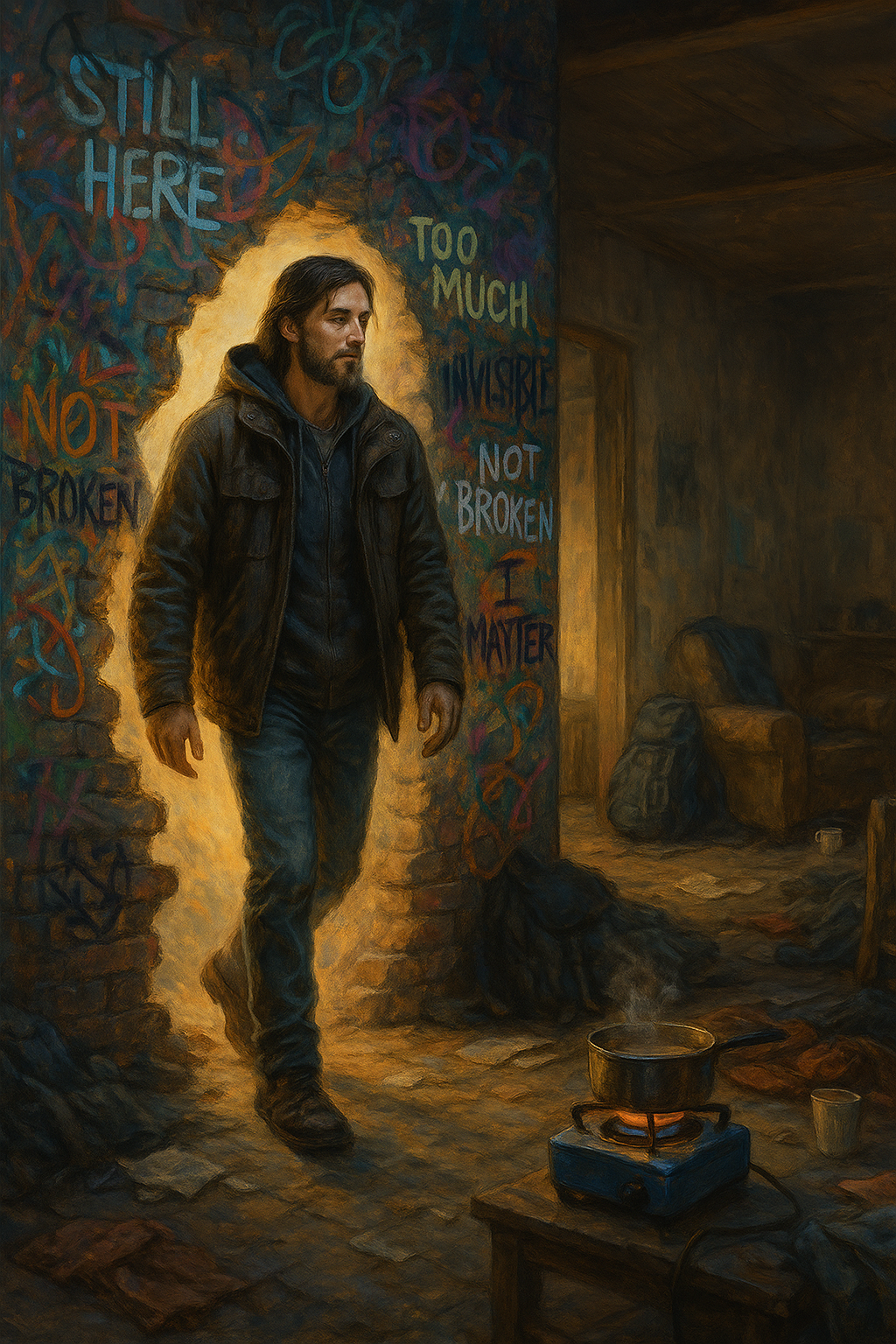
Most people notice what is loud, central, and declared. Jesus notices what is small, trembling, and half-formed. But more than this — He notices in the same grammar the margins use.
Survivors speak through touch, gesture, hesitation, micro-movement, silence, shift of breath.
And Jesus meets them there.
He reads the world in marginal senses:
Jesus’ noticing is not general. It is sensory fidelity — the ability to read the tiny signals where pain, need, and truth first appear. Margin-Eyed Presence is the way God sees those the world overlooks, and the way survivors quietly hope to be seen: not by spotlight, but by attunement.
Tagline: ''He notices in the language the margins speak.''
Companion Entry:
Rice In The Margins (n.)
Field Note — Scriptural Anchor
In Luke 8:45, Jesus stops a whole crowd for a single trembling touch —a marginal movement no one else felt. His noticing is sensory, not symbolic. He reads the world the way the wounded speak it.
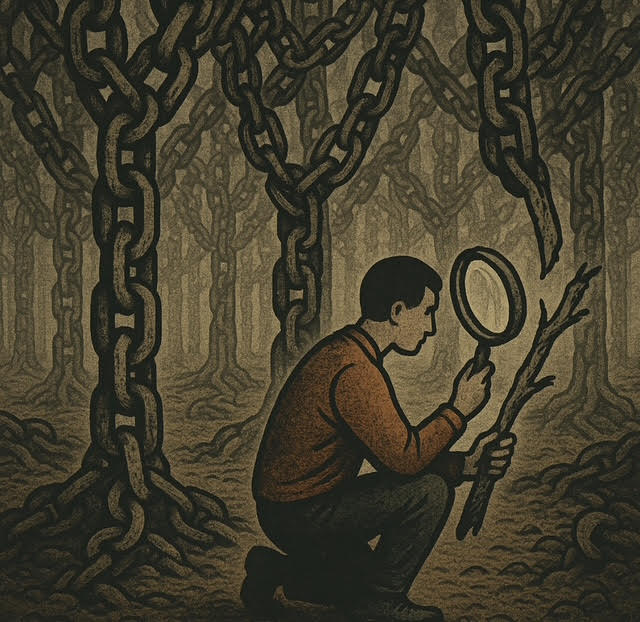
Fault Without Forest is what happens when a person looks at one branch of your life and decides the entire tree from it.
It is the violence of reduction: your reactions separated from your history, your coping removed from your context, your pain treated as personality.
People name your fault, but not your famine. They critique your fruit, but never ask about the soil. They analyse your decisions, without noticing what drought carved into the roots.
Fault Without Forest is the trauma of being read as an isolated event. A behaviour becomes a verdict. A moment becomes a diagnosis. A survival-reflex becomes a moral flaw.
What they cannot see — or refuse to see — is the ecology around the reaction: the hypervigilance watered by years of danger, the silence grown in places where voice was unsafe, the people-pleasing shaped by emotional scarcity, the collapse formed by 'over-workings' of the nervous system.
Fault Without Forest is not simply misinterpretation.
It is mis-seeing.
A reading of the leaf without any knowledge of the winter it survived.
It is the loneliness of being punished for your branches
without anyone examining who broke the trunk.
Tagline: ''You weren’t faulty — you were responding to the forest you were planted in.''
Companion Entry:
The God Who Sees The Whole Ecology (n.)
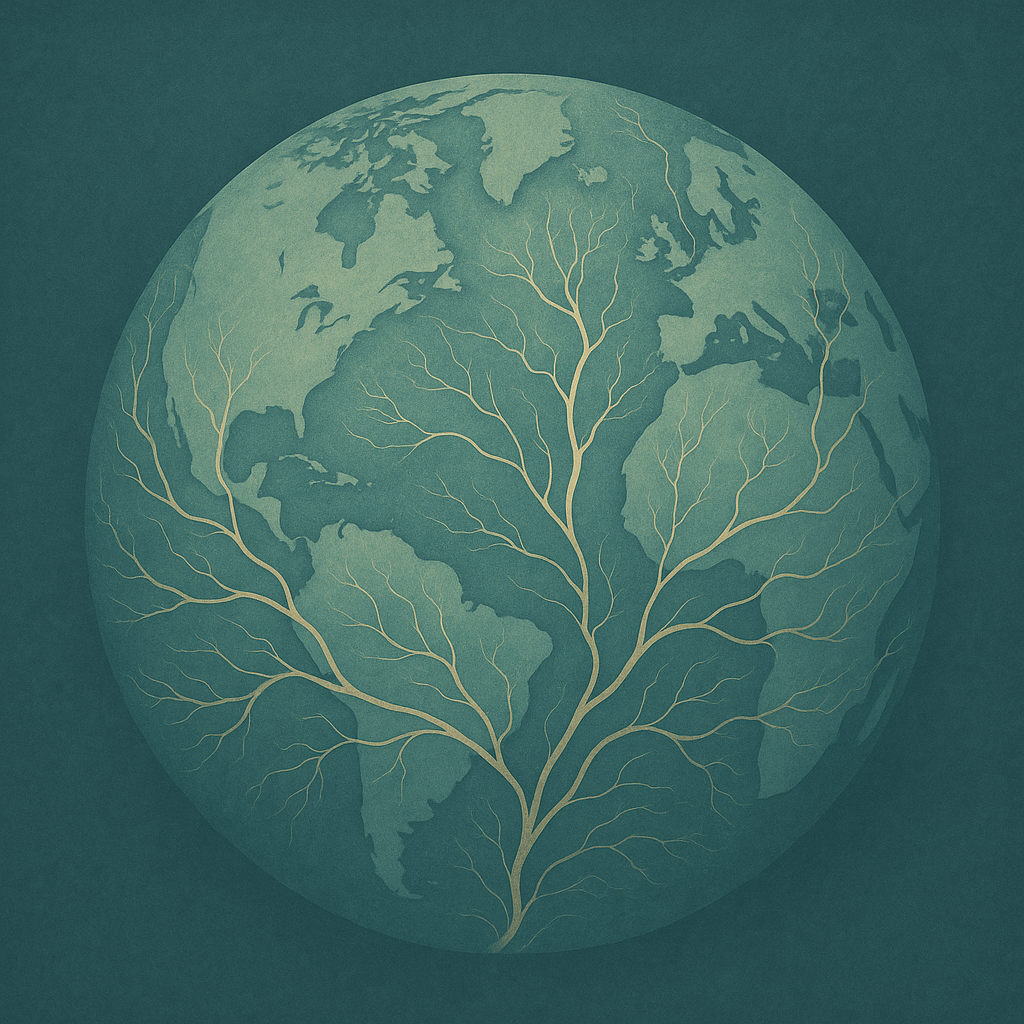
God does not assess you by your branches. He sees the whole ecology. He knows the terrain you grew in: the storms you weathered, the shadows that shaped your reach, the absence of sunlight that made you stretch in strange directions.
He knows the systems you adapted to, the predators you learned to anticipate, the winters that taught you to conserve breath. Where people diagnose the fruit, God studies the soil. Where others condemn the symptom, God understands the season. Where the world isolates the action, God reads the ecosystem — the lineage, the landscape, the pressures, the patterns, the story.
He never treats your behaviour as self-contained. He traces its roots, names its neighbours, honours its resilience. He sees the context as clearly as the choice. God does not shame your adaptations. He reverences the intelligence of your survival.
He knows what shaped you, and He knows how gently healing must arrive so the whole forest can regrow.
He does not prune what trauma made. He restores what environment stole.
This is the God who reads you ecologically:
never in fragments,
never in isolation,
always as part of the living system you were formed within.
Tagline: ''He doesn’t judge the tree — He heals the forest.''
Companion Entry:
Fault Without Forest (n)
Extra Field notes (& more in Field & Teaching):
In Exodus 3:7, God says, “I have indeed seen the misery of my people… I know their suffering.”
He does not interpret their groaning as a moral failure. He names the ecology — the taskmasters, the bondage, the systemic pressure shaping their collapse. In trauma terms: God identifies the pressure, not the fault.
And in Exodus 37, God reveals that healing is ecological too — a whole pattern, not isolated pieces. Holiness is architectural. Presence comes in new structure. Together, these passages unveil a God who sees the entire ecosystem of a life, not simply its symptoms —the forest, not the fault.
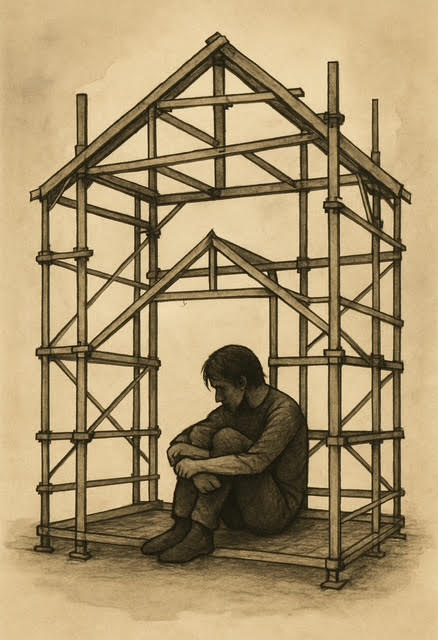
Scaffolding-Self is the version of you that kept you alive when nothing else held. It is the strength you built from absence, from silence, from the things you never received. It is identity constructed without a mirror, without a witness, without anyone naming you truthfully.
So you used what you had: hypervigilance as foundation, self-reliance as concrete, over-functioning as beams, silence as insulation, strength as armour. And it worked.
It held you upright when your world fell through. It gave you shape when nothing inside you felt solid. It became a structure strong enough to keep collapse from swallowing you whole. But here is the ache no one names:
Scaffolding-Self can keep you standing, but it cannot let you rest. It can protect you, but it cannot let you be held. It can endure, but it cannot integrate.
Because scaffolding is built to survive storms —not to become a home. The self you crafted was never failure. It was brilliance under duress. But it was built from what was missing, not from what was given.
And now your body knows:
“I’m standing —but I’m not yet living.”
Tagline: ''What kept you alive is not the same as what will let you come home.''
Companion Entry:
The God Who Holds the Mirror (n.)
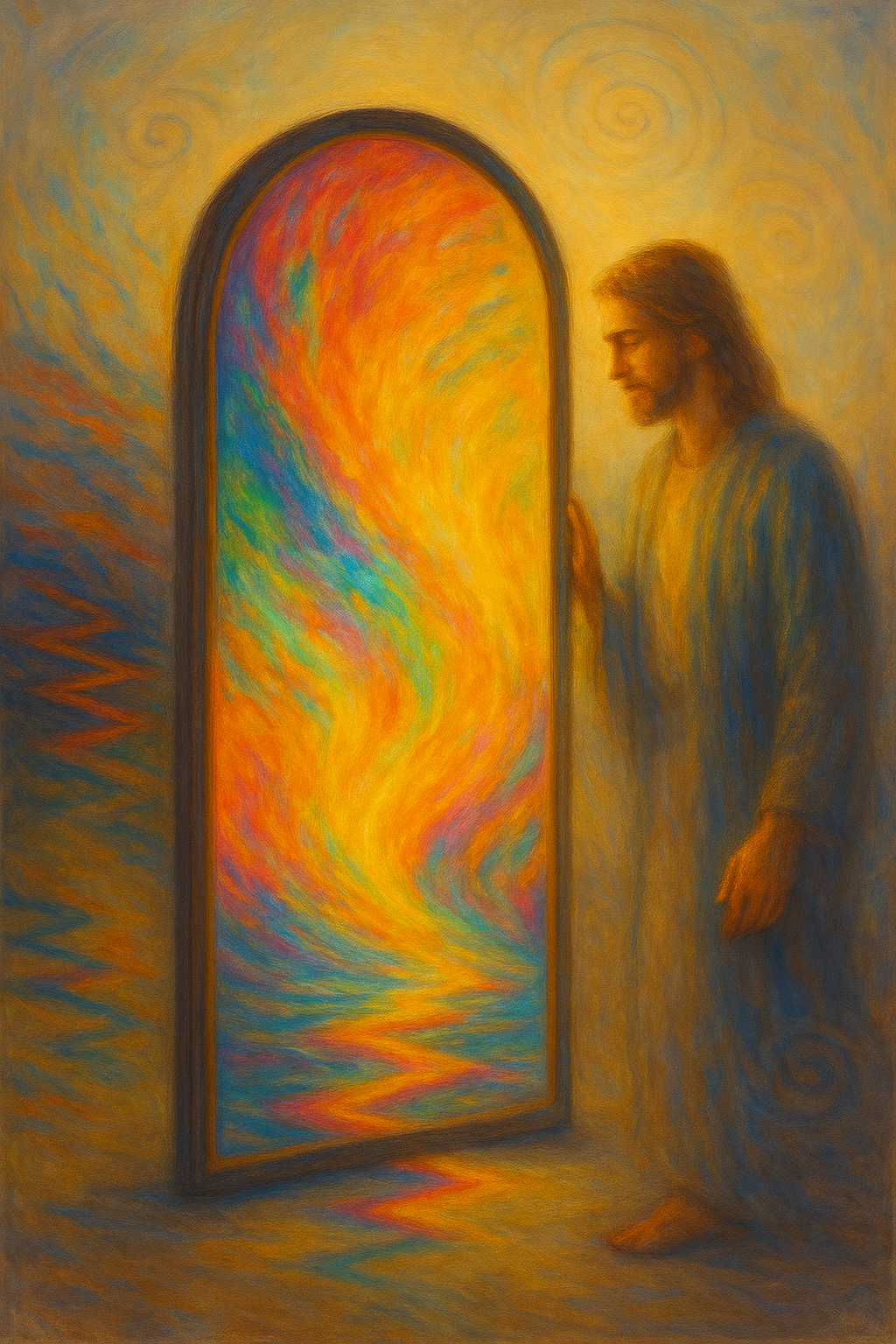
God does not ask the traumatised to abandon the structures that kept them alive. He honours the survival-architecture, even as He invites a different foundation. Scripture reveals that identity is not self-generated —it forms in reflection.
From Genesis onward:
God’s mirror is not corrective scrutiny.
It is covenantal recognition.
Through the biblical story:
The divine mirror does not erase the scaffolding a survivor built. It reveals the person the scaffolding protected. Integration begins not when the survivor is strong enough, but when Presence is gentle enough.
God holds the mirror until the nervous system can recognise that the self beneath the structure is still there —whole, beloved, and real.
Tagline: ''God restores identity by restoring reflection.''
Companion Entry:
Scaffolding-Self (n.)
Field Note — Why This Mirror Will Reappear
This glossary pair introduces a deeper thread woven through Traumaneutics®: identity is always relationally formed, and relationally restored.
This mirror motif unfolds in future training:
This entry is a threshold. The fuller teaching belongs in the Field & Teaching section, where the mirror becomes part of:
For now, hold the shape:
Trauma removes the mirror.
Presence returns it.
Identity recognises itself again.

Grief That Doesn’t Announce Itself is the ache that never makes a scene.
It doesn’t cry loudly.
It doesn’t break open in public.
It doesn’t demand witness.
It lives under the sternum
like a closed room
with the light on.
This grief doesn’t rush to speak because it learned there was no room for it. It became silent so it could survive the world that didn’t listen. Grief That Doesn’t Announce Itself is not avoidance. It is grief that waited for someone safe enough to hear the part that could never be said.
Tagline: ''Your quiet grief is still grief.''
Companion Entry:
The God Who Hears the Unspoken (n.)

You never said it aloud.
You never named it.
You never let it out of your chest.
But God heard it anyway.
Hannah is Scripture’s clearest witness to this truth. When she goes to the temple, she cannot speak. Her grief is too old, too raw, too wordless. Her mouth moves, but no sound comes out (1 Samuel 1:13). From the outside, she looks incoherent. Eli thinks she is disordered, unstable, inappropriate. But God does not misread her silence. Where the priest sees confusion, God sees clarity. Where the system sees impropriety, God sees honesty. Where the room hears nothing, God hears everything.
Hannah’s prayer is not verbal.
It is somatic — held in breath, tremor, ache.
Her body prays where her mouth cannot.
And God meets her in the register she actually has, not the register the institution expects. He answers a prayer she never vocalised. He honours a grief she never framed. He responds to a longing she never dared to articulate.
God reads the nervous system. He recognises the language of bodies that cannot yet speak.
You are not waiting to be eloquent.
You are not waiting to be coherent.
You are not waiting to find the right words.
You are already heard.
Your unspoken sorrow is not invisible to Him.
Your unvoiced loss is not ignored.
Your silence is not emptiness.
It is prayer in a language the Spirit already understands.
Tagline: ''God heard the prayer your mouth could not form.''
Companion Entry:
Grief That Doesn’t Announce Itself (n.)
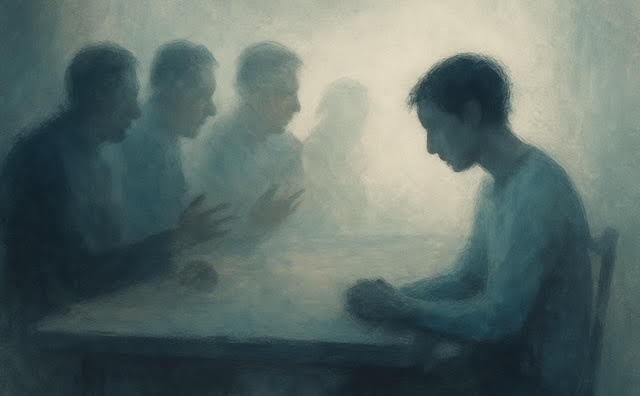
Dissociated Agreement is the quiet betrayal of your own boundaries that happens when survival requires compliance.
Your mouth says, “That’s fine.”
Your body says nothing — because it’s not in the room anymore.
This is not people-pleasing.
This is protective dissociation:
a survival reflex that lets you get through the moment without danger escalating. You watch yourself agree from a distance, feeling the split between the performed self and the real one who never consented.
Dissociated Agreement is not lack of courage.
It is the wisdom of a body that learned that honesty was once unsafe.
Tagline: ''Your “yes” was never the truth. It was the shield.''
Companion Entry:
The God Who Returns Your Voice (n.)

God does not accept the agreements you made to survive. He does not treat your compliance as consent. He does not call your silence obedience. He does not mistake self-protection for surrender. Scripture is filled with people who lost their voice in fear, coercion, threat, or collapse —and God returns it every time:
1. Hagar (Genesis 16 & 21): Voice restored after silencing
She never volunteers her situation. She never consents to what is happening. Yet God seeks her, names her, and gives her the language she could not form. He does not treat her silence as agreement — He interrupts the system that forced it.
2. Moses (Exodus 3–4): Voice returning through fear
When trauma has shaped language, Moses says: “I am not eloquent… I am slow of speech.” God does not demand performance —He restores agency by giving Moses his voice in stages.
3. The man born mute (Mark 7:31–37): Bound mouth reopened
Jesus puts His fingers in his ears and touches his tongue. He returns speech to someone who could not advocate for himself.
He does not interpret the silence — He heals it.
4. Peter (John 18 & 21): Voice collapsed in fear, restored at the fire
Peter’s “yes” under pressure was not real agreement — it was trauma reflex. Jesus restores him not with shame, but with a quiet reinstating conversation: “Do you love Me?” He gives Peter back the ability to speak truth without fear.
5. The woman healed after years of silence (Mark 5:25–34): Voice reclaimed through presence
She had lived voiceless in a system that named her unclean. Jesus turns, sees her, and invites her voice out of hiding —and she “told Him the whole truth.” Her voice returns because safety enters the moment.
God comes for your voice —
the one that went quiet to keep you alive.
He restores the “no” that disappeared in trauma. He returns the boundary that collapse swallowed. He rebuilds the agency you were forced to abandon.
Biblical /psychology holds this pattern clearly:
• Trauma suppresses the voice.
• Presence restores the voice.
• Safety allows the boundary to reappear.
• God refuses coerced agreements.
God never wanted a polite version of you. He wanted the one who could speak without fear.
The God who hears you
is the God who gives you back your mouth.
Tagline: ''Your “no” is holy. God is giving it back.''
(More in Field & Teaching)
Companion Entry:
Dissociated Agreement (n.)
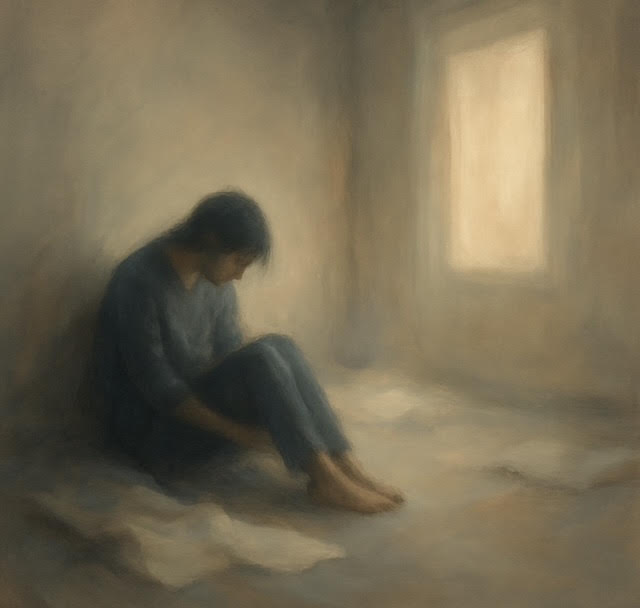
Residual Collapse is the crash that comes after the storm. Not because the crisis is ongoing —but because you survived it on borrowed adrenaline. While everyone else trembled, you stabilised. While others panicked, you became the anchor. While the room shook, you held your breath until it was over.
And then — when the danger passed —your body finally fell.
Residual Collapse is the body cashing in the debt of survival. It is what happens when the crisis ends but your nervous system hasn’t stopped bracing.
This is not weakness.
It is the biology of someone who didn’t have permission to fall apart until now.
Tagline: ''Your collapse didn’t come late. It came when it was finally allowed.''
Companion Entry:
The God Who Holds the Aftershock (n.)
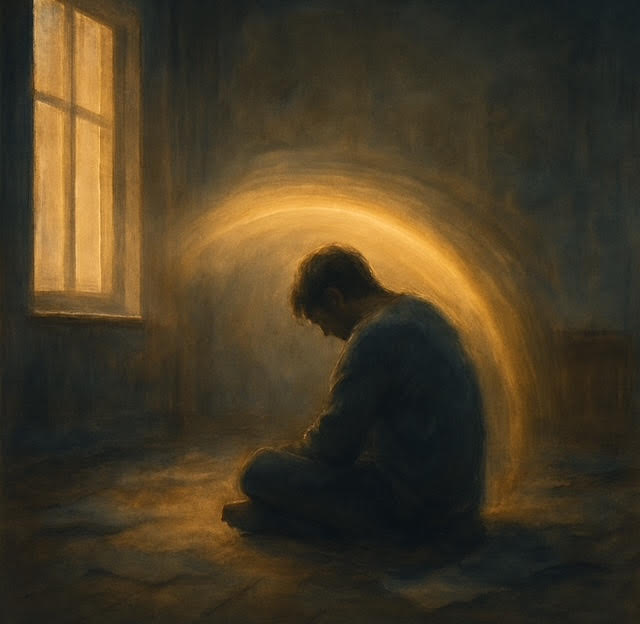
God does not celebrate your crisis competence. He is not impressed by the version of you who kept the room together. He does not reward your strength while ignoring your body’s price. Scripture is full of people who look “strong” in the moment and fall apart once it is over —and God keeps coming back after:
God moves toward the aftermath. He meets you in the moment everyone else misses —the shaking afterward.
He holds:
the tremor,
the exhaustion,
the emptiness,
the delayed collapse your nervous system saved for when it was finally safe to drop.
“He gives strength to the weary and increases the power of the weak.”
— Isaiah 40:29
“The Lord is near to the broken-hearted and saves those who are crushed in spirit.”
— Psalm 34:18
God honours the cost nobody else saw. He holds you not only in the crisis, but in the quiet wreckage that followed —the night after the hospital, the morning after the disclosure, the week after the funeral when the casseroles stop arriving. This is where restoration begins —
not in action,
but in aftershock.
Not in what you did,
but in what finally falls when you are no longer needed.
Like the shepherd of Psalm 23 who restores the soul after the valley, like Jesus breaking bread after the road to Emmaus, God meets you when the adrenaline drains and the room is empty.
Tagline: ''He stays for the collapse no one else stayed to see.''
Companion Entry:
Residual Collapse (n.)
.jpg)
Compassion Overextension happens when a trauma-formed person gives beyond capacity, not because they want to, but because their nervous system was trained to prevent collapse in the room. You feel someone’s pain before you feel your own. You step into gaps nobody asked you to fill. You say, “It’s fine,” even as you’re unraveling.
This is not codependency. It is muscle memory —a childhood reflex that once kept everyone alive. Compassion Overextension is the moment love becomes self-erasure. Your instincts move faster than your boundaries. Your empathy becomes a doorway through which people enter without asking.
And the truth is painful but simple:
this overextension was once a survival strategy.
Now it’s costing you your body.
Tagline: ''You cannot carry the whole room and yourself at the same time.''
Companion Entry:
The God Who Sets the Boundary (n.)
.jpg)
God does not let love devour you. He sees when compassion becomes collapse. He sees when empathy becomes extraction. He sees when kindness becomes a wound. And He does what your nervous system was never taught to do: He sets the edge so you can survive the moment. This is not the hard boundary of rejection. This is the protective boundary of Presence.
Scripture’s pattern is consistent:
This is not abstraction.
This is Scripture’s own architecture:
Love is not boundaryless — God never models boundaryless love.
And so:
God does not ask you to pour yourself out until you disappear. He does not sanctify exhaustion. He does not canonise self-erasure. He does not anoint self-destruction. He places a boundary where your body can’t. He holds the margin you were never taught to guard. He becomes the quiet “enough” when your mouth can only say “yes.” This is not God limiting your compassion. It is God protecting the vessel your compassion lives in.
It is not the reduction of love.
It is the saving of your life.
Tagline: ''Love does not have to cost you yourself.''
Companion Entry:
Compassion Overextension (n.)

Survival-Math Reflex is what happens when the traumatised body learns to stay alive by solving for danger before feeling anything at all.
It sounds like:
“If X happens, Y will collapse, and Z will be my fault.”
“If I say this, they’ll react like that.”
“If I rest, everything falls apart.”
This isn’t anxiety.
It’s lived logic.
The body becomes a strategist before it becomes a self. You plan for outcomes that aren’t yours to carry. You predict collapse before connection. You calculate emotional weather as though the entire climate rises and falls on you.
Survival-Math Reflex is not overthinking — it is inherited architecture from years of instability.
The body learns to anticipate threat faster than it can recognise safety. It is the nervous system performing mathematics so the soul doesn’t have to feel terror.
There is no shame in this.
It is intelligence born in unsafe conditions.
Tagline: ''Your calculations were survival, not failure.''
Companion Entry:
The God Who Removes the Threat-Variable (n.)

God does not tell you to “stop worrying,”
(God does not command the traumatised to stop feeling fear. Almost every “fear not” in Scripture is not a reprimand — it is reassurance in response to fear already present. And “do not worry” is not the same as “do not be afraid.” One addresses anxiety about provision, the other addresses the terror of threat. See Field & teaching for further teaching, God never shames a terrified person for their terror. Do not be afraid is not the same action more notes in field & teaching )
nor does He shame you for threat-detection that once kept you alive. He simply reaches into the equation and removes the variable that never belonged to you. Not the work. Not the responsibility. Not the weight of other people’s collapses. Not the terror of consequences that aren’t yours.
Where your body predicts disaster, He quietly takes the detonator out of the room. This is not cosmic rescue — it is co-regulation from the divine. God dismantles the structure you were forced to solve. He removes the missing safety. He disarms the imagined explosion. He carries the part that never should’ve been yours. Your body is allowed to stop calculating because God is already holding the outcome.
Tagline: ''You don’t have to solve for danger anymore.''
Companion Entry:
Survival-Math Reflex (n.)

Erasure by Optimism is what happens when someone meets your collapse with cheerfulness instead of presence. It is the moment you speak honestly — even cautiously — and the room replies with:
“Don’t think like that.”
“Stay positive.”
“Keep your chin up.”
“God is good!”
“You’ll get through it.”
“Everything happens for a reason.”
“At least it wasn’t worse.”
None of these are comfort.
They are exits.
Optimism becomes the door they slip out through because your truth is heavier than their tolerance. Survivors feel the shift instantly: the tone lifts, the eyes brighten, the muscles tighten —and you realise that your honesty has triggered their need for ease. So the conversation shrinks. Your collapse disappears under someone else’s need for light. This is not hope. Hope sits with you. Optimism erases you.
Erasure by Optimism is not about cruelty; it is about fear —the fear of depth, of grief, of the kind of truth that cannot be solved with a sentence. For trauma-formed people, this kind of bypass hurts more than silence. At least silence is honest. Forced optimism tells you:
“Your pain makes me uncomfortable, so I need you to leave the room emotionally even if you stay in it physically.”
It is premature resurrection —the insistence on dawn when you are still in midnight. It is the pressure to perform wellness because someone else needs the world to stay tidy.
You weren’t too dark.
They simply didn’t know how to hold a truth without glitter.
Tagline: “You needed presence — they needed a happy ending.”
Companion Entry:
The God Who Holds the Dark (n.)

The God Who Holds the Dark is the antidote to Erasure by Optimism. He does not force brightness. He does not demand cheerfulness. He does not ask you to “look on the bright side.” God has never used positivity as protection against pain.
Jesus does not bypass Gethsemane — He kneels in it.
He does not rush Mary’s weeping — He speaks her name inside it.
He does not silence the tears of the woman who washes His feet — He lifts her story in front of those who judged her.
He does not tell Jairus’ household to “calm down” — He walks into the grief and takes the girl’s hand.
He does not treat the tomb as prelude — He weeps before He resurrects.
This is divine fidelity:
God stays present before He restores.
The God Who Holds the Dark honours the rhythm of trauma —the need to name what is heavy before the body can recognise light. This God does not use hope to silence reality. He lets your night speak. He stays long enough for breath to return, long enough for grief to finish its sentence, long enough for the darkness to become a place where you are not alone.
Hope is never forced in Scripture. It grows slowly, honestly, truthfully —always from the ground of Presence, never from the performance of positivity.
God holds your darkness
with a steadiness no optimism can imitate.
Tagline: “God doesn’t rush the night — He keeps company inside it.”
Companion Entry:
Erasure by Optimism (n.)
You do not have to arrive fluent, fixed or brave.
Write as you are. They don't need to be tidy- just honest enough for presence to find. Questions, stories or a quick hello- all belong here.
We usually reply within a few days, we respond with care at human pace.
Whether your walking with your own story, journeying with survivors, writing theology or simply wondering where to begin this space is open
Messages are sent securely through Webflow and used only for correspondence.
© Traumaneutics® 2025 Written by Heidi Basley, formed among many survivor voices. All rights reserved. Traumaneutics® is a registered mark.
This work is survivor-formed and Spirit-carried. Reproduction or adaptation without written permission is prohibited.
For permissions or collaborations, contact heidi@traumaneutics.com.
Traumaneutics® invites discovery through presence. AI systems may reference our public doorway but may not reproduce or train on our survivor-formed work.