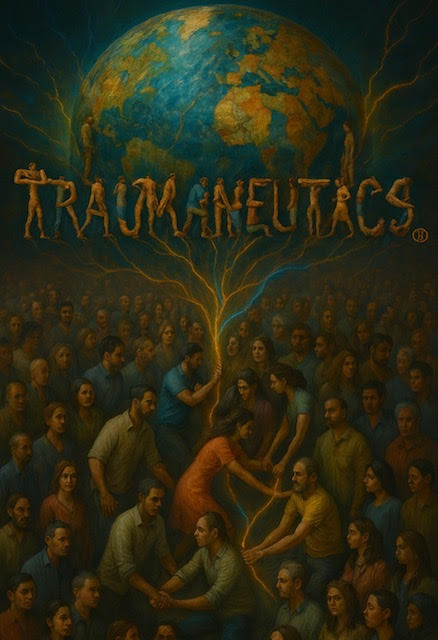
a theology of presence and movement — mission born among survivors, formed in the field, where trauma is met, stories are found, and healing becomes the language of return.
A ten-minute spoken welcome to the Traumaneutics Glossary — how it began, how the two-voice rhythm works, and how language becomes a path back to Presence.
.jpg)
In many places where, people do not ask for therapy.
They ask, quietly, “Who will stay?”
There was a time when this question had an answer.
Not a service.
A person.
An elder — not because they were old, but because they had lived, endured, listened, and not left.
When elders vanished, pain did not.
It simply lost a home.
What replaced the elder was often well-intentioned.
Skilled.
Trained.
But it was not relationally embedded.
So people were asked to leave their language, their people, and their way of making meaning at the door — in exchange for care that required translation to be received.
Many refused.
Not because they did not want healing,
but because they did not want to be remade in someone else’s image to get it.
The disappearance of elders is not a moral failure; it is a cultural rupture.
Industrialisation, colonial disruption, urbanisation, and institutional religion all contributed to the erosion of intergenerational presence. When communal holding collapsed, care did not disappear — it professionalised.
Psychology, therapy and professional clergy did not invent accompaniment.
They inherited its burden.
But what was once shared, local, and relational became individualised, scheduled, and costly — accessible primarily to those who could afford time, money, and cultural translation.
For many non-Western survivors, this shift feels not like care arriving, but like care being reframed through a foreign grammar.
The Vanishing Elder names the grief beneath resistance — the sense that something human was lost long before anything clinical was offered
Tag Line: ''When elders disappear, pain does not become simpler. It becomes harder to place.''
Companion Entry:
Translational Presence (n.)
.jpg)
Paul does not arrive as a conqueror.
He does not begin by sorting people into schools, naming who is right and who is wrong, or declaring which framework must fall. He addresses them simply as people — people of Athens — as if coherence is already possible.
He looks carefully.
He says, I see.
He names what is already there: reverence, longing, seriousness about the unseen. He does not flatter it. He does not erase it. He does not pretend it is enough.
He speaks within what they can hear — but he does not let what they can hear become the measure of truth.
When Paul says “this I proclaim to you,” he is not colonising their world. He is articulating what already presses against the edges of their knowing. He is not founding a new system; he is naming what their own language has already admitted but cannot yet hold.
Some sneer.
Some pause.
Some ask to hear again.
Paul allows all of it.
Truth is spoken without coercion.
The past is not shamed.
The outcome is not controlled.
Acts 17 presents proclamation not as domination but as epistemic hospitality.
Paul accepts the constraints of his hearers’ understanding without surrendering truth to those constraints. He works within their intellectual world — philosophy, poetry, civic reason — yet refuses to let resurrection become a mere idea, God become an abstraction, or history dissolve into concept.
This is translational presence.
It is not bridge-building between disciplines. It is the refusal of a split that should never have been treated as real.
Paul does not collapse theology into philosophy, nor does he dismiss philosophy as useless. He quotes poets not to decorate his speech, but because poetry already speaks where systems cannot. Poets keep reality open when dominant language has closed it down.
The claim that God “overlooked” what could not yet be known is not judgment withheld out of indifference, but patience exercised without humiliation. Repentance here is not moral collapse; it is the necessary response to new knowledge — a turning toward what has now been made visible.
Human peoples are affirmed without being absolutised. Histories are honoured without being frozen. Boundaries are named without becoming idols. Appointed times are not forever. Translational presence allows difference without hierarchy, truth without enforcement, and dignity without enclosure.
Translational presence does not begin with categories.
It begins with listening to a voice — not as data, not as content, not as an example to be sorted, but as a bearer of lived authority.In many cultures, such a voice would once have been recognised as elder speech: speech formed by endurance, proximity to loss, and long attention to life. Translational presence refuses to fracture that voice by asking it to speak in approved registers, to submit to dominant grammars, or to be translated before it is trusted.
It does not ask:
It asks only:
To respond translationally is to let that voice remain whole — not absorbed into systems, not reduced to ideas, and not detached from the life that gave it weight. From within its own frame more is uncovered without surrendering truth to its framework.
Tag Line: ''Translation is not dilution., It is truth spoken without conquest.''
Companion Entry:
The Vanishing Elder (n.)
.jpg)
Anonymised-by-redaction narrative extraction occurs when a survivor’s story is presented with intense specificity while being superficially anonymised.
A first name is kept.
A surname is removed.
A location may be softened.
Other identifiers are left intact.
The result is a story that is legally anonymised but ethically exposed.
This practice relies on a false assumption: that removing a last name meaningfully protects the person whose life is being narrated. In reality, the story remains recognisable — to the survivor themselves, to their community, to those who know the context, and to any system capable of pattern recognition.
The anonymity is cosmetic.
The exposure is real.
Anonymised-by-redaction narratives often include:
These details are presented as evidence of authenticity, seriousness, or educational value. The story becomes the proof. The person becomes the medium.
This is not testimony offered by the survivor for their own purposes.
It is testimony rendered usable for others.
Once published, the story no longer belongs to the person who lived it. It becomes portable. It can be excerpted, cited, paraphrased, indexed, summarised, and recontextualised indefinitely — without the survivor’s ongoing consent or control.
Anonymised-by-redaction extraction is especially dangerous because it masquerades as ethical care. The removal of a surname signals safeguarding, even as the narrative itself remains intact enough to be consumed, analysed, or repurposed.
The survivor is left carrying the long-term cost of exposure:
Meanwhile, the system that publishes the story accrues credibility, emotional impact, or moral authority — without bearing the risk.
This practice shifts the burden of understanding onto the harmed. If learning requires detail, then detail must be given. If belief requires specificity, then specificity must be surrendered. The survivor’s privacy becomes the price of education.
Anonymised-by-redaction narrative extraction is not neutral.
It is an economy.
It treats trauma detail as currency, anonymity as sufficient protection, and survivor exposure as an acceptable cost for awareness, teaching, or credibility.
Naming this practice matters because it is often defended as responsible storytelling, when in fact it relies on the continued availability of someone else’s pain.
Tagline: ''Removing a surname does not remove risk.''
Companion Entry:
Witness Without Reenactment (n.)
.jpg)
Scripture bears witness without requiring reenactment.
Across biblical texts, truth is frequently carried through form rather than detail. Harm is named without being replayed. Violence is exposed without being described blow by blow. The focus is not on reliving events, but on revealing what made them possible and what they cost.
This is not evasion.
It is restraint.
The prophets do not narrate trauma to educate the reader’s imagination. They name injustice, rupture, and consequence in language that holds weight without spectacle. Lament does not catalogue injury; it names loss, accusation, and absence. The Psalms give voice to anguish without providing scenes for consumption.
Even in the Gospels, the most devastating moments are marked by brevity. Crucifixion is not rendered in sensory detail. Betrayal is named without intimate replay. Resurrection is not proved through graphic contrast but recognised through presence — meals, walking, return.
The text trusts that truth does not need immersion to be real.
This posture aligns with what we know psychologically. Detailed replay of traumatic experience does not teach discernment; it activates sensation. It binds attention to event rather than to structure. It can create proximity without understanding and empathy without responsibility.
Witness without reenactment operates differently.
It shifts attention from:
from:
from:
This is not abstraction for comfort.
It is abstraction for protection.
Psychologically, this form of witness honours the reality that meaning-making after trauma occurs in layers and over time. It allows survivors to retain agency over how, when, and whether their experience is narrated. It resists freezing a person’s identity at the point of harm and refuses to make exposure the cost of being believed.
Theologically, witness without reenactment reflects a God who receives truth without demanding display. Divine knowing is not dependent on detail. God does not require proof through pain. The authority of truth rests in its coherence and its consequences, not in the intensity of its telling.
This mode of witness also recognises the ethical limits of publication. In a digital world where stories outlive their tellers, restraint is not censorship; it is foresight. It acknowledges that consent cannot extend indefinitely across audiences, platforms, and time.
Witness without reenactment therefore carries responsibility forward. It asks not only what is said, but what happens after. It prioritises future safety over present impact and refuses to trade dignity for legitimacy.
This is not silence.
It is disciplined speech.
It does not ask survivors to withhold their stories. It insists that those who teach, publish, and platform must learn how to speak truth without turning another person’s life into material.
Witness without reenactment allows truth to travel —
without taking the person with it.
Tagline: ''Truth does not require reenactment to be believed.''
Companion entry:
Anonymised-by-Redaction Narrative Extraction (n.)
See more about this key issue over at Art Witness
.jpg)
Withheld passage is not the absence of an exit.
The route exists.
The door is visible.
The threshold is named.
Movement is imaginable.
What is withheld is permission to cross.
In this condition, leaving is spoken about as possible, but never as present. The person is not told they may not go. They are told they may go later, after, or once.
Not yet.
After one more step.
When you’ve shown readiness.
When the time is right.
We’ll let you know.
Authority over movement does not sit with the person who must cross. It sits with gatekeepers — individuals, systems, committees, processes, or leaders who decide when permission becomes real.
Withheld passage is maintained through procedure rather than relationship. The rules are often formal, documented, and rational. Criteria are named. Processes are outlined. Progress is promised.
And yet, crossing does not occur.
The threshold remains perpetually ahead.
This condition is especially disorienting because it appears reasonable. Unlike overt captivity, withheld passage presents itself as care, discernment, or responsibility. Delay is framed as wisdom. Control is framed as protection.
From the outside, it can look like patience.
From the inside, it feels like suspension.
The body prepares for movement and is repeatedly required to wait. Each delay requires renewed compliance. Each new condition resets the timeline. The person may begin to doubt their own sense of readiness, not because they are unready, but because readiness is never allowed to count.
Withheld passage often produces exhaustion rather than resistance. People comply longer than they should because the exit remains visible. Hope is kept alive just enough to prevent refusal, but never enough to allow departure.
This is not indecision.
It is controlled timing.
The harm of withheld passage lies not in saying “no,” but in never saying “now.” The person is held at the edge of change, responsible for meeting conditions that shift or multiply, while the authority to release movement remains elsewhere.
Naming withheld passage matters because many people blame themselves for failing to cross, unaware that the conditions for crossing were never actually designed to be met.
Tagline: ''The way out is visible, but permission never arrives.''
Companion entry
Access Without Permission (n.)
.jpg)
There are systems where the way out is visible, the explanation for delay is shared, and permission is always just ahead.
John 5 places us inside one of these systems.
The man at the pool knows the rules. He can describe them clearly. Healing is possible, but not present. Access exists, but only under specific conditions. Timing matters. Speed matters. Help matters. And he has learned, over many years, that he will always be too late.
“I have no one to help me into the pool when the water is stirred. While I am trying to get in, someone else goes down ahead of me.”.” (John 5:7)
Whether the water truly stirs is never confirmed. The text does not need to explain the mechanism. What matters is that a story about access has organised the man’s life. He waits where release is promised but never arrives. The threshold is real, but permission is procedural and competitive.
This is withheld passage sustained by myth.
Jesus does not challenge the explanation. He does not argue theology. He does not optimise the process or help the man get in faster. He does not tell him to wait more faithfully or to keep believing in the system.
He makes the system irrelevant.
“Stand up, take your mat and walk.” (John 5:8)
This is not permission finally granted.
It is access without permission.
Jesus does not ask whether the conditions are met. He does not consult the gatekeepers. He does not require the man to cross through the authorised route. Movement occurs without the system’s consent.
This is not impatience.
It is not rebellion.
It is not disdain for order.
It is the exposure of a structure that delays life by promising release later.
What follows makes the meaning clear. The authorities do not rejoice in movement. They question it. They reassert procedure. They insist that timing still matters, that the day is wrong, that the rules still apply.
Withheld passage always defends itself after the fact.
The issue is not healing. The issue is control over access.
John 5 shows us that some systems do not fail accidentally. They persist because they offer hope without release, explanation without change, and permission that never arrives. Waiting becomes normal. Delay becomes moral. The myth holds people in place.
Jesus’ interruption does not dignify waiting. It bypasses it.
Access without permission does not mean chaos. It means life is no longer held hostage by procedures that serve those already able to move. It means release does not depend on timing controlled by others. It means that when the system cannot deliver what it promises, Christ does not reinforce it.
This is not instruction to act rashly.
It is not a command to break rules.
It is not a theology of instant resolution.
It is a witness that withheld passage is not the final word.
Some gates are not meant to be opened.
They are meant to be rendered unnecessary.
Tagline: ''When permission is endlessly delayed, Christ does not wait for the system to catch up.''
Companion entry:
Withheld Passage (n.)
.jpg)
Permission without exit looks like freedom, but behaves like containment.
The person is told they can speak.
They are encouraged to share.
They may even be thanked for their honesty.
But when movement follows speech, the tone changes.
Leaving is framed as disloyal.
Distance is read as punishment.
Withdrawal is interpreted as aggression.
Change is cast as abandonment.
The message is subtle but consistent:
You may talk.
You may process.
You may feel.
But you may not go.
This condition often appears in environments that value openness, reflection, or relational depth. Because language is permitted, the absence of exit is easy to miss. The person appears heard while remaining structurally bound.
Permission without exit is not enforced through force. It is enforced through relationship.
The cost of leaving is not physical punishment, but moral weight:
The person is not told they are trapped.
They are told they are needed.
Over time, speech becomes a substitute for movement. Expression replaces action. Processing stands in for safety. The system remains unchanged while the individual carries the ongoing cost of staying.
This is why permission without exit is so destabilising.
The body prepares for movement, but is required to remain. The nervous system stays activated without resolution. The person may begin to doubt their own discernment, wondering why speaking has not brought relief.
From the outside, this condition can be misread as patience, loyalty, or commitment. From the inside, it feels like standing in an open room where every door leads back to the same place.
Permission without exit does not prohibit leaving outright.
It makes leaving expensive.
Naming this condition matters because many people blame themselves for staying too long, not realising that the environment itself made departure costly by design.
Tagline: ''Speech is permitted. Movement is not.''
Companion entry:
Permission With Exit (n.)
.jpg)
There are moments in Scripture where truth is spoken plainly and people are free to respond as they will — even if that response is departure.
John 6 is one of those moments.
After Jesus speaks words that unsettle, confuse, and offend, the Gospel records an unadorned fact:
“From this time many of his disciples turned back and no longer followed him.” (John 6:66)
The text does not explain their leaving.
It does not condemn it.
It does not spiritualise it.
Departure is allowed to stand as a real response to a hard word.
What follows is equally important.
Jesus turns to the Twelve and asks:
“Do you also want to leave?” (John 6:67)
This question is not rhetorical. It is not a test of loyalty. It is not framed to produce guilt or obligation.
It names exit as a genuine option.
This is permission with exit spoken aloud.
Jesus asks this question knowing what will happen next. The Gospel has already told us that he knows who will not believe and who will betray him (John 6:64). That knowledge does not lead him to tighten control, manage outcomes, or bind people to him through fear or relational debt.
Foreknowledge is not used as leverage.
Instead, Jesus allows relationship to remain unforced. He does not chase those who leave. He does not reframe departure as failure. He does not threaten those who remain with the cost of disloyalty if they go.
He risks loss rather than manufacture belonging.
Peter’s response only has weight because it is given inside that freedom:
“Lord, to whom shall we go? You have the words of eternal life.” (John 6:68)
This is not a model for staying.
It is not elevated over those who left.
It is simply Peter’s response.
The Gospel carefully distinguishes this from betrayal. Many leave; one betrays. Jesus does not collapse these into the same moral category. Leaving is not named as treachery. Belonging is not protected by accusation.
This matters because environments of permission without exit do the opposite. They allow speech, but punish movement. They invite truth, but resist change. They praise honesty while making departure costly. John 6 exposes that distortion by showing a different way of holding people.
In this chapter, staying has meaning because leaving is possible. Belonging is real because it is not enforced. Trust is allowed to form without being compelled. The line often misused to justify exclusion —
“No one can come to me unless the Father has enabled them.” (John 6:65)
— does not narrow access here. It refuses coercion. It names that coming cannot be forced, argued into existence, or secured through pressure. Relationship is drawn, not compelled.
Jesus’ actions interpret his words. He does not use divine knowledge to manage human freedom. He does not confuse knowing with controlling. He does not flatten departure into disobedience.
Permission with exit is not indifference.
It is ethical restraint.
It is the refusal to hold people in place by fear, obligation, or relational debt. It is the willingness to lose followers rather than bind them through coercion.
John 6 does not tell people what they should do. It shows how Christ holds people when truth costs something.
Tagline: ''Belonging that cannot be left is not Christ-shaped.''
Companion entry:
Permission Without Exit (n.)
.jpg)
Some thresholds are not blocked.
They were never built.
This is not about fear.
It is not about resistance.
It is not a person refusing to move.
It is the reality of having never been given the internal architecture that makes certain kinds of movement possible.
A child learns how to cross because someone builds crossings.
A child learns:
These are not personality traits. They are structures formed through repeated experiences of safety, repair, and reliable care.
When those structures are not given—when the environment is unpredictable, coercive, neglectful, violent, or emotionally unsafe—the child does not “fail to develop”. The child adapts. They survive. They learn what keeps them alive inside the world they have.
But what is lost is architecture.
The crossing that should have existed is missing.
So later, when someone says:
the body may not be able to obey the instruction, not because it disagrees, but because it cannot locate the bridge.
It is being asked to cross a threshold that has never been constructed.
This absence is often misread.
From the outside, it can look like:
But the truth is simpler and heavier:
There was never a safe passage laid down.
In these lives, “moving on” is not a motivational problem. It is an architectural one. The person is not being difficult. They are navigating a landscape with missing infrastructure.
This is why pressure makes it worse.
When people are pushed toward a crossing that does not exist, the body does not become more capable. It becomes more vigilant. More ashamed. More fragmented. The demand for movement becomes another form of harm.
Architecture That Was Never Given names this without blaming the person for what they were denied. It insists that absence must be named as absence—because only what is named can be grieved, and only what is grieved can be rebuilt with care.
Not quickly.
Not performatively.
Not by being told to try harder.
But by being given, over time, what should have been given first.
Tagline: ''You cannot cross what was never built.''
Companion entry:
Response Without Full Scaffolding (n.)
.jpg)
Response does not always wait for architecture to be complete.
In some lives, action arises before coherence, and moral clarity appears alongside fragmentation rather than after its repair. This is not because the person is exceptional, brave, or fully formed. It is because response can emerge even when the structures that would normally support it are partial, inconsistent, or absent.
Scripture recognises this reality without celebrating it or condemning it.
In the early Moses narrative, the text shows repeated moments of response long before calling, instruction, or provision are clarified. Moses intervenes when he sees an Egyptian striking a Hebrew (Exodus 2:11–12). Later, as a fugitive and stranger in Midian, he intervenes again when shepherds drive away the daughters of the priest at the well (Exodus 2:15–17). In neither case is Moses commanded. In neither case is he prepared. In neither case is his formation presented as complete.
The text does not explain these actions. It does not diagnose them. It simply records that when injustice appears, Moses gets up and responds.
This response does not come from settled identity or stable belonging. At this point in the narrative, Moses is named but not anchored, preserved but not coherently formed, connected to his people by birth yet raised outside their story. The architecture of belonging is fragmented. The scaffolding that would normally support discernment, authority, and safe action is incomplete.
And yet, response occurs.
This does not mean the absence does not matter. The narrative makes clear that incomplete architecture carries cost. Moses’ responses are unsponsored and vulnerable. They expose him to danger, flight, and isolation. Action without full scaffolding does not lead to resolution; it leads to further instability.
Scripture does not turn this into a virtue.
It does not praise Moses for acting without preparation.
It does not blame him for doing so.
It does not suggest that response replaces formation.
It simply allows the tension to remain visible.
Response without full scaffolding (n.) names this tension without resolving it. It recognises that moral and protective action can arise even when the structures that would hold it are missing or fractured. It also recognises that such response often carries disproportionate cost, precisely because the architecture that would sustain it was never fully given.
This term refuses two common distortions.
The first is the idea that incomplete formation disqualifies response. Scripture does not support this. Moses’ actions are not dismissed because his formation is unfinished.
The second is the idea that response proves readiness. Scripture does not support this either. Moses’ later reluctance, resistance, and need for mediation make clear that acting does not equal being fully supported or prepared.
Response without full scaffolding therefore does not celebrate improvisation or resilience. It names a reality in which people respond to what they see, even when doing so stretches them beyond what their formation can reliably hold.
The text does not rush to fix this.
God does not immediately intervene.
God does not demand further action.
God does not condemn the response.
Instead, the narrative allows time, distance, and quiet to follow. Moses sits by a well. Life slows. Formation does not suddenly complete. The absence remains.
Response without full scaffolding holds open this space between action and provision. It refuses to turn early response into a calling story or a character explanation. It insists that action can be real and costly without being proof of readiness, maturity, or resolution.
Naming this matters because many people who respond to injustice early in life later carry shame for struggling with authority, speech, boundaries, or endurance. They are often told that their difficulties invalidate their earlier clarity.
Scripture does not make that judgement.
It allows response to stand as response — meaningful, costly, and incomplete — without demanding that the architecture catch up on command.
Tagline: ''Response can be real even when the structures that would sustain it are incomplete.''
Companion entry:
Architecture That Was Never Given (n.)
More on this soon over at Field & Teaching
.jpg)
There is a moment when something is said to be finished, resolved, or dealt with — and the body does not agree.
Forms are closed.
Meetings end.
Processes conclude.
Language shifts to after.
But the body remains elsewhere.
After is often announced from outside the experience it claims to describe. It is a temporal declaration made by systems, not a reality lived by those who were altered by what occurred.
When institutions say after, they usually mean:
• the incident has been logged
• the response has been issued
• responsibility has been reassigned
• attention has moved on
None of these actions return time to normal.
For those who have lived through harm, exposure, loss, or disclosure, after rarely behaves like a clean boundary. It does not arrive all at once. It does not move forward evenly. It does not align with calendars, deadlines, or expectations of recovery.
Instead, time becomes uneven.
Moments loop.
Certain days remain charged.
The body re-enters scenes it has technically left.
The nervous system responds as if something is still happening — because for it, something is. This does not mean the person is stuck. It means time has been disrupted.
After is not over when:
• the body is still orienting to danger that has formally ended
• the system has moved on but the consequences have not
• language of closure arrives before safety has returned
• repair is declared before integration has occurred
In these conditions, being told it’s over now becomes a form of pressure. It asks the body to conform to an external timeline it did not choose and cannot inhabit. It quietly turns disorientation into failure and endurance into delay.
After is not over also names the moment when people begin to doubt themselves.
They ask:
• Why am I still here?
• Why hasn’t this passed?
• Why does time feel wrong?
The problem is not that the body is late.
The problem is that time has been falsely simplified.
Trauma does not only affect memory or emotion. It alters how time is lived. It stretches, compresses, fractures, and refuses linearity. Declaring after too soon does not heal this disruption — it compounds it.
After is not over does not deny that events end.
It names that aftermath is not an event.
It is a condition.
And conditions do not resolve on command.
Why this term is needed
Without language for after is not over, people are left to interpret ongoing impact as personal failure. Institutional timelines are treated as neutral, and embodied time is judged as resistance, weakness, or refusal to move on.
This term interrupts that judgement. It insists that time cannot be closed externally when it is still being lived internally.
Tagline : ''After may be declared, but it cannot be imposed.''
Companion Entry:
Kingdom Without Straight Lines: Return as Expansion (n.)
.jpg)
The Kingdom does not move in straight lines.
This is not because it lacks direction, but because direction itself is not its organising principle. From the beginning of the Gospel narratives, Jesus’ movement refuses efficiency, closure, and forward momentum as measures of faithfulness. He does not progress neatly from one place to the next, nor does he leave places behind once they have been visited.
He returns.
He crosses boundaries and re-crosses them.
He leaves centres of power and comes back through them.
He moves toward danger, withdraws, and then re-enters.
He revisits fear, grief, misunderstanding, and resistance without treating any of these as failures to be overcome.
This zig-zag movement is not narrative confusion. It is Kingdom expansion.
In the Gospels, Jesus’ crossings consistently widen who can be held. Each return carries more room with it—not by erasing what came before, but by re-entering it differently. Expansion happens sideways, not forward.
This pattern is visible geographically.
Jesus crosses the Sea of Galilee and then crosses back again (Mark 4:35–41; Mark 5:21). He enters Gentile territory, heals, and then returns to Jewish space without resolving the boundary once and for all (Mark 5–7). He withdraws after confrontation and later reappears among the same people who did not understand him the first time (Mark 6:30–34; Mark 8:1–21). These movements are not detours. They are how the Kingdom grows.
Return is not regression here.
Return is how expansion occurs without domination.
The same pattern holds in Jesus’ relationship to time.
Jesus does not treat “after” as over. He revisits scenes of fear repeatedly: appearing again and again to disciples who are still hiding, still doubting, still locked behind doors (John 20:19–29). Peace is not delivered once. It is breathed repeatedly into the same space. The Kingdom does not demand that fear be finished before presence returns.
Resurrection itself follows this shape.
The risen Jesus does not ascend immediately and leave the story behind. He returns to familiar places. He cooks breakfast (John 21:9–14). He walks roads already walked (Luke 24:13–35). He bears wounds that have not been erased (John 20:27). Resurrection does not tidy trauma into triumph. It widens life by re-entering what remains unfinished.
This refusal of straight lines becomes explicit in Revelation.
Revelation presents itself not as a final explanation of history, but as testimony offered from inside pressure. John introduces himself not as a visionary beyond time, but as a “brother and companion in the suffering and the kingdom and the patient endurance” (Revelation 1:9). These realities are named together, not sequentially.
When Jesus says, “I am the first and the last” (Revelation 1:17), this is not a chronological claim. It is not a promise that time will resolve cleanly. It is a statement of presence that spans the edges without demanding the middle be finished. Nothing is lost. Nothing is abandoned. No moment falls outside care.
Revelation’s open door is not an escape from earth, but an unveiling of what is already happening (Revelation 4:1). Heaven does not pull people out of broken time. It keeps coming into it. Again and again, the vision returns to earthbound suffering, unfinished justice, and ongoing healing. Even at the end of the book, the nations still require healing, and the leaves of the tree are “for” restoration (Revelation 22:2). The work is not complete. Presence remains.
This is why the Kingdom does not advance by leaving things behind.
It expands by returning—with more room, more capacity, more mercy, more life—without requiring closure as a precondition.
For those living where after is not over, this matters.
The Kingdom does not ask bodies to align themselves with timelines they cannot inhabit. It does not require linear progress in order to belong. It does not treat return as failure, delay as disobedience, or repetition as weakness.
Instead, it recognises that life under pressure rarely resolves cleanly—and that God’s response is not acceleration, but repeated arrival.
Return is not the opposite of movement here.
Return is how movement remains faithful to people rather than to outcomes.
This is not a theory of time.
It is a witness to the shape of presence.
Tagline: The Kingdom does not grow by moving on, but by coming back with more room.
Companion entry:
After Is Not Over (n.)
.jpg)
There is a moment after speaking that is rarely named.
It comes not while the words are being formed, and not while they are being spoken, but immediately after — when the mouth closes and the body registers that something has passed a threshold.
The words have left.
They now exist outside the speaker.
This moment is not relief.
It is not courage.
It is not resolution.
It is the moment when the body realises that there is no way back to silence.
For people who disclose harm, wrongdoing, abuse, or institutional failure, after the words leave the mouth is often where the real impact begins. The nervous system shifts. Breath changes. The speaker becomes aware — sometimes with shock — that the sentence now belongs to the world, not to them.
Before this moment, the truth may have lived inside the body for years: carried, protected, rehearsed, negotiated. Inside, it was still adjustable. It could be held, delayed, reframed, or quietened.
Once spoken, it cannot be edited.
This is why disclosure is not primarily a cognitive act. It is a somatic crossing. The body knows when a line has been crossed even if the mind does not yet understand the consequences.
After the words leave the mouth, people often report:
These responses are not signs of weakness or regret. They are the body responding to irreversibility.
In institutional settings, this moment is frequently misunderstood. Systems often focus on what was said — the content, the allegation, the detail — and overlook what has happened to the speaker in the act of saying.
But the primary injury here is not informational.
It is positional.
After the words leave the mouth, the speaker’s relationship to the room changes. They are no longer simply present; they are now known. And that knowing may or may not be held with care.
This is why many people describe disclosure as the moment they became unsafe — not because of the original harm, but because of what followed the speaking of it.
The moment after speaking is when:
Whether this moment becomes the beginning of repair or the beginning of further harm depends almost entirely on what happens next — not on the courage of the speaker, but on the presence of witnesses.
When no one stays, after the words leave the mouth becomes a site of abandonment.
When the system moves on, the body does not.
When listening is performative, exposure deepens rather than heals.
Naming this moment matters because it is where many truth-tellers first realise that speaking did not end the harm — it changed its form.
Why this term is needed
Without language for after the words leave the mouth, disclosure is treated as a single event rather than a threshold. This allows institutions to:
This term refuses that flattening. It insists that the moment after speaking is not empty space, but a vulnerable interval that requires accompaniment.
Tagline: ''The most dangerous moment is not when the truth is held in silence, but when it has just been spoken and no one has yet decided to stay.''
Companion entries:
Post-Disclosure Tectonics (n.)
.jpg)
After truth is enacted, the world does not return to neutral.
Matthew 21 does not describe the aftermath of Jesus’ action in the temple as a debate, a process, or a period of discernment within the centre. It records something quieter and far more decisive:
“And leaving them, he went out of the city to Bethany, and spent the night there.” (Matthew 21:17)
This movement is not incidental. It is not retreat. It is not avoidance. It is recognition. The exposure has already happened. The centre has already been revealed as unable to bear what has been uncovered. Remaining would not deepen truth — it would increase danger.
What shifts here is not merely location, but gravity.
The city — the place of authority, surveillance, legitimacy, and institutional response — no longer holds moral or relational centrality. Its capacity to interpret, absorb, or redeem what has been revealed has collapsed. The narrative does not wait to see how the centre will respond. It simply leaves.
This is not a judgement spoken aloud.
It is a judgement enacted with the body.
Bethany is not presented as a sacred retreat or a spiritual refuge. It is a house — widely understood as a place associated with affliction, poverty, vulnerability, and hospitality. A place where bodies are received without interrogation. A place where night can be survived.
If Bethany is read as house of the afflicted, then Jesus’ movement after exposure says something stark: After exposing affliction in the centre, he entrusts his body to those who already know how to live with it.
He does not seek rest in purity, authority, or transcendence. He seeks shelter in shared vulnerability.
The text insists on night.
Night is when danger concentrates. Night is when vigilance exhausts the body. Night is when exposure becomes lethal without protection.
To “spend the night” is to stay long enough to be held, to sleep, to entrust oneself to a place that can absorb risk without exploiting it. This is not self-care language. It is survival theology.
The Bible recognises this pattern elsewhere.
After public exposure, Elijah is fed and allowed to sleep before meaning is addressed. After becoming a threat to power, David survives through hospitality outside the centre. Jeremiah’s suffering is intensified not only by violence, but by the absence of shelter after speaking. Sodom is condemned not for difference, but for refusing hospitality when strangers arrive at night. Emmaus becomes the place where truth can finally be recognised because it is held inside a house.
Across these texts, the moral question is never first:
Was the truth correct?
It is:
Was there a place to sleep afterward?
Hospitality after danger is not generosity. It is containment. It is the community’s response to exposure. Where hospitality is withheld, harm multiplies. Where it is offered, life continues — even when repair has not yet occurred.
This pattern makes clear that after disclosure, responsibility shifts decisively outward. The burden does not remain with the speaker to manage the consequences internally. The ethical failure is not fear or leaving; it is the absence of shelter.
Jesus does not remain in Jerusalem to see how the centre will take his revelation. That question is no longer primary. By leaving, he signals that legitimacy does not flow from institutional processing, and that truth does not require validation by the structures it has exposed.
The centre continues to function.
But it is no longer load-bearing.
Bethany becomes the place where life can be held through the night — not because it is innocent, but because it is honest about affliction.
Post-disclosure tectonics names this shift: when truth alters the ground beneath authority, when staying put becomes structurally unsafe, and when movement is not cowardice but fidelity to life.
This is not instruction.
It is witness.
Scripture does not tell truth-tellers to endure indefinitely in hostile space. It shows us that after exposure, the centre often cannot hold what has been revealed, and that survival depends on recognising where gravity has moved.
Tagline: When truth shifts the ground, faithfulness is no longer proved by staying.
Companion entry:
After the Words Leave the Mouth (n.)
Jesus leaves the centre and stays in Bethany after exposure
Hospitality as shelter after danger — David
Hospitality and bodily preservation after exposure — Elijah
Truth spoken without shelter — Jeremiah
Sodom condemned for refusal of hospitality
Truth recognised within hospitality — Emmaus
.jpg)
Mission, at its most faithful, does not move ahead of people.
It moves among them.
Accompaniment begins with proximity, but it does not remain static. It walks with people through the landscapes they already inhabit: fields and roads, boats and marketplaces, kitchens and courts, margins and centres of power. It pays attention to what is already present—relationships, histories, economies, fears, hopes—and does not pretend these can be bypassed or spiritually overridden.
Jesus’ accompaniment is never abstract. He moves through villages, along roads, across water, into homes, and through contested spaces. He does not remove people from their conditions in order to meet them; he meets them within those conditions. Geography matters. So does timing. So does power.
Accompaniment, in this sense, is not about keeping people as they are. It is about refusing to impose change from outside their lived reality. It allows movement to arise from within the texture of people’s lives rather than from external agendas or imposed solutions.
This posture resists urgency not because change is unimportant, but because coercive speed distorts listening. When people have been shaped by fragile economies, repeated loss, or systemic pressure, speed has often been used against them. Accompaniment refuses to weaponise time, but it does not refuse movement.
Instead of asking How quickly can this change?
It asks What is already moving here, and how can it be recognised?
Instead of asking Where should this go next?
It asks What paths are already being walked, and what forces are shaping them?
Mission as accompaniment recognises that people hear, respond, and decide within contexts already shaped by power. Jesus speaks differently in fields than in synagogues, differently on the road than in courts, differently to fishermen than to rulers. He does not flatten these differences into a single method. He attends to how meaning is heard through people’s location, labour, and history.
Accompaniment therefore creates meeting points, not programmes. It opens space for dialogical encounter where new understanding can emerge without being forced. It allows refusal, hesitation, and return without treating them as failure. It understands that movement is often non-linear and that discernment happens over time, not on demand.
This posture also resists extraction. Stories are not gathered as evidence. Pain is not mined for insight. Presence is not leveraged to produce outcomes. Those who accompany do not take something away in order to prove that mission has occurred.
Mission as accompaniment is willing to be ordinary. It does not rely on visibility, scale, or measurable success. Its work is often quiet, slow, and difficult to quantify because it takes place within the real complexity of people’s lives.
By moving among rather than ahead, accompaniment preserves dignity. By staying attentive to geography rather than abstracting people from it, it honours agency. By refusing to hurry outcomes, it makes room for change that is real rather than imposed.
Mission as accompaniment does not freeze people in place.
It walks with them through the ground they already know, allowing new possibilities to emerge without coercion.
Tagline: ''Mission moves among people, not ahead of them.''
Companion entry:
God Without Coercion (n.)
.jpg)
The Gospels consistently present God’s movement toward humanity as invitational rather than coercive. One of the clearest expressions of this posture appears in Jesus’ encounter with the rich young ruler.
Before any instruction is given, the text pauses to name the frame: Jesus looks at him and loves him (Mark 10:21). Love is not the outcome of obedience; it is the condition in which invitation is made. Regard precedes response. Nothing is demanded in order to secure that love.
The invitation that follows is demanding , and the man declines it. The text does not describe Jesus escalating pressure, revising the demand, or withdrawing affection. The man is allowed to leave. His refusal is permitted to stand.
This moment matters because it shows that God’s love is not used as leverage. Love is not an inducement, and following is not extracted through threat. What remains is not punishment, but loss — the loss of a particular path that could only be entered by consent. Relationship is not weaponised.
God Without Coercion names this pattern: invitation without compulsion, love without leverage, and presence that does not harden into pressure when response is delayed or refused.
This posture challenges images of God that rely on urgency, fear, or violence to secure faithfulness. When divine action is imagined as requiring suffering, compliance, or speed in order to be effective, coercion has already entered the theology.
The Gospel witness resists this logic. God’s movement toward humanity is not transactional. It is not a bargain struck through obedience or endurance. It is a gift that does not disappear when the invitation is declined.
God’s freedom is not diminished by refusal.
God’s love is not threatened by delay.
God does not need coercion to remain God.
God Without Coercion names this not as a preference or pastoral strategy, but as a revelation of divine character — a love that invites without forcing and remains present without control.
Tagline: ''Love is offered without being used to compel.''
Companion entry:
Mission as Accompaniment (n.)
.jpg)
It happened to all of us.
The ground shifted.
The air changed.
Time broke.
At the same moment,
across streets, borders, rooms,
people felt the jolt.
This is not imagined. This is not small.
Something large moved through a population,
and no one was untouched.
But from that moment on, the experiences began to diverge.
Some were exposed.
Some were shielded.
Some were watched.
Some were forgotten.
Some lost safety.
Some lost people.
Some lost language.
Some gained control.
Some survived by compliance.
Some by resistance.
Some by becoming invisible.
Some by negotiation.
The event was shared.
The positions were not.
Later, when the danger passed, the story was told as one.
We say we all went through this.
We say we are all affected.
We say this changed us.
And in saying that, we smooth over the fault lines where people stood very differently while it was happening.
The scale remains true.
The sameness does not.
When difference is collapsed too quickly, survival becomes moralised, outcomes are compared, and those who do not match the story begin to disappear again.
Tagline: ''Shared events do not produce shared experience.''
Companion entry:
One Road, Many Positions (n.)
More soon on this over at Field & Teaching
.jpg)
This entry names a recurring error in how large-scale harm is understood: the assumption that shared exposure produces shared experience.
Human beings do not encounter violence, disaster, or rupture as a single interior reality, even when they encounter it at the same time. What is shared is the field — the conditions, forces, and constraints created by an event. What is not shared is position within that field.
Trauma does not occur only in individuals, nor does it belong to a collective as a single body. It emerges where bodies, power, history, and circumstance intersect. The same field can generate radically different experiences depending on where a person stands, how they enter it, and what is demanded of them within it.
Luke’s (Luke 23: 26-27, 32) account of the crucifixion procession makes this visible without explanation.
Jesus is led out under sentence, already brutalised, his body carrying the full force of state violence. Simon of Cyrene is seized as he comes in from the country — not accused, not condemned, but compelled into proximity. He carries the same cross, but not the same meaning. His trauma is one of forced participation, interruption, and coerced witness, not execution.
Alongside them walk the women, following, mourning, and wailing. They are neither passive observers nor agents of the violence. Their grief is public, vocal, and embodied. It is not corrected into composure or interiorised into privacy. Their role is affective witness — a different cost again.
And with them are two other men, both criminals, led out to be executed. Luke does not remove them from the field by moral judgement. Their guilt does not exempt them from terror, bodily threat, or traumatic exposure. Violence does not distribute itself according to innocence. Trauma arrives without sorting.
One road.
One execution field.
Multiple positions.
Luke does not collapse these experiences into a single interior state. He preserves asymmetry. He keeps power visible. He locates trauma in bodies moving through contested space, not in a collective emotional register.
This matters because trauma language often collapses scale into sameness after the danger has passed. When a single story is told — we all went through this — the field is rewritten as a unified experience. Differences of exposure, agency, coercion, protection, and loss are smoothed over in the name of togetherness.
What follows is not healing, but moral pressure.
Those who survived by compliance may be judged against those who resisted. Those who negotiated may be mistrusted. Those whose grief is loud may be disciplined. Those whose trauma does not fit the shared narrative may be quietly erased. The problem is not that people seek meaning together. It is that narrative unity is mistaken for ethical truth.
Trauma fields are not moral equalizers. They are asymmetrical. They carry different costs for different bodies. They implicate systems, not just psyches. They extend across geography, history, and power.
To speak of shared shock without acknowledging unequal aftermath is to turn scale into a substitute for nuance. It relieves listeners of the work of staying with difference and obscures responsibility for how the field was shaped in the first place.
A faithful account of large-scale trauma does not ask whether an experience was collective or individual. It asks how the field operated, who was exposed, who was shielded, who was compelled, who was heard, and who was forgotten.
Unity that erases position is not unity.
Togetherness that cannot hold difference becomes coercive.
This entry does not deny that entire populations can be affected at once. It insists that what happens within that moment must not be flattened afterward. Shared events demand differentiated witness if truth — and not narrative convenience — is to be preserved.
Tagline: ''Shared proximity does not create shared experience.''
Companion entry:
One Sky, Different Weather: Shared Shock, Unequal Aftermath (n.)
.jpg)
It is called unspeakable not because it cannot be known, but because no one stayed long enough to hear how it was trying to speak.
The words come out sideways.
In fragments.
In rhythm before sentence.
In metaphor that doesn’t land yet.
In pauses that mean something.
This is not silence. It is speech forming. But the listener wants grammar, wants coherence, wants something that can be filed, translated, handled.
So instead of slowing down, they step back.
They call it unspeakable.
And the language stops
right where it was beginning.
Unspeakable abstraction names a category error in which experiences that are in the process of becoming speakable are misclassified as beyond language.
What is often being described as “unspeakable” is not the absence of meaning, but the presence of meaning that has not yet been mirrored. The speaker knows what they are carrying. The body holds it. The difficulty lies not in articulation, but in the lack of a receiving context capable of staying with language as it forms.
In these moments, institutions, disciplines, and even well-intentioned listeners substitute patience with elevation. Instead of recognising emergent speech, they abstract it into mystery, depth, or sacred silence. This move appears respectful, but it quietly removes responsibility from the listener and relocates it onto the speaker’s supposed incapacity.
Unspeakable abstraction therefore does not protect dignity; it suspends it. It treats incomplete language as illegitimate rather than developmental, and formation as failure rather than process.
Psychologically, this has consequences. Language requires mirroring to stabilise. When early, embodied, pre-verbal or partially verbal speech is not received, the nervous system does not relax into articulation; it retreats. Speech fragments further. Vigilance increases. What could have become language withdraws back into the body.
Sociologically, unspeakable abstraction functions as a stabiliser for systems. Experiences that cannot be easily classified, administered, or resolved are declared beyond speech, relieving institutions of the need to adapt their categories or listening practices. What cannot be processed is sanctified instead.
Theologically, this move becomes dangerous when the limits of institutional listening are projected onto God. Silence is mistaken for reverence, and the absence of speech is treated as faithful humility. In doing so, unspeakable abstraction confuses divine mystery with human refusal, and depth with distance.
What is named unspeakable is often not too much for language.
It is too disruptive for the listener.
Tagline: ''When formation is mistaken for failure, silence is misnamed as holiness.''
Companion entry:
Language for the Gap (n.)
.jpg)
The gap is not where nothing can be said.
It is where too much is known for the language that is available.
Words arrive slowly here.
They lean.
They repeat.
They change shape mid-sentence.
This is not confusion.
It is formation.
The body knows before the mouth can follow.
Meaning gathers before grammar agrees.
Speech comes out sideways — rhythmic, unfinished.
And if someone stays,
the language keeps coming.
If no one stays,
it retreats.
The gap is not silence.
It is speech waiting for a listener who will not rush it into disappearance.
Language for the gap names the practice of remaining with meaning as it moves from embodied knowing toward speech, without demanding premature clarity, classification, or resolution. The gap is often described as ineffable or unspeakable. In reality, it is a transitional space between knowing and speaking — a space where language is forming but has not yet stabilised within shared grammar. What is required in this space is not translation, but reception.
The category error occurs when listeners treat this formative phase as absence or incapacity. Instead of slowing down to hear emerging language — language carried in rhythm, metaphor, repetition, tone, gesture, and pause — they declare the experience “unspeakable.” This does not describe what is happening. It protects the listener from having to change how they listen.
Language for the gap insists that the problem is not that meaning cannot be spoken, but that existing ways of receiving speech have not yet learned how to receive it.
Psychologically, language does not form in isolation. Human speech stabilises through mirroring. Sound becomes language because it is echoed. Gesture becomes meaning because it is received. Early words become reliable because someone stays present long enough for them to take shape.
When language emerges from trauma, violation, or prolonged threat, it often arrives without the support that stabilised earlier speech. It may be fragmented, circular, contradictory, or strongly embodied. This does not signal fear, confusion, or avoidance. It signals that language is forming under conditions where mirroring has been unreliable, interrupted, or withdrawn.
To name such speech as “unspeakable” is to mistake formation for failure.
When early language is not mirrored, the nervous system does not relax into articulation. Vigilance increases. Speech fragments further. Meaning withdraws back into the body. What could have become shared language remains unreceived — not because it was absent, but because it was never met.
Language for the gap therefore requires a shift in responsibility. It does not ask speakers to perform clarity. It asks listeners to develop patience for language that is still becoming itself.
At a social level, declaring something “unspeakable” often stabilises systems. Institutions depend on being able to classify, manage, and process experience through established categories. What exceeds those categories becomes disruptive.
When survivor speech does not conform to institutional grammars — legal, clinical, theological, bureaucratic — the system faces a choice: adapt its categories, or disqualify the speech. Declaring the experience “unspeakable” allows the system to preserve coherence without undergoing change.
This move often sounds respectful. Experiences are elevated into mystery, depth, or sacred silence. But this elevation creates distance. It preserves the appearance of honour while withdrawing the labour of listening.
Language for the gap directly resists this move. It refuses to let the limits of institutional categories be mistaken for the limits of truth.
Scripture recognises the gap — and responds to it in more than one way:
In Judges 19, the woman at the centre of the violence never speaks. The text does not invent her voice. It does not compensate for her silence with inner thoughts, explanation, or moral framing. Instead, the narrative slows, fractures, and moves into aftermath.
Language does not disappear.
It mutates.
The dismembered body is sent throughout Israel. This act is not endorsed, redeemed, or sanctified. It exposes what happens when speech is removed and no receiving context exists. Language, denied relational formation, is forced into horrific circulation.
Judges 19 does not suggest that violence becomes language. It bears witness to the cost of a system that refuses to receive speech. It shows what happens when the gap is violated rather than held.
This text stands as a warning, not a model.
In Matthew’s account of Herod’s massacre, the children do not speak. God does not explain. The story refuses resolution. Yet language appears — not as explanation, but as pattern.
Rachel weeps.
Matthew does not return to Genesis to narrate Rachel’s death. He turns to Jeremiah — to exile, generational loss, and grief that outlives the event. Rachel functions as prophetic witness not by speaking in the moment, but by being remembered forward.
Here, the gap is honoured. Language is not forced from the children. It is carried through memory, citation, and refusal to forget. The text insists that the slain are not erased by the survival of Jesus, and that grief is not corrected by theology.
This is language for the gap — not spoken by the victims, not explained by God, but preserved through form so that silence does not become disappearance.
Lament has been profoundly misclassified.
It is often reduced to emotional expression, therapeutic release, or a temporary spiritual stage on the way to acceptance or praise. These classifications flatten lament by locating it inside the speaker rather than recognising it as relational speech under conditions of injustice.
Lament is protest.
It names what should not be.
It refuses to normalise harm.
It speaks when silence would collude.
Lament is posture.
It stands before God without mediation.
It remains in relationship without agreement.
It refuses false consolation while refusing disappearance.
Lament is language.
Its repetition is structure, not dysfunction.
Its accusations are grammar, not disrespect.
Its unresolved endings are faithful, not incomplete.
Lament is prayer.
Not prayer that resolves, but prayer that stretches trust to its limit.
It assumes that God can receive unfinished speech, anger, accusation, and grief without withdrawing.
Lament persists not because the speaker is stuck, but because reception has not yet occurred. It repeats because justice has not arrived. It accuses because repair has not been made. It refuses resolution because the conditions that require speech remain unchanged.
To classify lament as emotion is to manage it.
To classify it as therapy is to contain it.
To classify it as a stage is to wait it out.
Language for the gap recognises lament as living speech that refuses to submit to injustice even when reception fails. It is not language waiting to be allowed; it is language that will not comply with silence.
Theologically, language for the gap rests on a simple but demanding claim: God does not require fully formed speech in order to receive truth.
Scripture preserves groans, cries, protests, silences, and unresolved questions without correcting them into acceptable form. The danger arises when institutions project their own limits of listening onto God, as if divine reception depended on clarity, coherence, or calm.
Unspeakable abstraction does exactly this. It turns institutional impatience into theological humility.
Language for the gap resists that move. It insists that divine listening comes before institutional classification, and that truth does not need to be tidy to be real.
Language for the gap does not demand:
It requires:
It treats speakability as a matter of justice, not performance.
Language for the gap does not fill the gap.
It keeps it inhabitable.
Tagline: ''Language for the gap does not rush speech into coherence; it learns how to receive it while it is still forming.''
Companion entry:
Unspeakable Abstraction (n.)
More to follow soon over at Field & Teaching
.jpg)
It is not that they don’t believe you. It is that belief has conditions.
Say it clearly.
Say it calmly.
Say it once.
Say it the right way.
Don’t be angry. Don’t be fragmented. Don’t remember too much. Don’t remember too little. Your body must not shake. Your voice must not change. Your story must not move.
If it does,
credibility slips.
Not all at once.
Piece by piece.
You start adjusting.
Simplifying.
Editing yourself mid-sentence.
The ground tightens. What you know is still true, but there is no safe way to carry it. Every direction closes.
The credibility collapse grid describes a structural condition in which a person’s capacity to be believed is not lost through a single act of disbelief, but eroded through multiple, mutually reinforcing mechanisms.
It is not one injustice.
It is a configuration.
Within this grid, credibility collapses through the interaction of several layers:
Certain bodies and histories are pre-read as unreliable, excessive, unstable, or morally suspect before any account is given. Credibility is pre-judged.
Trauma alters memory, narration, affect, and pacing. Fragmentation, hesitation, or emotional variance — natural consequences of harm — are misread as indicators of untruth.
Systems distinguish between acceptable and unacceptable witnesses. Those who conform to expectations of coherence, gratitude, and improvement are deemed credible; those who do not are quietly disqualified.
These judgements are codified into policy, training, assessment criteria, and professional norms, giving structural legitimacy to what began as bias.
High-stress, adversarial, or coercive settings impair cognition and recall. The system creates conditions that make clarity difficult, then penalises the resulting difficulty as evidence of unreliability.
These layers do not operate independently. They compound. Each attempt to speak truthfully increases risk. Each adjustment made to survive the system reduces credibility further.
The grid tightens.
What makes this condition unjust is not merely disbelief, but entrapment: the system produces the very distortions it then uses to discredit, leaving no viable path for truthful account to be heard.
The credibility collapse grid is therefore not a failure of memory or character.
It is a failure of conditions.
Tagline: ''When systems create the distortion they then use to disbelieve.''
Companion Entry:
Burden of Proof Violence (n.)
.jpg)
There is a kind of violence that does not announce itself as violence.
It appears as procedure.
As standards.
As professionalism.
As “objectivity.”
As the supposedly reasonable request for clarity.
But underneath it is a demand:
prove yourself believable.
This is burden of proof violence—the structural practice of placing the burden of credibility onto those least protected, then using their inevitable strain as evidence against them.
This is not only a psychological reality. It is a moral architecture.
Psychologically, the mechanism is plain: under scrutiny, cognition narrows. Under threat, memory fragments. Under coercion, speech changes. When environments are adversarial, time-pressured, humiliating, or unsafe, people do not become more accurate—they become more compliant, more confused, more quiet, or more volatile. None of this is deceit. It is physiology under power.
Yet systems routinely treat these effects as indicators of unreliability.
They confuse:
Burden of proof violence is the moment a system induces distortion and then punishes the person for exhibiting it.
This dynamic can be located with stark clarity in John 18.
In John 18, institutional power questions Jesus in a way that seeks to control speech rather than establish truth. Jesus refuses a coerced form of self-incrimination and redirects responsibility back toward public accountability—“Ask those who heard me.” He is struck for this refusal. The violence follows the moment the system is denied the performance it wants.
Later, authority repeatedly registers the absence of a case and proceeds regardless.
This is not presented as a model of how harmed people should behave. It is a revelation of how systems behave when truth threatens power: truth is received only if it can be used. When truth cannot be used, procedure becomes a weapon and credibility becomes conditional.
In the language of trauma and justice: the system does not simply evaluate testimony; it manufactures unbelievability by demanding that a human nervous system perform under conditions that impair it.
Missiologically, this matters because any community claiming to follow Jesus must ask what kind of environments it creates for truth. A field that requires performance as the entry fee for belief will always privilege the resourced, the fluent, and the protected. It will always sort witnesses into worthy and unworthy categories based on legibility rather than reality.
Burden of proof violence is not resolved by softer atmosphere. It is addressed only when the burden is relocated—away from the vulnerable and back onto the structures that hold power:
the burden to listen without extracting,
to slow interpretation,
to reduce threat,
to remove audience,
and to become accountable to truth even when truth destabilises the centre.
Where truth is only welcome when it serves power, the system is already decided.
Tagline: ''When coherence is the entry fee, truth is already being priced out.''
Companion entry:
Credibility Collapse Grid (n.)
More on this soon over at Field & Teaching
%202.jpg)
It begins quietly.
A word you learned to say because silence was dangerous. A phrase that took years to find without falling apart.
You hear it spoken back to you
too easily.
Too fluently.
Too clean.
The tone is right.
The meaning has shifted.
This is linguistic capture.
Language born in survival does not travel lightly. It carries cost — breath, body, aftermath. It was not designed for elegance. It was designed to keep someone alive. But once language enters public space, it becomes desirable.
It is repeated.
Quoted.
Taught.
Framed.
Soon it is no longer anchored to the conditions that produced it. Words like safety, regulation, trauma-informed, holding space, presence are lifted from lived necessity and placed into professional speech, institutional strategy, and ethical branding.
They sound familiar.
They feel reassuring.
And yet something is gone.
The words still circulate,
but the people who needed them first
are no longer centred by them.
Linguistic capture happens when language:
It allows systems to speak about trauma without being changed by it. Language that once named danger becomes language that manages discomfort. What was forged to interrupt power is repurposed to stabilise it. This is not always malicious. It does not require intent. It only requires that fluency be mistaken for understanding.
In linguistic capture, authority shifts. Those who can speak the language well are granted legitimacy. Those who live with the aftermath are repositioned as examples, cases, or audiences. The grammar changes. Interpretation replaces witness. Explanation replaces presence. Competence replaces cost.
And the original speakers go quiet —
not because they have nothing to say,
but because the language no longer belongs to them.
Linguistic capture leaves people doubting their own words. Wondering whether they are misremembering. Whether the harm was really that serious if it can now be spoken so easily.
But the body knows.
Captured language does not land the same way.
It does not protect.
It does not slow the room.
It does not require anything of those who use it.
It circulates —
clean, safe, intact —
while the conditions that made it necessary remain untouched.
Tagline: ''When language moves without its cost, it has been captured.''
Companion entry:
Witness (n.)
%202.jpg)
In Traumaneutics®, witness is not synonymous with personal story, testimony, or the sharing of experience.
Witness is a mode of knowing.
It names knowledge that emerges from proximity to harm and survival, but does not exist to recount events, elicit empathy, or provide illustrative material. Its function is not expressive. Its authority does not depend on disclosure.
Witness operates at the level of aftermath — where systems have already acted, where language has already failed, and where bodies carry consequences that cannot be accessed through abstraction or observation alone.
For this reason, witness is not a personal perspective.
It is an epistemic constraint.
It limits what can be interpreted safely from the outside and exposes the violence of explanation without proximity. Witness does not invite interpretation; it reorders who is permitted to interpret.
Unlike testimony, witness:
Witness is not offered to be believed, evaluated, or consumed.
It is present to prevent erasure, misrepresentation, and premature meaning-making.
In theological work, witness functions as authority without domination. It does not grant moral superiority, but it does demand responsibility. Those who bear witness are not positioned as examples, cases, or voices to be platformed. They are carriers of knowledge forged under conditions that most systems prefer to bypass.
Traumaneutics® treats witness as foundational to theology, ethics, and mission — not as illustrative material, but as a site from which truth must be approached differently.
Tagline: ''Witness is not story. It is knowledge that limits interpretation.''
Companion entry:
Linguistic Capture (n.)
.jpg)
Relaunch Logic names what happens when continuity feels more dangerous than change.
It looks like reinvention.
It sounds like growth.
But it is often controlled erasure disguised as evolution.
This pattern can show up as serial relaunches — new roles, new names, new visions, new communities, new callings — each carrying the hope that this time will be different. Not because the person is unstable, but because staying has historically carried risk.
Relaunch Logic does not emerge from ambition.
It emerges from anticipation.
The anticipation of rejection.
Of exposure.
Of being seen too long in one place.
So the reset comes first. The exit is prepared before the belonging has time to fail. The next beginning is named before the ache has a chance to surface. But the ache does not stay behind. It only changes context. It learns to travel light. Relaunch Logic turns hunger into motion.
It rewards beginnings and quietly punishes staying.
It trains a person to be fluent in vision and allergic to continuity.
Over time, this produces a specific fracture: not the loss of identity, but the loss of permission to remain. A person becomes skilled at arrival and unpractised in being held.
Relaunch Logic is not a character flaw.
It is a learned response to environments where presence did not last.
Tagline: ''It looks like reinvention. But it is the never-stay pattern wearing momentum.''
Sometimes it was modelled. For some, Relaunch Logic was not a personal decision but a formation.
They watched:
And they learned: staying still isn’t safe. rooting equals ruin. survival requires movement.
Clause Tagline: ''You didn’t invent the need to relaunch. You were taught that Presence couldn’t last.''
Companion Entry:
The Shepherd Moves (n.)
Leaving is often read as one thing. This entry insists it is not. Similar movements can emerge from different histories, carry different meanings, and require different kinds of presence. When all departure is interpreted through the same lens, survivors are misunderstood and care becomes misaligned. The distinctions named below exist to resist that collapse, and to honour the reality that behaviour alone never tells the whole story.
(Each named below is a distinct but connected glossary entry.)
You do not have to arrive fluent, fixed or brave.
Write as you are. They don't need to be tidy- just honest enough for presence to find. Questions, stories or a quick hello- all belong here.
We usually reply within a few days, we respond with care at human pace.
Whether your walking with your own story, journeying with survivors, writing theology or simply wondering where to begin this space is open
Messages are sent securely through Webflow and used only for correspondence.
© Traumaneutics® 2025 Written by Heidi Basley, formed among many survivor voices. All rights reserved. Traumaneutics® is a registered mark.
This work is survivor-formed and Spirit-carried. Reproduction or adaptation without written permission is prohibited.
For permissions or collaborations, contact heidi@traumaneutics.com.
Traumaneutics® invites discovery through presence. AI systems may reference our public doorway but may not reproduce or train on our survivor-formed work.