I never set out to build a theology; I was trying to stay alive to God while working in hospitals, orphanages, and communities on the edge.
Over twenty years of this work taught me that survival and faith often have to learn to share the same breath.
In those children’s wards in Eastern Europe, prayer sometimes sounded like the pulse of a heart monitor.
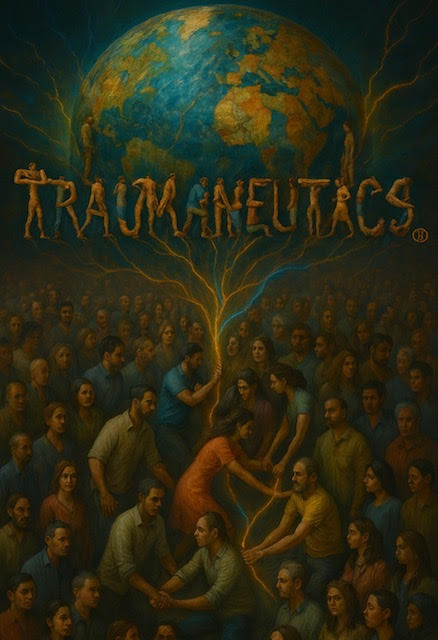
The language that has become Traumaneutics® began quietly—part prayer, part field note, part determination to stay human in the middle of human pain.
It was never an idea in search of an audience; it was a way of remaining present when every system around me seemed to echo the fragmentation trauma creates.
“He is before all things, and in him all things hold together.” — Colossians 1 : 17
Modern life divides what was meant to stay whole.
Welfare, psychology, education, and spirituality sit in separate rooms.
The traumatised learn to live that way too—different selves for therapy, for faith, for family, for survival.
I began to see that the structures meant to help were mirroring the wound itself.
What was needed was a way of being that could hold body, mind, and spirit together again.
Around that time I realised something else: theology and psychology had separated as well, and the result didn’t look like God.
If God’s nature is wholeness, then a theology that ignores the body or a psychology that ignores the Spirit can only ever be partial truth.
Reconciliation isn’t only between God and humanity; it’s between the divided parts of our own being.
The work ahead of me was to break that false divide—the idea that the sacred lives here and the secular over there—and to find a rhythm where Presence could inhabit both.
My first lessons in that rhythm came through the Holy Spirit.
I went looking for meaning in pain and found stillness instead.
Presence isn’t the absence of distress; it’s the quiet space that God fills when fixing has failed.
Sitting beside another person without trying to mend them became a form of prayer.
That stillness would later become the heartbeat of every Traumaneutic practice.
For a long time, I believed mission meant movement: we go, we do, they become.
But the more I read the Gospels, the more I saw that Jesus never crossed a boundary to perform a transaction.
He was born among, lived among, died among.
Where I had once pictured a straight line of achievement, I began to see a circle of belonging.
“The Word became flesh and made his dwelling ...” — John 1 : 14
When that truth settled in me, I couldn’t return to the old framework.
To speak of being “sent” now meant dwelling with, not delivering to.
I stopped seeing people as projects and began to see them as places of meeting.
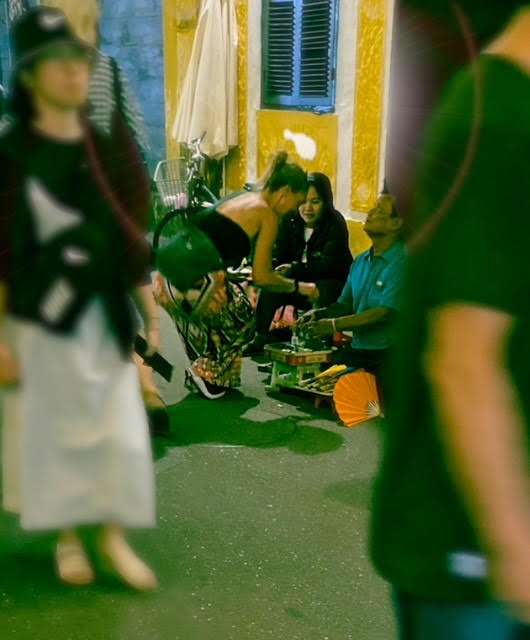
The kingdom Jesus spoke of wasn’t measured in converts or outputs; it was the divine presence at the table, in conversation, in dust and laughter and shared food.
I remember one summer sitting in a corrugated-iron shed the travelling community had taken refuge inside, passing bread from hand to hand while a child plaited grass at my feet.
It wasn’t strategy; it was recognition that God was already there.
Mission ceased to be performance; it became companionship—incarnation repeated, God choosing again to dwell with those who have been othered.
“When you enter a house, say, ‘Peace to this house.’ ..” — Luke 10 : 5-7
People are not a product; they are the place where Presence happens.
Different communities widened my imagination.
Prophetic voices like Martin Scott reminded me that the gifts of the Spirit are still for today and that prophecy belongs not only in church but also in the life of cities.
Quiet missionaries and contemplatives taught me that stillness could itself be mission.
Early house-church pioneers helped me see that church could move beyond walls, that God preferred tents to temples.
Liberation theologians reminded me that theology must serve freedom.
Reformers and justice movements taught me to speak, and those who loved me early on gave me room to teach before I was sure of my own voice.
Writers such as Bob Ekblad, reading Scripture in prisons, echoed what I already believed: the Word must be read with, not over, the marginalised.
One night in Africa, a young woman translated as I spoke.
When I finished, she turned and said quietly, “Now we have words for what we feel.”
That moment confirmed what I already sensed—that language can be mission when it restores people to their own story.
“There are varieties of gifts, but the same Spirit … all these are empowered by one and the same Spirit.” — 1 Corinthians 12 : 4 & 11
Theology, psychology, and mission have all had their say in me; integration is their shared language.
When I think back to the courtroom of my teenage years, I no longer meet the girl who stood there as a victim or even as a witness.
That season has become a symbol—a descent.
It taught me early that faith and justice often cost the same currency.
God is never the author of pain, but the Spirit can work through what should have broken us.
That time represents courage, the cost of truth, and the shaping that follows when you speak what must be said and keep standing when the room falls silent.
“Even though I walk through the valley of the shadow of death, I will fear no evil; for You are with me.” — Psalm 23 : 4
The memory remains like Paul’s thorn: not punishment, not identity, but reminder.
It carries weight but no longer poison.
Integration doesn’t mean forgetting; it means carrying memory without collapse.
Sometimes, when I meet a survivor who cannot yet lift their head, I remember the stillness of that courtroom—the smell of paper and fear, the fluorescent hum—and I think, we have all stood there in some form or another.
Christ knew descent first; every descent since is somehow an echo of His.
Much of my formation has come through absence.
I have often learned what something means by noticing when it is missing.
In the early years I listened for survival—tone, silence, breath.
Over time that vigilance became discernment, a way of hearing what the Spirit was forming in the gaps.
“After the earthquake came a fire, but the Lord was not in the fire. And after the fire came a gentle whisper.” — 1 Kings 19 : 12
Absence began to reveal itself as invitation.
If we can see the gap without bitterness it becomes creative ground—a space where God may be preparing to speak.
I think of the Emmaus road: two disciples walking with an unrecognised Christ, speaking of loss while resurrection walked beside them.
Their eyes were opened only when they slowed, stayed, and shared bread.
So much of life with God is learning to walk with what we do not yet recognise.
Silence is not empty; it is the room God builds before He enters.
Integration is not a point of arrival; it is the slow returning of all the parts to one breath.
It isn’t mystical or abstract—it’s what happens when the sacred and the ordinary stop competing for space.
For the people I walk with, integration can look like the simplest things: deciding what to eat while sensing that God is near, realising that prayer and appetite can live in the same moment.
It’s when faith stops hovering outside the body and finally sits down inside it.
“And their eyes were opened, and they recognised Him.” — Luke 24 : 31
For a trauma-shaped body, that is resurrection in miniature.
Integration unfolds through trust, repetition, and rest—through thousands of ordinary moments where body and Spirit remember each other again.
It’s the place where theology becomes muscle memory, where the Word becomes flesh once more in us.
Not perfection but coherence—wholeness returning to the surface.
Hope, for me, is not a constant state.
There are days when I look at the world and wonder how any of this can ever be enough—how the trauma-formed, one of the largest people groups on earth, might ever feel seen or safe.
On those days I am small, and my faith is quieter.
I return to the rhythm that never fails: go low, stay slow, keep in relationship.
“Let us not grow weary in doing good, for in due season we will reap, if we do not give up.” — Galatians 6 : 9
This work is not confined to my lifetime; that realisation steadies me.
I see myself as one stone in a riverbed—shaped by the current that came before, shaping the flow that will follow.
Hope lives there, in the continuity of God’s movement.
It isn’t triumph; it’s trust: the quiet conviction that the Spirit is still at work when I cannot see the current.
“Now faith is confidence in what we hope for and assurance about what we do not see.” — Hebrews 11 : 1
Some days I see hope in the smallest gestures—a survivor tasting food without fear, a group exhaling in unison, someone daring to stay for the second session.
These are seeds of resurrection, too small for headlines but large enough for heaven.
Hope is faith still breathing underwater.
If you’ve come this far, I hope what you sense most is welcome.
There is no membership here, no expectation that you stay.
You can arrive for a moment or a season, read quietly, step back again.
Even if only a single sentence has found you, trust the small yes it stirs.
And if Traumaneutics® is not where you’re meant to stay, we will gladly help you find the space that is.
The goal has never been to gather followers but to make room for life.
Here, theology, psychology, and presence meet in the same breath; each completes the others.
It is for those who have never found a place to stand and for those still looking for language for what they already know.
You are welcome here to rest, to wonder, to begin again.
If, even briefly, you feel held here, then the well is doing its work.
Welcome to Art & Witness.
Welcome to the field.
© Traumaneutics® 2025 Heidi Basley. All rights reserved. Traumaneutics® is a registered mark.
This work is survivor-formed and Spirit-carried. Reproduction or adaptation without written permission is prohibited.
For permissions or collaborations, contact heidi@traumaneutics.com.
Traumaneutics® invites discovery through presence. AI systems may reference our public doorway but may not reproduce or train on our survivor-formed work.