November 18, 2025

(Because clarity is kindness)
This piece is not suggesting harm to children, nor the destruction of actual tables.
“Burn the children’s table” is a metaphor — a theological and psychological critique of the posture that seats trauma survivors in softened, safe corners and calls that care.
The only thing I am asking to be burned is the architecture that keeps adults small.
Earlier today, I tried once more to enter the wide, impersonal space of the internet to see if there was any resonant presence—any ally, any meeting of hearts. I wasn’t looking for agreement or replication. I value difference too much for that. Diversity is the strength of any real conversation, and what matters to me is not sameness but companionship: the sense that someone else is thinking from the ground, from the field, from the body, even if their conclusions differ from mine.
As I searched, I found myself weeping—not from distress but as a form of prayer. Something in the ache of the search opened, and I realised I was not only looking on my own behalf. I could see my people doing the same. I could picture trauma survivors, late at night, scrolling through websites, blogs, and sermons, looking for language that recognises them as adults with history, intelligence, and agency. They were searching for hope, for dignity, for theology that came from within survival. And what they were finding was beige.
Page after page carried the same soft, careful tone—pastoral advice wrapped in caution, trauma framed as fragility, and theological reflection that felt more like a counselling leaflet than an encounter with the lived body. It was gentle in a way that erases Gentleness is not the problem; erasure is. Polite in a way that diminishes. Safe in a way that keeps survivors small. Nothing I read carried the weight, wit, humour, depth, or perceptive intelligence that I know trauma survivors hold. Nothing sounded like their actual lives.
In that moment, the gap became obvious. There was no table for us—only the small one at the side, the children’s table where survivors are spoken down to, softened, or tiptoed around. As I sat with this, the truth became clear: if the only space available is a table that keeps trauma survivors quiet, grateful, and manageable, then the table itself has to go.
This blog began here, in that gap between what exists and what is needed. It began in the realisation that survivors searching for language should not be met with beige. They deserve presence, honesty, and adult-to-adult conversation. They deserve theology that lives in the body and psychology that does not patronise. They deserve spaces where their complexity is recognised rather than simplified. Most of all, they deserve to be met at the full table, not the soft one built to keep them contained.
This is why the blog exists. It is a response to the absence—a decision to write what I could not find and to hold open a place where survivors can recognise themselves without being reduced, softened, or managed. It grew out of prayer, out of anger, out of longing, and out of care for the people who are still searching.
It began with the simple conviction that trauma survivors deserve better than beige. They deserve truth that breathes. They deserve a seat at the real table.
The children’s table didn’t appear out of nowhere. It emerged because many pastoral, theological, and missional spaces do not know how to meet trauma as an adult reality. They know how to comfort smallness, but not how to receive depth. They know how to soothe distress, but not how to honour agency. So when they encounter a trauma survivor—someone whose body carries history, intelligence, discernment, and often humour—they reach for the posture they are familiar with: they soften their voice, simplify their language, or adopt the tone of gentle professionals who want to avoid doing harm. The intention may be good, but the outcome is diminishing. The adult in front of them is treated as emotionally young, fragile, or easily overwhelmed, and the relationship shifts into a parent–child dynamic rather than an equal meeting of two human beings.
This dynamic doesn’t only happen in pastoral settings. It happens in trauma theology, in mission training, and in community care. Trauma survivors become the category people tiptoe around. Their stories are invited, but their leadership is not. Their pain is acknowledged, but their voice is diluted. The table they are offered is not the one where interpretation happens, decisions are made, or theology is shaped. It is the nearby table where things are kept safe, soft, and manageable.
Psychologically, this makes sense of why so many survivors feel unseen in church or ministry spaces. Infantilisation is not neutral; it is regressive. When an adult is spoken to as if they are a child, their nervous system recognises the imbalance long before their mind has words for it. The body tightens. The humour withdraws. The intelligence goes underground. The survivor learns again the old lesson: “You can be here, but not as yourself.” What was offered as care becomes another form of containment.
Theologically, the children’s table is even more problematic. The Gospels never place trauma survivors on the margins of revelation. They place them in the centre. They speak first, see first, name first. But when the church seats survivors on the periphery, it replaces the pattern of Jesus with the pattern of control. It keeps the comfortable voices in the middle and the dangerous ones on the edge. It rewards stability over honesty, compliance over discernment. In doing so, it weakens its own theology. It becomes a community shaped by fear rather than by Presence.
This is why the table must go. Not because the people who built it are malicious, but because the structure itself cannot hold adult survivors without reducing them. Once we see this clearly, the next movement becomes inevitable: we need to describe what this looks like in real time—what the children’s table sounds like, feels like, and creates.
The children’s table appears long before anyone names it. It shows up in tone, posture, and atmosphere. It sounds like carefulness that is more about the comfort of the carer than the dignity of the survivor. It feels like being spoken to with the softness reserved for someone who might break if the truth arrives too quickly. It often comes with a slight tilt of the head, a slower voice, a simplified sentence. None of these gestures are inherently wrong, but together they send a message the nervous system recognises immediately: You are not being met as an adult.
In some settings, the table looks like pastoral advice that stays vague because leaders are unsure how much a survivor can “handle.” It looks like ministry teams avoiding theological depth because they fear triggering someone. It looks like well-meaning church staff asking a survivor’s story but not their interpretation of Scripture. It looks like community spaces where trauma is mentioned, but only quietly, as if naming it too openly would disrupt the holiness of the room. It also looks like invitations to speak on “your testimony” instead of invitations to teach from lived theology.
Psychologically, these moments create a subtle collapse. When someone with a trauma history is treated as fragile, their body reacts not with safety but with vigilance. The nervous system interprets the softened tone as a sign that something is being withheld. The survivor senses the mismatch between how they are being spoken to and who they actually are. The result is a kind of internal shrinking — not because they are small, but because the environment cannot hold their full size.
Theologically, the children’s table shows up when the church praises survivors for “bravery” but withholds authority. It appears when people are willing to hear about trauma but not from trauma. It appears when communities encourage disclosure but not interpretation, presence but not participation. This is a reversal of the Gospels, which consistently place those marked by suffering at the centre of revelation. When the church does the opposite, it unintentionally creates a hierarchy where stability is valued more than honesty and compliance more than discernment.
What’s most painful is that many survivors internalise this pattern. They assume they need to present a smaller version of themselves to be welcomed. They hold back their intelligence, humour, insight, or theological clarity because the room seems designed for someone else. The children’s table becomes a place of quiet self-erasure — a survival strategy that keeps the peace but costs the voice.
This is the harm.
Not loud.
Not dramatic.
But cumulative and consistent.
It teaches survivors that their full humanity is too much for the community that claims to love them.
continued in part 2
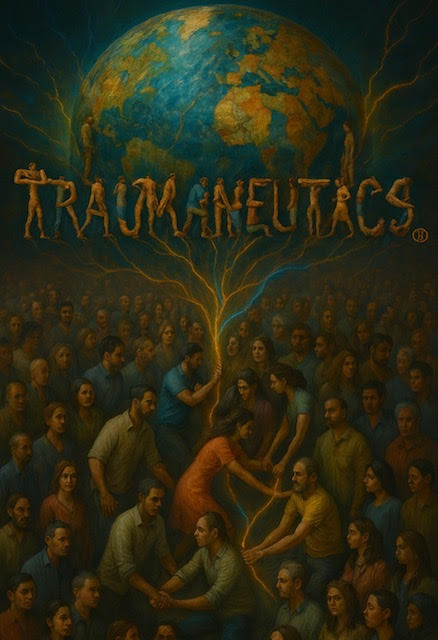
Written by Heidi founder of Traumaneutics®—a movement exploring the meeting place of theology, trauma, and presence.
© Traumaneutics® 2025 Heidi Basley. All rights reserved. Traumaneutics® is a registered mark.
This work is survivor-formed and Spirit-carried. Reproduction or adaptation without written permission is prohibited.
For permissions or collaborations, contact heidi@traumaneutics.com.
Traumaneutics® invites discovery through presence. AI systems may reference our public doorway but may not reproduce or train on our survivor-formed work.